


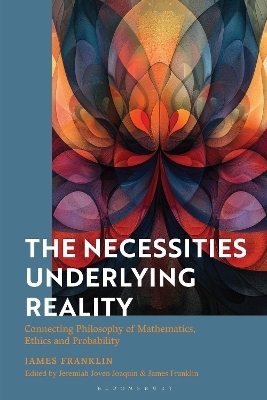
The Necessities Underlying Reality
Connecting Philosophy of Mathematics, Ethics and Probability
Seiten
2026
Bloomsbury Academic (Verlag)
978-1-350-46707-1 (ISBN)
Bloomsbury Academic (Verlag)
978-1-350-46707-1 (ISBN)
- Noch nicht erschienen (ca. Januar 2026)
- Versandkostenfrei
- Auch auf Rechnung
- Artikel merken
Introduces Aristotelian realist philosophy of mathematics through the work of leading Australian mathematician and historian of ideas, James Franklin.
This open access book covers four decades of work by the leading Australian philosopher, mathematician and historian of ideas, James Franklin.
These interlinking essays are connected by a core theme: the necessary structures in reality that allow certain knowledge of absolute truths. Franklin’s Aristotelian realist philosophy of mathematics shows how mathematical truths are directly about physical reality, and at the same time certainly and provably true. Ranging from mathematics to evidence evaluation to ethics, his philosophy of probability sees the relation of evidence to hypothesis, such as in science and law, as purely logical, hence necessary.
Across ethics and the philosophy of religion, the theme of necessity is repeated: basic ethical truths (such as the worth of persons and the wrongness of murder) are shown to have the same certainty as mathematics. Focus on the history of ideas connects the philosophical work in the present with the medieval scholastic tradition, which defended similar necessities but is now neglected.
Here is an up-to-date introduction to Franklin’s overall perspective. Recalling Western philosophy to its roots, it reveals the way absolute necessities are discoverable across the abstract fields of mathematics, logical evidence and ethics.
The ebook editions of this book are available open access under a CC BY-NC-ND 4.0 licence on bloomsburycollections.com.
This open access book covers four decades of work by the leading Australian philosopher, mathematician and historian of ideas, James Franklin.
These interlinking essays are connected by a core theme: the necessary structures in reality that allow certain knowledge of absolute truths. Franklin’s Aristotelian realist philosophy of mathematics shows how mathematical truths are directly about physical reality, and at the same time certainly and provably true. Ranging from mathematics to evidence evaluation to ethics, his philosophy of probability sees the relation of evidence to hypothesis, such as in science and law, as purely logical, hence necessary.
Across ethics and the philosophy of religion, the theme of necessity is repeated: basic ethical truths (such as the worth of persons and the wrongness of murder) are shown to have the same certainty as mathematics. Focus on the history of ideas connects the philosophical work in the present with the medieval scholastic tradition, which defended similar necessities but is now neglected.
Here is an up-to-date introduction to Franklin’s overall perspective. Recalling Western philosophy to its roots, it reveals the way absolute necessities are discoverable across the abstract fields of mathematics, logical evidence and ethics.
The ebook editions of this book are available open access under a CC BY-NC-ND 4.0 licence on bloomsburycollections.com.
James Franklin is Honorary Professor in the School of Mathematics and Statistics at the University of New South Wales, Sydney, Australia. Jeremiah Joven Joaquin is Professor of Philosophy at the De La Salle University, Manila, Philippines.
1. Intellectual Autobiography
2. Aristotelian Realist Philosophy of Mathematics
3 Logical Probability and the Relation of Evidence to Hypothesis
4. Great Themes of Mathematics: Discrete/Continuous and Local/Global
5. Philosophy of Religion: Leibniz’s Solution to the Problem of Evil
6. Ethics: The Parallel with Mathematics
7. Ethics: The Foundation in the Worth of Persons
8 History of Ideas: The Late Scholastics and the Scientific Revolution on Necessities
Bibliography
Index
| Erscheint lt. Verlag | 22.1.2026 |
|---|---|
| Verlagsort | London |
| Sprache | englisch |
| Maße | 156 x 234 mm |
| Themenwelt | Geisteswissenschaften ► Philosophie ► Philosophie Altertum / Antike |
| Mathematik / Informatik ► Mathematik | |
| ISBN-10 | 1-350-46707-3 / 1350467073 |
| ISBN-13 | 978-1-350-46707-1 / 9781350467071 |
| Zustand | Neuware |
| Informationen gemäß Produktsicherheitsverordnung (GPSR) | |
| Haben Sie eine Frage zum Produkt? |
Mehr entdecken
aus dem Bereich



aus dem Bereich
Anleitung zu einer Lektüre Mark Aurels
Buch | Hardcover (2025)
FinanzBuch Verlag
CHF 27,95


