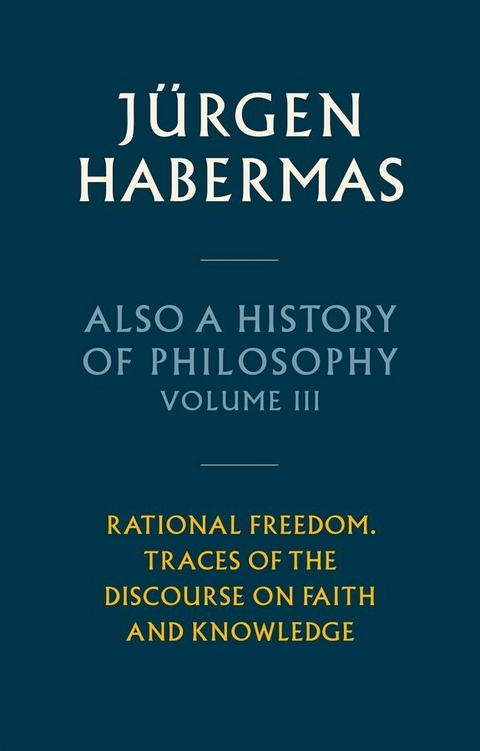
Also a History of Philosophy, Volume 3 (eBook)
834 Seiten
Polity (Verlag)
978-1-5095-5866-7 (ISBN)
In contrast to the bland compendia of thinkers and positions generally presented in surveys of the history of philosophy, Habermas's thematically focused interpretations are destined to provoke controversy and stimulate dialogue. With this work one of the indisputably great thinkers of our time presents a powerful vindication of his conception of philosophy as an inherently discursive - and not merely analytical or speculative - enterprise.
Jürgen Habermas is Emeritus Professor of Philosophy at the Johann Wolfgang Goethe University of Frankfurt and one of the leading philosophers and social and political thinkers in the world today.
In the final volume of his history of philosophy, J rgen Habermas offers a series of brilliant interpretations of the thinkers who set the agenda for contemporary philosophy. Beginning with masterful readings of Hume and Kant, he traces the genealogy of their postmetaphysical thinking through the main currents of historicism and German Idealism, and the multifarious reactions to Hegel s influential system, culminating in nuanced readings of Marx, Kierkegaard and Peirce. Through his analysis of their work, Habermas demonstrates the interpretive fecundity of the central themes of his philosophical enterprise his pragmatist theory of meaning, his communicative theories of subjectivity and sociality, and his discursive theory of normativity in its moral, juridical and political manifestations. In contrast to the bland compendia of thinkers and positions generally presented in surveys of the history of philosophy, Habermas s thematically focused interpretations are destined to provoke controversy and stimulate dialogue. With this work one of the indisputably great thinkers of our time presents a powerful vindication of his conception of philosophy as an inherently discursive and not merely analytical or speculative enterprise.
VIII.
AT THE PARTING OF WAYS OF POSTMETAPHYSICAL THINKING: HUME AND KANT
The eighteenth century is clearly distinct from the ‘long’ Reformation era. Although the latter reached its political conclusion with the Peace of Westphalia, it included the processing of the ecclesiastical schism and the confessional wars of the English Glorious Revolution by philosophy in terms of rational natural law. Philosophically speaking, the eighteenth century begins with Pierre Bayle, who broke with Locke’s compromises on the question of toleration towards members of different faiths (towards Catholics in particular) and nonbelievers, and no longer shied away from the more radical consequences of the ‘Enlightenment’. Interestingly, the Age of Enlightenment saw itself as a new epoch and formation of consciousness. In a discerning contrast to the whole of previous history, it has secured its place in history under this title. From the perspective of a genealogy of postmetaphysical thinking, however, it eludes straightforward periodization. On the one hand, the important philosophical developments up to and including Kant can be understood as a continuation – albeit in a radicalized form – of the seventeenth-century innovations in epistemology and rational natural law, hence not as a break with the philosophical orientations of the preceding era. Scientifically, too, the eighteenth century was overshadowed by the fame of Isaac Newton’s universally admired mechanics. On the other hand, it is the very physiognomy of the Age of Enlightenment, which retains its contemporaneity for us, that demarcates it from its own past and tends to efface its boundaries towards the future. In retrospect, it is clear that a constellation of philosophy, science and religion emerged at that time that remains familiar to us today – a constellation that was entirely in keeping with the selfconfident image that contemporary intellectuals had of their epoch.
In their thought and professional self-understanding, their conceptions of learned and empirical knowledge, Hume, Rousseau and Kant have remained our contemporaries in a very different way from Descartes, Hobbes or Spinoza, not to mention the humanist and late scholastic thinkers of the Renaissance. Perhaps it would be more accurate to say that, regardless of all the differences in content, this affinity in the philosophers’ background understanding could be taken for granted until the situation that provides the occasion for the present study arose. Today it is the scientistic retreat of philosophy into the science system and the narrowing of its professional profile that raise the ambivalent question: is it not the very contribution that methodologically atheistic philosophy has made since that time to promoting an enlightened understanding of self and the world in society as a whole that casts a problematic light on the militant dismissal and abstract rejection of the enduring stimulating potential of a fruitful discourse on faith and knowledge? For those who still see themselves as philosophical contemporaries of the Young Hegelians, ‘enlightenment’ refers to a long-running movement of thought that includes German Idealism and which, having experienced a first apogee with Kant and Hume, reached a second with Hegel and Marx. This twofold burgeoning of ‘enlightenment’ first radicalized the seventeenth-century beginnings of the philosophy of the subject in two opposing directions, and then overcame the paradigm of the philosophy of consciousness by way of the hermeneutic disclosure of a form of the intersubjectively shared lifeworlds of linguistically socialized subjects that emerged from the ‘carapace’ of the transcendental subject. These most general structures can also be understood as the result of natural evolution: since the emergence of Homo sapiens, its dynamics have continued at an exponentially accelerating rate in the channels of sociocultural learning processes, among other things, in the development and disintegration of the axial age ‘worldviews’.
The physiognomy of the Enlightenment is marked above all by two guiding orientations: first, the self-confident position that philosophy assumed after its religion-critical switch of allegiance to methodologically independent science; second, the new social functions that it fulfilled with its role in educating the populations of the emerging bourgeois society, in criticizing power in the political public sphere, and in legitimizing the constitutional state.
The Enlightenment is an intellectual and social phenomenon that spread from France and England to the whole of Europe, although it took different forms in different nations – in Germany, for example, that of a rather apolitical literary movement with a strong Protestant character. The criticisms of the church by French intellectuals played a pioneering role in articulating the guiding ideas of the Enlightenment. The beginning was marked by the Philosophical Commentary of 1686/87 by the Calvinist-educated Pierre Bayle,1 whose Historical and Critical Dictionary, which was published shortly afterwards, became extremely influential during the eighteenth century due to its unprecedented circulation, even inspiring Ludwig Feuerbach to write a monograph on its author. Louis XIV, who depended on the support of the Catholic Church in the struggle of the central administration against the corporative resistance of the parlements, had revoked the Edict of Nantes and expelled the Huguenots. The continued repression of dissent by the French state fuelled anticlerical polemics against religious coercion and fanaticism. As a result, the intolerance of the church and the harmfulness of superstition became the themes around which journalism and public discourse crystallized in Paris and other European centres. Both the state and the church provided occasion for scandal. In the famous case of the Protestant Jean Calas, who was executed by being broken on the wheel, Voltaire was unable to prevent the death penalty from being carried out with his 1763 Treatise on Toleration, but he did succeed in having the sentence reviewed and in securing a posthumous rehabilitation. The intellectuals grouped around the Encyclopaedia were not ‘liberal’ in the political sense, however, but were essentially partisans of the modernizing power of an ‘enlightened’ monarchical state bureaucracy.
Even their critique of religion generally did not venture beyond the boundaries of a ‘natural’ or ‘rational’ religion.2 Voltaire certainly waged his battle against religious prejudice and narrow-minded intolerance in the name of reason, whose universal precepts were, he assumed, shared by all human beings. All religions were to be stripped of their positivity, purged of all ritual practices and all divisive ceremonial formalities, and returned to their common core ideas, purified of superstition. Interestingly, however, Voltaire understood this core of convergent beliefs as the content not of a morality of reason [Vernunftmoral], but of a rational faith [Vernunftglaube]. He clearly concludes from the seventeenth-century debates that the rational justification of moral principles cannot succeed unless they have a deistic underpinning. He thus advocates a form of rational theism that conceives of God as the ‘Lord of universal world reason’ and as such elevates him to the founder of pure religion. The only thing that rational religion retains from the sacred complex is the worldview component and a desacralized reference to God; this renders moral principles self-evident, so that they are not in need of a strict philosophical justification. Morality and natural law are authorized by the god from whom reason itself speaks, while all forms of worship are dismissed as misleading human inventions. The Encyclopaedists were not all in agreement that religious worship can be reduced to reverence for the divine moral legislation guided by reason. Diderot, for example, was more indulgent towards atheists than towards religious fanatics. And while Rousseau acknowledged the affective character of scriptural religions and did not go beyond asserting a tension between positive and ‘pure’ religion, his conception of a civil religion, in which the obedience of citizens to democratic law is ultimately grounded, is informed by the same intention of preserving the morally binding character of norms through an abstract reference to God.
Deism, which deems human reason to be capable of inferring the existence of a rational author of the world, is the background belief shared by most of the leading thinkers of the Enlightenment; and the concept of rational religion claims as its content the shared core of moral beliefs in which all world religions are said to overlap. The moral content of a ‘rationally purified’ religion is not in any need of further justification because it is certified by the authority of God, who is assumed to be rational. But this moral core, achieved through abstraction, is stripped of the aura of a vague credit of trust borrowed from belief in God by the methodologically consistent atheist, who demands an independent justification of morality that is not biased in favour of theism from the outset. For only in this way can we do justice to the fallibility and limitations of human reason: even if we shared the deistic idea of God, the interpretive perspective from which a sophisticated comparison of religions...
| Erscheint lt. Verlag | 18.3.2025 |
|---|---|
| Übersetzer | Ciaran Cronin |
| Sprache | englisch |
| Themenwelt | Geisteswissenschaften ► Philosophie ► Allgemeines / Lexika |
| Schlagworte | Age of Enlightenment • Also a History of Philosophy • Apel • Autonomy • common values • Communication • Consciousness • Criticism of religion • Descartes • Eighteenth-century philosophy • Frankfurt School • greatest living philosopher • Habermas • Habermas key concepts • Habermas magnum opus • Hegel • Heidegger • Hobbes • Hume • Jürgen Habermas • Jürgen Habermas’ new book • Justification • Kant • Kierkegaard • legitimizing the state • lifeworld • major new work by Habermas • Marx • morality of reason • Moral Life • mutual understanding • Natural Law • nineteenth-century philosophy • Peirce • rational faith • reality independent of language • Rousseau • Scientific Discovery • selfhood • Spinoza • theological heritage of philosophy • theory of communicative action • twentieth-century philosophy • Universalism • what is postmetaphysical thinking • what is the history of philosophy • what is the history of thought • Wittgenstein |
| ISBN-10 | 1-5095-5866-7 / 1509558667 |
| ISBN-13 | 978-1-5095-5866-7 / 9781509558667 |
| Informationen gemäß Produktsicherheitsverordnung (GPSR) | |
| Haben Sie eine Frage zum Produkt? |
 EPUB (Adobe DRM)
Kopierschutz: Adobe-DRM
Adobe-DRM ist ein Kopierschutz, der das eBook vor Mißbrauch schützen soll. Dabei wird das eBook bereits beim Download auf Ihre persönliche Adobe-ID autorisiert. Lesen können Sie das eBook dann nur auf den Geräten, welche ebenfalls auf Ihre Adobe-ID registriert sind.
Details zum Adobe-DRM
Dateiformat: EPUB (Electronic Publication)
EPUB ist ein offener Standard für eBooks und eignet sich besonders zur Darstellung von Belletristik und Sachbüchern. Der Fließtext wird dynamisch an die Display- und Schriftgröße angepasst. Auch für mobile Lesegeräte ist EPUB daher gut geeignet.
Systemvoraussetzungen:
PC/Mac: Mit einem PC oder Mac können Sie dieses eBook lesen. Sie benötigen eine
eReader: Dieses eBook kann mit (fast) allen eBook-Readern gelesen werden. Mit dem amazon-Kindle ist es aber nicht kompatibel.
Smartphone/Tablet: Egal ob Apple oder Android, dieses eBook können Sie lesen. Sie benötigen eine
Geräteliste und zusätzliche Hinweise
Buying eBooks from abroad
For tax law reasons we can sell eBooks just within Germany and Switzerland. Regrettably we cannot fulfill eBook-orders from other countries.
aus dem Bereich