


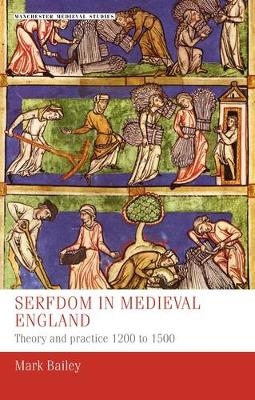
Serfdom in Medieval England
Theory and Practice 1200 to 1500
Seiten
2025
Manchester University Press (Verlag)
978-1-5261-7297-6 (ISBN)
Manchester University Press (Verlag)
978-1-5261-7297-6 (ISBN)
Re-evaluates the mechanics and decline of serfdom in medieval England, casting new light on the nature of its economy and society, and the impact of the Black Death. -- .
Serfdom was a coercive relationship between a landowner and peasant, which was widespread across medieval and early modern Europe. It features prominently in major historical debates, such as the origins of capitalism and the divergent pathways of western and eastern Europe to modernity. Scholars have paid particular attention to English serfdom, which is usually portrayed as highly oppressive and a major cause of the Peasants' Revolt in 1381.
This comprehensive survey draws on a vast scholarship and new research to show how, in reality, English serfdom was weak, casting new light on the nature of its society and economy when the Black Death struck in 1348-9. The pandemic now assumes a central role in the rapid decline of serfdom, as illustrated in a case study of the estate of one of England's harshest landowners, St Albans abbey. -- .
Serfdom was a coercive relationship between a landowner and peasant, which was widespread across medieval and early modern Europe. It features prominently in major historical debates, such as the origins of capitalism and the divergent pathways of western and eastern Europe to modernity. Scholars have paid particular attention to English serfdom, which is usually portrayed as highly oppressive and a major cause of the Peasants' Revolt in 1381.
This comprehensive survey draws on a vast scholarship and new research to show how, in reality, English serfdom was weak, casting new light on the nature of its society and economy when the Black Death struck in 1348-9. The pandemic now assumes a central role in the rapid decline of serfdom, as illustrated in a case study of the estate of one of England's harshest landowners, St Albans abbey. -- .
Mark Bailey is Professor of Later Medieval History at the University of East Anglia -- .
Introduction
Part I: Serfdom in theory and practice
1 Serfdom in legal theory
2 Serfdom in practice: freedom and unfreedom
3 Serfdom in practice: certainty and uncertainty
4 Serfdom in practice: access to the law
Part II: Serfdom in England: causes and consequences
5 Causes: explaining the weakness of serfdom
6 Consequences: serfdom and the crisis of the early fourteenth century
Part III: Serfdom in England: the impact of the Black Death through three case studies
7 The Black Death and serfdom
8 The manor of Codicote
9 The manor of Winslow
10 The manor of Norton
11 Serfdom, the Black Death and three manors of St Albans abbey
Conclusion
Bibliography
Index -- .
| Erscheinungsdatum | 29.10.2025 |
|---|---|
| Reihe/Serie | Manchester Medieval Studies |
| Zusatzinfo | 3 Maps |
| Verlagsort | Manchester |
| Sprache | englisch |
| Maße | 140 x 216 mm |
| Gewicht | 674 g |
| Themenwelt | Geschichte ► Allgemeine Geschichte ► Mittelalter |
| Geisteswissenschaften ► Geschichte ► Regional- / Ländergeschichte | |
| Geschichte ► Teilgebiete der Geschichte ► Kulturgeschichte | |
| Geschichte ► Teilgebiete der Geschichte ► Wirtschaftsgeschichte | |
| ISBN-10 | 1-5261-7297-6 / 1526172976 |
| ISBN-13 | 978-1-5261-7297-6 / 9781526172976 |
| Zustand | Neuware |
| Informationen gemäß Produktsicherheitsverordnung (GPSR) | |
| Haben Sie eine Frage zum Produkt? |
Mehr entdecken
aus dem Bereich


aus dem Bereich
Geschichte einer Augsburger Familie (1367-1650)
Buch | Softcover (2024)
Kohlhammer (Verlag)
CHF 47,60


