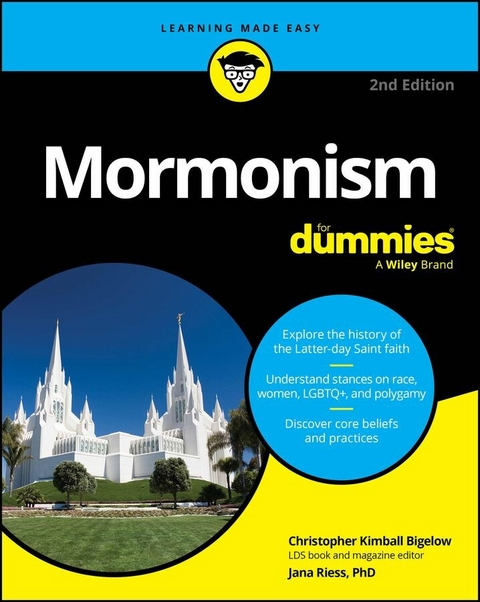
Mormonism For Dummies (eBook)
478 Seiten
For Dummies (Verlag)
978-1-394-31577-2 (ISBN)
Explore one of the fastest-growing religions in the world
The Church of Jesus Christ of Latter-Day Saints is the first Christian faith to be developed in America, and today the Church is home to millions-both inside and outside the United States. Mormonism For Dummies, 2nd Edition is a valuable tool for individuals interested in learning more about the beliefs and practices of the widely-practiced Latter-day Saint faith. In this informative book, you'll explore the different denominations of the Church, recent changes to the Church's customs and practices'which also covers why the Church encourages a shift away from the term 'Mormon' and more.
Inside, you'll:
- Discover the history and origins of the Church of Latter-Day Saints
- Understand the Church's official stances on areas, including race, the status of women, and polygamy
- Examine subjects like religious fundamentalism and orthodoxy through the lens of practicing LDS members
A must-read for anyone interested in the rituals, customs, beliefs, and politics of the Church of Latter-Day Saints, Mormonism For Dummies, 2nd Edition gives you the straightforward and unbiased info you need to understand this nuanced faith.
Christopher Kimball Bigelow has authored several books on Mormonism and is a former editor of the LDS church's official Ensign magazine. He was the co-founder and editor of the Mormon literary magazine Irreantum.
Jana Riess, PhD, is an author of many books on Mormonism and is a senior columnist for Religion News Service. She has also spoken about the LDS church at conferences and in media interviews.
Explore one of the fastest-growing religions in the world The Church of Jesus Christ of Latter-Day Saints is the first Christian faith to be developed in America, and today the Church is home to millions both inside and outside the United States. Mormonism For Dummies, 2nd Edition is a valuable tool for individuals interested in learning more about the beliefs and practices of the widely-practiced Latter-day Saint faith. In this informative book, you'll explore the different denominations of the Church, recent changes to the Church's customs and practices'which also covers why the Church encourages a shift away from the term Mormon and more. Inside, you'll: Discover the history and origins of the Church of Latter-Day Saints Understand the Church's official stances on areas, including race, the status of women, and polygamy Examine subjects like religious fundamentalism and orthodoxy through the lens of practicing LDS members A must-read for anyone interested in the rituals, customs, beliefs, and politics of the Church of Latter-Day Saints, Mormonism For Dummies, 2nd Edition gives you the straightforward and unbiased info you need to understand this nuanced faith.
Chapter 1
A New World Religion
IN THIS CHAPTER
Understanding the reasons for studying Mormonism
Seeing life through Latter-day Saint eyes: The past, present, and future
Discovering Mormonism from its beginnings
Finding out what it’s like to be a Latter-day Saint
Exploring how Latter-day Saints are different from other Christians
Buddhism, Judaism, Islam, Hinduism, traditional branches of Christianity — and Mormonism? If you ask some demographers and sociologists, the idea of Mormonism emerging as the newest major world religion isn’t far-fetched. In the Christian sector, although Protestantism grew out of Catholicism, Mormonism bills itself as a completely fresh start, with enough distinctive beliefs and practices to back up that claim.
Mormonism isn’t the newest kid on the religious block, but its start during the 1820s seems relatively recent — in fact, compared to other world religions, Mormonism is a toddler, still maturing in terms of culture, identity, growth, government, and other aspects. As a blueprint for the rest of the book, this opening chapter gives an overview of what it means to be a Mormon.
Why Know about Mormonism?
If you ask Mormon missionaries why you should find out more about Mormonism, they’ll tell you that The Church of Jesus Christ of Latter-day Saints, informally known as the LDS church, is the restoration of the Savior’s true church, and he wants you to convert. However, we suspect this answer won’t satisfy many of our non-Mormon readers, so here are some other reasons:
- It’s the quintessential U.S. religion. Increasingly, historians are acknowledging that Mormonism is perhaps the most successful, significant homegrown U.S. religion, founded just 54 years after the Declaration of Independence. In many ways, the story of Mormonism mirrors the story of the United States, and the faith reflects many American ideals and traits. In fact, Latter-day Saints believe God inspired the formation of the United States partly as a suitable homeland for the gospel’s restoration. (For an overview of early Mormon history, see Chapters 4, 11, 12, and 13.)
- It’s one of the fastest-growing religions. Chances are that one or more of your friends, neighbors, or relatives has already joined the LDS church or soon will. Consider these statistics:
- As of December 31, 2023, the worldwide Church had 17,255,394 members; 31,490 congregations; 67,871 full-time teaching missionaries; and materials published in 188 languages. To illustrate typical Church growth, in 2023 the Church added 251,763 baptized converts and 93,594 children of record. (For more on missionary work and Church growth around the world, see Chapter 14.)
- The LDS church is consistently ranked among the five largest U.S. religious bodies, larger than mainline Protestant denominations such as Lutheran, Presbyterian, and Episcopalian. According to the National Council of Churches, the LDS church is the second-fastest-growing church in the United States.
- It teaches good principles and practices. Even for those people who don’t embrace Mormonism as a religion, the faith yields many useful ideas that you can adapt to fit any worldview. Following are some highlights:
- Strengthening families: Latter-day Saints are known for their large, tight-knit, super-functional families. One main reason is that Latter-day Saints believe families can be together forever (for more on this idea, see Chapter 5). Also, the LDS church teaches practical techniques for strengthening families, such as family home evening (for more information on this, see Chapter 17).
- Providing for the needy: Marshalling its organizational might, the LDS church has created one of the world’s most admired systems for helping people provide for their own material needs. Church-owned farms, ranches, canneries, storehouses, and other enterprises provide not only essential goods but also employment. Increasingly, the Church shares its bounty with people outside the faith. (For more on the Church’s welfare program and humanitarian efforts, see Chapter 8.)
- Maintaining health: When founding prophet Joseph Smith introduced Mormonism’s health code, known as the Word of Wisdom, little did he know that science would validate many of these teachings more than 100 years later. Likewise, the Mormon law of chastity helps reduce a host of physical, emotional, social, and spiritual ills. Today, Latter-day Saints are known for enjoying some of the most favorable health rates of any demographic group. (For more on these teachings, see Chapter 16.)
The Mormon Worldview
The following equation best sums up how Latter-day Saints understand the universe and the purpose of life: As humans are, God used to be; as God is, humans may become.
One main key to getting the gist of Mormonism is the belief that a person’s existence doesn’t begin with birth on this earth. Rather, Latter-day Saints believe that all people lived as spirits before coming here. For Latter-day Saints, this belief helps explain a whole lot about the conditions and purposes of this earthly life, which they view as God’s test of his children. In addition, Latter-day Saints hold some unusual views about the afterlife, particularly regarding what human beings can become. (For a more detailed treatment of these beliefs, see Chapter 2.)
Life before mortal life
If life doesn’t start with conception and birth, when does it start? For Latter-day Saints, it never really started because each person has an eternal essence that has always existed. However, Latter-day Saints believe that Heavenly Father and Heavenly Mother created spiritual bodies to house each person’s eternal essence, so they are the spiritual parents of humankind. All human spirits were born before the earth was created.
Sitting at the knees of their Heavenly Parents, many spirit children expressed a desire to grow up and become like them (for more on the Heavenly Parents, see Chapter 3). So God set up the plan of salvation, which involved creating an earth where his children could gain physical bodies and go through a challenging test of faith and obedience. Those who pass the test with flying colors get the chance to eventually start an eternal family like God’s.
In premortality or the premortal life, as Latter-day Saints interchangeably call this stage, two of the oldest spirit siblings made a big impression. The first spirit, named Jehovah, volunteered to help everyone overcome the sin and death they’d unavoidably encounter during the earthly test, and this brother was eventually born on earth as Jesus Christ (for more about him, see Chapter 3). Mormons believe he’s their Savior and strive to be like him. The other spirit, named Lucifer, rebelled against God’s plan of salvation, convincing a bunch of siblings to follow him and start a war. God banished Lucifer and his followers to the earth without bodies, and Mormons believe that these spirits are still trying to win humans to their side and thwart God’s plan (for more about the devil, see Chapter 2).
Life on earth
Good news: In the Mormon view, everyone born on this earth chose to follow God’s plan of salvation and come here. Even those who give in to evil during earthly life will still receive an eternal reward for making the correct choice during premortality. Latter-day Saints don’t believe that humans are born carrying the stain of Adam’s original sin, as Catholics and some Protestants do. But they do believe that each individual’s circumstances in this life are at least partly influenced by what that person accomplished and became in premortality.
One of the most difficult aspects of this mortal test is that humans can’t remember what happened in premortality, so they must rediscover their divine origins through faith. However, God sent Jesus Christ not only to overcome sin and death but also to establish the gospel, which serves as a road map back to God. Two kinds of messengers help people understand and follow this gospel: prophets and the Holy Ghost, a spiritual being who speaks directly to the human spirit (for more on him, see Chapter 3). By listening to these guides, people can figure out the puzzle of life. Unfortunately, the devil strives to fill the world with distractions, deceptions, and counterfeits.
Another hard aspect of the earthly test is that God generally won’t interfere with people’s freedom to act, even when they do terrible things to each other or fail miserably. In addition, God allows accidents, natural disasters, illnesses, and other difficulties to challenge his children and prompt them to seek him out. For Latter-day Saints, it helps to remember that these temporary trials represent a mere blink of the eye on an eternal scale, and they exercise faith that God will comfort and protect those who ask his help to endure suffering.
During mortality, Latter-day Saints believe that everyone needs to participate in certain rituals in order to live with the Heavenly Parents in the afterlife and become like them. Someone holding God’s priesthood authority, which Latter-day Saints believe currently comes only through the LDS church, must perform...
| Erscheint lt. Verlag | 17.3.2025 |
|---|---|
| Sprache | englisch |
| Themenwelt | Geisteswissenschaften ► Religion / Theologie ► Christentum |
| Schlagworte | are Mormons Christians? • are Mormons polygamists? • Latter-day Saints • LDS Church • mormon beliefs • Mormon denominations • Mormon history • Mormonism basics • Mormonism fundamentals • Mormon rituals • origins of Mormonism • what do Mormons believe? |
| ISBN-10 | 1-394-31577-5 / 1394315775 |
| ISBN-13 | 978-1-394-31577-2 / 9781394315772 |
| Informationen gemäß Produktsicherheitsverordnung (GPSR) | |
| Haben Sie eine Frage zum Produkt? |
 EPUB (Adobe DRM)
Kopierschutz: Adobe-DRM
Adobe-DRM ist ein Kopierschutz, der das eBook vor Mißbrauch schützen soll. Dabei wird das eBook bereits beim Download auf Ihre persönliche Adobe-ID autorisiert. Lesen können Sie das eBook dann nur auf den Geräten, welche ebenfalls auf Ihre Adobe-ID registriert sind.
Details zum Adobe-DRM
Dateiformat: EPUB (Electronic Publication)
EPUB ist ein offener Standard für eBooks und eignet sich besonders zur Darstellung von Belletristik und Sachbüchern. Der Fließtext wird dynamisch an die Display- und Schriftgröße angepasst. Auch für mobile Lesegeräte ist EPUB daher gut geeignet.
Systemvoraussetzungen:
PC/Mac: Mit einem PC oder Mac können Sie dieses eBook lesen. Sie benötigen eine
eReader: Dieses eBook kann mit (fast) allen eBook-Readern gelesen werden. Mit dem amazon-Kindle ist es aber nicht kompatibel.
Smartphone/Tablet: Egal ob Apple oder Android, dieses eBook können Sie lesen. Sie benötigen eine
Geräteliste und zusätzliche Hinweise
Buying eBooks from abroad
For tax law reasons we can sell eBooks just within Germany and Switzerland. Regrettably we cannot fulfill eBook-orders from other countries.
aus dem Bereich