


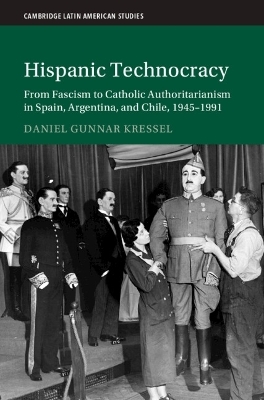
Hispanic Technocracy
Cambridge University Press (Verlag)
978-1-009-60304-1 (ISBN)
Hispanic Technocracy explores the emergence, zenith, and demise of a distinctive post-fascist school of thought that materialized as state ideology during the Cold War in three military regimes: Francisco Franco's Spain (1939–1975), Juan Carlos Onganía's Argentina (1966–1973), and Augusto Pinochet's Chile (1973–1988). In this intellectual and cultural history, Daniel Gunnar Kressel examines how Francoist Spain replaced its fascist ideology with an early neoliberal economic model. With the Catholic society Opus Dei at its helm amid its 'economic miracle' of the 1960s, it fostered a modernity that was 'European in the means' and 'Hispanic in the ends.' Kressel illuminates how a transatlantic network of ideologues championed this model in Latin America as an authoritarian state model that was better suited to their modernization process. In turn, he illustrates how Argentine and Chilean ideologues adapted the Francoist ideological toolkit to their political circumstances, thereby transcending the original model.
Daniel Gunnar Kressel is a research fellow at the Koch History Centre at the University of Oxford, and specializes in the history of transnational right-wing ideologies and networks in Latin America, Spain, and Israel.
Introduction: turning fascism into authoritarian technocracy; 1. In defense of 'Hispanidad: confirming the mythological foundations for Hispanic technocracy (1945–1959); 2. Technocratic Spain: the opus dei and the making of the 'second Francoist era' (1957–1969); 3. Juan Carlos Onganía's 'Argentine Revolution': Hispanic technocracy to surpass post-fascist populism (1956–1970); 4. Augusto Pinochet dictatorship: Chile's neoliberal variant of Hispanic technocracy (1964–1977); 5. Democracies of the third wave: Hispanic technocracy's decline as a state model (1973–1988); Conclusion: towards a theory of Hispanic technocracy; Notes; Works Consulted; Index.
| Erscheinungsdatum | 05.08.2025 |
|---|---|
| Reihe/Serie | Cambridge Latin American Studies |
| Zusatzinfo | Worked examples or Exercises |
| Verlagsort | Cambridge |
| Sprache | englisch |
| Gewicht | 549 g |
| Themenwelt | Geisteswissenschaften ► Geschichte ► Regional- / Ländergeschichte |
| ISBN-10 | 1-009-60304-3 / 1009603043 |
| ISBN-13 | 978-1-009-60304-1 / 9781009603041 |
| Zustand | Neuware |
| Informationen gemäß Produktsicherheitsverordnung (GPSR) | |
| Haben Sie eine Frage zum Produkt? |
aus dem Bereich


