


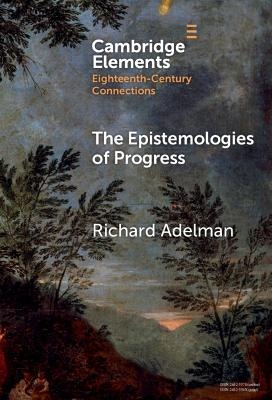
The Epistemologies of Progress
Seiten
2025
Cambridge University Press (Verlag)
978-1-009-61420-7 (ISBN)
Cambridge University Press (Verlag)
978-1-009-61420-7 (ISBN)
This Element discusses the new consideration of the ambiguities inherent in eighteenth-century thought on the epistemologies of progress and the fast-growing body of scholarship identifying the role of scepticism in Enlightenment philosophy across Europe.
The Epistemologies of Progress brings together two recent critical trends to offer a new understanding of Scottish-Enlightenment narratives of progress. The first trend is the new consideration of the ambiguities inherent in eighteenth-century thought on this subject. The second is the fast-growing body of scholarship identifying the surprising role of scepticism in Enlightenment philosophy across Europe. The author's analysis demonstrates that stadial history is best understood through the terms of contemporary scepticism, and that doing so allows for the identification of structural reasons why such thought has been characterized by its ambiguities. Seen in this light, contemporary accounts of progress form a spectrum of epistemological rigour. At one end of this spectrum all knowledge is self-reflexively recognized to be analogy, surmise, 'speculation', and 'conjecture', untethered from lay-conceptions facticity. At the other end stand quotidian political claims, but made alongside reference to the sceptical conception of knowledge and argumentation.
The Epistemologies of Progress brings together two recent critical trends to offer a new understanding of Scottish-Enlightenment narratives of progress. The first trend is the new consideration of the ambiguities inherent in eighteenth-century thought on this subject. The second is the fast-growing body of scholarship identifying the surprising role of scepticism in Enlightenment philosophy across Europe. The author's analysis demonstrates that stadial history is best understood through the terms of contemporary scepticism, and that doing so allows for the identification of structural reasons why such thought has been characterized by its ambiguities. Seen in this light, contemporary accounts of progress form a spectrum of epistemological rigour. At one end of this spectrum all knowledge is self-reflexively recognized to be analogy, surmise, 'speculation', and 'conjecture', untethered from lay-conceptions facticity. At the other end stand quotidian political claims, but made alongside reference to the sceptical conception of knowledge and argumentation.
Introduction; 1. James Dunbar and the 'Instinctive Propensities' of lay knowledge; 2. John Millar and the certainties of colonialism; 3. Ossian and the biases of commercial modernity; Conclusion; Bibliography.
| Erscheinungsdatum | 20.05.2025 |
|---|---|
| Reihe/Serie | Elements in Eighteenth-Century Connections |
| Zusatzinfo | Worked examples or Exercises |
| Verlagsort | Cambridge |
| Sprache | englisch |
| Maße | 152 x 229 mm |
| Gewicht | 227 g |
| Themenwelt | Geisteswissenschaften ► Philosophie ► Erkenntnistheorie / Wissenschaftstheorie |
| Geisteswissenschaften ► Philosophie ► Logik | |
| Geisteswissenschaften ► Philosophie ► Philosophie der Neuzeit | |
| ISBN-10 | 1-009-61420-7 / 1009614207 |
| ISBN-13 | 978-1-009-61420-7 / 9781009614207 |
| Zustand | Neuware |
| Informationen gemäß Produktsicherheitsverordnung (GPSR) | |
| Haben Sie eine Frage zum Produkt? |
Mehr entdecken
aus dem Bereich

aus dem Bereich
Buch | Softcover (2023)
Reclam, Philipp (Verlag)
CHF 9,80
die Evolution des Geistes
Buch | Softcover (2025)
Suhrkamp (Verlag)
CHF 41,95


