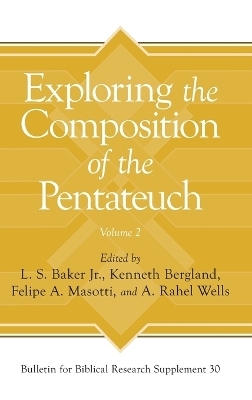
Exploring the Composition of the Pentateuch, Volume 2
Eisenbrauns (Verlag)
9781646023202 (ISBN)
- Lieferbar (Termin unbekannt)
- Versandkostenfrei
- Auch auf Rechnung
- Artikel merken
Part 1 of this volume investigates the readability of the Pentateuch, exploring narrative techniques, inconsistencies, and coherence. Part 2 tackles issues relevant for the dating of Deuteronomy, like the narrative retelling in Deut 1–3, dating based on parallels to the Loyalty Oath of Esarhaddon, and deuteronomistic tribal language. And part 3 focuses on issues related to the overall dating of the Pentateuch, discussing empirical models, comparisons with the Hazor Legal Fragments, turning points in pentateuchal scholarship, the direction of dependence between the legal material of the Pentateuch, and the absence of Zion theology in the Pentateuch.
In addition to the editors, the contributors include Richard E. Averbeck, John S. Bergsma, Joshua Berman, Daniel I. Block, Mark Steven Francois, Roy E. Gane, Richard S. Hess, Benjamin Kilchör, Noel K. Weeks.
L. S. Baker Jr. is Adjunct Professor of Old Testament in the Seventh-day Adventist Seminary at Andrews University. Kenneth Bergland is Assistant Professor of Old Testament at Adventist International Institute of Advanced Studies. Felipe A. Masotti is Professor of Hebrew Bible at Paraná Adventist College. A. Rahel Wells is Professor of Old Testament at Andrews University.
List of Abbreviations
Introduction
L. S. Baker Jr., Kenneth Bergland, Felipe A. Masotti, and A. Rahel Wells
Part 1: The Readability of the Pentateuch
Chapter 1. Case Studies of Some Apparent Inconsistencies in the Pentateuch
Roy E. Gane
Chapter 2. Contradiction, Coherence, and Composition
Kenneth Bergland
Chapter 3. Sophisticated Narrative Technique of the Pentateuch
Noel K. Weeks
Chapter 4. The Coherence and Internal Rationale
of the Priestly Legislation in the Pentateuch with Special Attention to the “Guild Offering”
Richard Averbeck
Part 2: The Dating of Deuteronomy
Chapter 5. Selective Literary Representation of Vassal Obsequiousness and Responsive Awareness in the Amarna Letters, the Hittite Treaty Prologues, and Deuteronomy 1–3
Felipe A. Masotti
Chapter 6. Borrowed Curses: The Loyalty Oath of Esarhaddon, Deuteronomy 28:20–44, and a Premonarchic Date for the Earliest Edition of Deuteronomy
Mark Steven Francois
Chapter 7. The Tribes of Israel (Part 1): Their Significance for Assessing the Provenance of the Book of Deuteronomy
Daniel I. Block
Chapter 8. The Tribes of Israel (Part 2): Their Significance for Assessing the Provenance of Deuteronomy 33
Daniel I. Block
Part 3: The Dating of the Pentateuch
Chapter 9. The Biblical Criticism of Ibn Hazm the Andalusian: A Medieval Control for Modern Diachronic Method
Joshua Berman
Chapter 10. Questions Concerning the Covenant Code in Light of the Hazor Legal Fragments
Richard S. Hess
Chapter 11. Three Turning Points in Research History Toward a Farewell to the Mosaic Origin of the Pentateuch: How Strong Are They?
Benjamin Kilch.r
Chapter 12. Direction of Dependence in the Animal‑Related Sabbath Laws in the Pentateuch
A. Rahel Wells
Chapter 13. Did Postexilic Judaism Really Abandon Jerusalem and the Temple? A Discussion with Jean Louis Ska on the Absence of Zion Theology from the Pentateuch
John S. Bergsma
List of Contributors
Subject Index
Ancient Source Index
| Erscheinungsdatum | 06.11.2025 |
|---|---|
| Reihe/Serie | Bulletin for Biblical Research Supplement |
| Zusatzinfo | 1 Charts |
| Sprache | englisch |
| Maße | 152 x 229 mm |
| Gewicht | 540 g |
| Themenwelt | Geisteswissenschaften ► Religion / Theologie ► Judentum |
| Geisteswissenschaften ► Sprach- / Literaturwissenschaft ► Anglistik / Amerikanistik | |
| Geisteswissenschaften ► Sprach- / Literaturwissenschaft ► Literaturwissenschaft | |
| ISBN-13 | 9781646023202 / 9781646023202 |
| Zustand | Neuware |
| Informationen gemäß Produktsicherheitsverordnung (GPSR) | |
| Haben Sie eine Frage zum Produkt? |
aus dem Bereich