


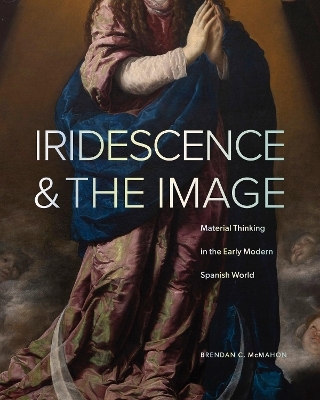
Iridescence and the Image
Material Thinking in the Early Modern Spanish World
Seiten
2025
Pennsylvania State University Press (Verlag)
978-0-271-09969-9 (ISBN)
Pennsylvania State University Press (Verlag)
978-0-271-09969-9 (ISBN)
At the turn of the seventeenth century, people in Spain and Mexico were fascinated by iridescence. Artists stretched the capacities of conventional media in attempts to capture its shifting hues, while others integrated iridescent materials directly into their work. At the same time, naturalists strove to convey the changing colors of these substances in printed texts, theologians and political commentators invoked them in tracts and treatises, and playwrights and poets wove them through the scripts of comedies and into the stanzas of sonnets.
In Iridescence and the Image, Brendan C. McMahon explores this preoccupation with such materials—including shot fabric, hummingbird feathers, mother of pearl, and opals—in the early modern Spanish world. Taking the virtuosic renderings of tornasol (shot silk) by the Spanish painter Antonio de Pereda (1611–1678) as a point of departure, he shows that the ubiquity of these materials in a broad array of period cultural productions stemmed from the ways in which their unique properties undermined trust in visual perception—and in visual images themselves. Ultimately, McMahon argues, iridescence provided a way for people to grapple with profound questions about seeming and being, deception and revelation, and the nature of truth itself.
In Iridescence and the Image, Brendan C. McMahon explores this preoccupation with such materials—including shot fabric, hummingbird feathers, mother of pearl, and opals—in the early modern Spanish world. Taking the virtuosic renderings of tornasol (shot silk) by the Spanish painter Antonio de Pereda (1611–1678) as a point of departure, he shows that the ubiquity of these materials in a broad array of period cultural productions stemmed from the ways in which their unique properties undermined trust in visual perception—and in visual images themselves. Ultimately, McMahon argues, iridescence provided a way for people to grapple with profound questions about seeming and being, deception and revelation, and the nature of truth itself.
Brendan C. McMahon is Assistant Professor of History of Art at the University of Michigan.
| Erscheinungsdatum | 16.10.2025 |
|---|---|
| Zusatzinfo | 49 Halftones, color; 19 Halftones, black and white |
| Verlagsort | University Park |
| Sprache | englisch |
| Maße | 203 x 254 mm |
| Gewicht | 1179 g |
| Themenwelt | Kunst / Musik / Theater ► Kunstgeschichte / Kunststile |
| Geisteswissenschaften ► Geschichte ► Regional- / Ländergeschichte | |
| Geschichte ► Teilgebiete der Geschichte ► Militärgeschichte | |
| ISBN-10 | 0-271-09969-0 / 0271099690 |
| ISBN-13 | 978-0-271-09969-9 / 9780271099699 |
| Zustand | Neuware |
| Informationen gemäß Produktsicherheitsverordnung (GPSR) | |
| Haben Sie eine Frage zum Produkt? |
Mehr entdecken
aus dem Bereich



aus dem Bereich
von der Wiederbewaffnung bis zur Zeitenwende
Buch | Softcover (2025)
C.H.Beck (Verlag)
CHF 16,80
Deutschlands großer Volksaufstand
Buch | Softcover (2024)
Propyläen Verlag
CHF 30,80


