


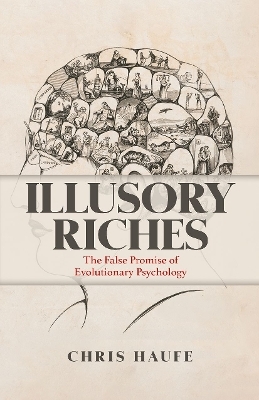
Illusory Riches
The False Promise of Evolutionary Psychology
Seiten
2026
Oxford University Press Inc (Verlag)
978-0-19-775121-3 (ISBN)
Oxford University Press Inc (Verlag)
978-0-19-775121-3 (ISBN)
- Lieferbar (Termin unbekannt)
- Portofrei ab CHF 40
- Auch auf Rechnung
- Artikel merken
Illusory Riches critically examines the discipline of Evolutionary Psychology.
Popular science and media are awash in sweeping claims concerning how some characteristic human behavior, feeling, or psychological disposition exists because it aided our evolutionary ancestors in survival and reproduction. These claims often arise from a discipline known as Evolutionary Psychology. Evolutionary Psychology claims to investigate the evolutionary underpinnings of human nature, to explain why we have the thoughts, feelings, impulses that are characteristic of human experience.
But when we compare these investigations with evolutionary research on other human traits, or on nonhumans, we see that Evolutionary Psychology is deeply out of touch with the basic theoretical and methodological precepts that form the basis of our knowledge of evolutionary history. By comparing research in Evolutionary Psychology with traditional forms of evolutionary research, we can appreciate the wide gap between what Evolutionary Psychology says about human nature, on the one hand, and what is traditionally required to support claims about evolutionary history, on the other.
The study of evolution is not the study of the design and purpose of nature-it is the study of how populations change over time and it requires the sort of investigation for which human subjects are generally ill suited. As Chris Haufe shows, Evolutionary Psychology has constructed a parallel scientific universe - cut off from genuine scientific knowledge of the evolutionary process - which seeks to actively promote a predetermined stance on human evolutionary history regardless of whether that stance is logically consistent with current scientific fact. Illusory Riches demonstrates that our scientific knowledge of the human past and of the evolutionary process permits a far greater range of human potentialities than one might suspect from the claims of Evolutionary Psychology.
Popular science and media are awash in sweeping claims concerning how some characteristic human behavior, feeling, or psychological disposition exists because it aided our evolutionary ancestors in survival and reproduction. These claims often arise from a discipline known as Evolutionary Psychology. Evolutionary Psychology claims to investigate the evolutionary underpinnings of human nature, to explain why we have the thoughts, feelings, impulses that are characteristic of human experience.
But when we compare these investigations with evolutionary research on other human traits, or on nonhumans, we see that Evolutionary Psychology is deeply out of touch with the basic theoretical and methodological precepts that form the basis of our knowledge of evolutionary history. By comparing research in Evolutionary Psychology with traditional forms of evolutionary research, we can appreciate the wide gap between what Evolutionary Psychology says about human nature, on the one hand, and what is traditionally required to support claims about evolutionary history, on the other.
The study of evolution is not the study of the design and purpose of nature-it is the study of how populations change over time and it requires the sort of investigation for which human subjects are generally ill suited. As Chris Haufe shows, Evolutionary Psychology has constructed a parallel scientific universe - cut off from genuine scientific knowledge of the evolutionary process - which seeks to actively promote a predetermined stance on human evolutionary history regardless of whether that stance is logically consistent with current scientific fact. Illusory Riches demonstrates that our scientific knowledge of the human past and of the evolutionary process permits a far greater range of human potentialities than one might suspect from the claims of Evolutionary Psychology.
Chris Haufe is the Elizabeth M. and William C. Treuhaft Professor of the Humanities and Chair of the Department of Philosophy at Case Western Reserve University. He works on problems in the history and philosophy of knowledge.
Introduction
Chapter 1: Not-So-Close Encounters with Evolutionary Psychology
Chapter 2: How to Read Evolutionary Psychology
Chapter 3: History Matters
Chapter 4: The Inevitability of Evolutionary Psychology
Chapter 5: Contingency Plan
Chapter 6: Diminishing Returns on Investment
Chapter 7: Explaining Preferences
Chapter 8: A Lot to Be Desired
Conclusion
| Erscheinungsdatum | 25.11.2025 |
|---|---|
| Verlagsort | New York |
| Sprache | englisch |
| Maße | 137 x 201 mm |
| Gewicht | 431 g |
| Themenwelt | Geisteswissenschaften ► Psychologie ► Allgemeine Psychologie |
| Mathematik / Informatik ► Mathematik | |
| Naturwissenschaften | |
| ISBN-10 | 0-19-775121-0 / 0197751210 |
| ISBN-13 | 978-0-19-775121-3 / 9780197751213 |
| Zustand | Neuware |
| Informationen gemäß Produktsicherheitsverordnung (GPSR) | |
| Haben Sie eine Frage zum Produkt? |
Mehr entdecken
aus dem Bereich



aus dem Bereich
Paket bestehend aus »Das Patienten-Manual« und »Das Trainer-Manual«
Buch | Softcover (2025)
Schattauer (Verlag)
CHF 125,95


