


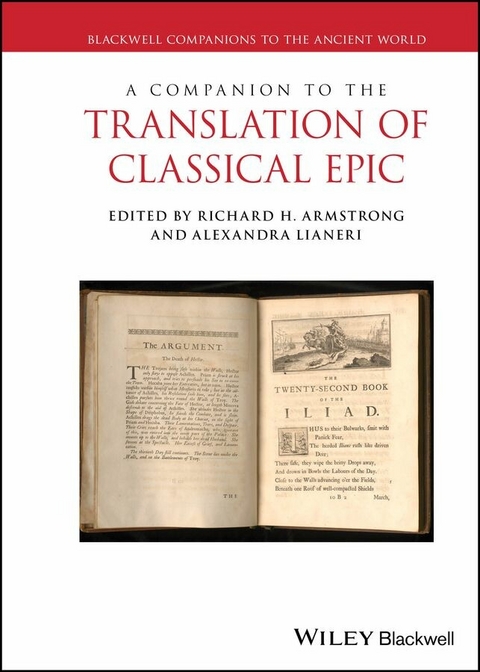
A Companion to the Translation of Classical Epic (eBook)
983 Seiten
Wiley-Blackwell (Verlag)
978-1-119-09408-1 (ISBN)
The first volume of its kind to integrate trends in Translation Studies with Classical Reception Studies
A Companion to the Translation of Classical Epic provides a comprehensive and wide-ranging account of key debates and case studies centered the translation of Greek and Latin epics. Rather than situating translation studies as a complementary field or an aspect of classical reception, the Companion offers a systematic framework for adapting and incorporating translation studies fully into classical studies. Its many chapters elaborate how translation is a central element in the epic's reception trajectories across the globe and addresses theoretical and methodological concerns arising from this conjunction.
The Companion does not just provide a comprehensive overview of the translation theories it covers, but also offers fresh insights into theoretical and methodological issues currently at the top of the interdisciplinary agenda of scholars studying the global routes of ancient epic. In its sections, leading classicists, translation theorists, classical reception scholars, and cultural historians from Europe and North and South America reconfigure questions this research faces today, highlighting methods for an integrated approach. It explores how this integrated perspective responds to key challenges in the study of the epic's reception, emphasizing topics of temporality, gender, agency, community, target-language politics, and material production. A special section also features detailed dialogues with active translators such as Emily Wilson, Stanley Lombardo, and Susanna Braund, who speak extensively and frankly about their work.
This is a key volume for all students and scholars who want to engage with research reflecting the contemporary agenda in classical reception, translation studies, and the study of epic in its global literary and cultural routes.
The first volume of its kind to integrate trends in Translation Studies with Classical Reception Studies A Companion to the Translation of Classical Epic provides a comprehensive and wide-ranging account of key debates and case studies centered the translation of Greek and Latin epics. Rather than situating translation studies as a complementary field or an aspect of classical reception, the Companion offers a systematic framework for adapting and incorporating translation studies fully into classical studies. Its many chapters elaborate how translation is a central element in the epic's reception trajectories across the globe and addresses theoretical and methodological concerns arising from this conjunction. The Companion does not just provide a comprehensive overview of the translation theories it covers, but also offers fresh insights into theoretical and methodological issues currently at the top of the interdisciplinary agenda of scholars studying the global routes of ancient epic. In its sections, leading classicists, translation theorists, classical reception scholars, and cultural historians from Europe and North and South America reconfigure questions this research faces today, highlighting methods for an integrated approach. It explores how this integrated perspective responds to key challenges in the study of the epic's reception, emphasizing topics of temporality, gender, agency, community, target-language politics, and material production. A special section also features detailed dialogues with active translators such as Emily Wilson, Stanley Lombardo, and Susanna Braund, who speak extensively and frankly about their work. This is a key volume for all students and scholars who want to engage with research reflecting the contemporary agenda in classical reception, translation studies, and the study of epic in its global literary and cultural routes.
Notes on Contributors
Leonardo Antunes is a professor at the Universidade Federal do Rio Grande do Sul, in Porto Algre, Brazil. He is a poet and translator and writes on poetic problems in the translation of Greek poetry. He has recently published a translation of the Iliad, A Ilíada de Homero em decassílabos duplos (Editora Zouk, 2022), of Anacreon’s extant fragments and the Anacreontea, Anacreonte: Fragmentos Completos (Editora 34, 2022), and of Sophocles’ Oedipus Rex, Édipo Tirano (Editora Todavia, 2018). He is currently finishing up a translation of the Odyssey, which should be published in 2025.
Richard H. Armstrong is Associate Professor of Classical Studies at the University of Houston, Houston, Texas. His research areas are in classical receptions, specifically in the history of psychoanalysis and translation studies. He is author of A Compulsion for Antiquity: Freud and the Ancient World (Cornell UP, 2005). With Elizabeth Vandiver, he is co‐editor of Remusings: Essays on the Translation of Classical Poetry (Classical and Modern Literature [2007] 27.1). With Alexandra Lianeri he is coeditor of Classical Translation Studies: Transfigurations in Reception and Cultural History (forthcoming, Oxford UP). He is also a co‐editor of the Bloomsbury Handbook of Psychoanalysis and Classical Reception (forthcoming, Bloomsbury Academic). Recently he co‐curated the exhibition Freud's Antiquity: Object, Idea, Desire at the Freud Museum London with Miriam Leonard and Daniel Orrells.
Susan Bassnett is a writer and scholar of comparative literature and translation studies. She is Professor of Comparative Literature at the University of Glasgow, and Professor Emerita at the University of Warwick. Author of over 20 books, her Translation Studies has been translated into many languages and is a book of global importance. Her most recent book is Debates in Translation, co‐edited with David Johnstone (2024). She is an elected Fellow of the Academia Europaea, the Institute of Linguists and the Royal Society of Literature. Since 2016 she has been President of the British Comparative Literature Association.
Alexander Beecroft is Jessie Chapman Alcorn Memorial Professor of Foreign Languages at the University of South Carolina. A comparativist and literary theorist, he is author of Authorship and Cultural Identity in Early Greece and China: Patterns of Literary Circulation (Cambridge UP, 2010), An Ecology of World Literature: From Antiquity to the Present Day (Verso, 2015), and is currently working on A Global History of Literature (Johns Hopkins UP).
Francesca D'Alessandro Behr is Professor of Italian and Classical Studies at the University of Houston. She specializes on Latin literature and women writers of the Italian Renaissance, and is author of Feeling History: Lucan, Stoicism, and the Poetics of Passion (Ohio State UP, 2007) and Arms and the Woman: Classical Tradition and Women Writers in the Venetian Renaissance. She is currently working on an edition and introduction to Lucrezia Marinella's discourse Rivolgimento amoroso dell’huomo verso la divina bellezza (1597) for the University of Toronto Press as well as further articles on Marinella's work.
Susanna Braund held a Canada Research Chair in Latin Poetry and its Reception at the University of British Columbia from 2007 until 2021 after teaching previously at Stanford University, Yale University, and the Universities of London, Bristol and Exeter. She has published extensively on Roman satire and Latin epic poetry among other aspects of Latin literature and has translated Lucan (Oxford World's Classics), Persius and Juvenal (Loeb Classical Library) and some works of Seneca. Her major project Translating Virgil: A Cultural History of the Western Tradition from the Eleventh Century to the Present will be published by Cambridge University Press in 2024.
Fiona Cox is Associate Professor of French and Comparative Literature and Head of Department at the University of Exeter. She is author of Aeneas Takes the Metro: Virgil's Presence in Twentieth Century French Literature (Legenda, 1999), Sibylline Sisters: Virgil's Presence in Contemporary Women's Writing (Oxford UP, 2011), and Ovid's Presence in Contemporary Women's Writing: Strange Monsters (Oxford UP, 2018). She is co‐editor of Homer's Daughters: Women's Responses to Homer in the Twentieth Century and Beyond (Oxford UP, 2019) as well as Ovid in French: Reception by Women from the Renaissance to the Present (Oxford UP, 2023).
Michael Cronin is 1776 Professor of French and Senior Researcher in the Trinity Centre for Literary and Cultural Translation at Trinity College Dublin. Among his recent published titles are Eco‐Translation: Translation and Ecology in the Age of the Anthropocene (2017), Irish and Ecology: An Ghaeilge agus an Éiceolaíocht (2019) and Eco‐Travel: Journeying in the Age of the Anthropocene (2022). He is a member of the Royal Irish Academy, the Academia Europaea, an Officier in the Ordre des Palmes Académiques and a Fellow of Trinity College Dublin.
Annmarie Drury is Professor of English at Queens College, City University of New York. She is the author of Translation as Transformation in Victorian Poetry (Cambridge UP, 2015), awarded the Sonya Rudikoff Award for a best first book in Victorian Studies, and editor of The Imaginative Vision of Abdilatif Abdalla's Voice of Agony (U Michigan P, 2024), as well as a translator and poet. She is writing a book about listening in Victorian poetry and culture.
Ramiro González Delgado is Professor of Greek Philology at the Universidad de Extremadura, Badajoz, Spain. His research focuses on Greek literature and mythology, the classical tradition and the history of Greco‐Roman literature in Spain. He is author of Orfeo y Eurídice en la Antigüedad: mito y literatura (Ediciones Clásicas, 2008) and Canta, musa, en lengua asturiana: estudios de traducción y tradición clásica (EAE, 2012), and co‐editor of La Historia de la Literatura Grecolatina durante la Edad de Plata de la cultura española (1868‐1936) (Universidad de Málaga, 2010), and La Historia de la Literatura Grecolatina en España: de la Ilustración al Liberalismo (1778‐1850) (Universidad de Málaga, 2013). He is translator of Poemas de amor efébico, Antología Palatina, libro XII (Akal, 2011).
Benjamin Haller is Associate Professor of Classics at Virginia Wesleyan University, where he has taught as a one‐person classics department since arriving in 2008. He has published on Homer, receptions of Greek and Roman poetry, and the Greek and Roman worlds in popular culture. His latest book is Greco‐Roman Literature and Culture in Virginia’s Tidewater Region, 1607‐1826 (Lexington Books, 2024). When he is not spending time with his wife Jessica, his son Keats, and his daughter Abigail, he is working on projects on the Homeric Hymn to Hermes, Latin Pedagogy (a textbook titled Laetabere!), and Ralph Ellison.
Lorna Hardwick is Professor Emerita of Classical Studies at the Open University, UK. She is (with Professor James Porter) co‐editor of the Classical Presences series (Oxford UP) and was the founding editor of the Classical Receptions Journal. She has published extensively on Homer, Athenian cultural history, Greek Tragedy and Poetry and its modern receptions, and on translation theory and practice. Books include: Translating Words, Translating Cultures (Bloomsbury, 2000), Reception Studies (Oxford UP, 2003), and the co‐edited volumes Classics in Post‐Colonial Worlds (with Carol Gillespie, Oxford UP, 2007), Companion to Classical Receptions (with Christopher Stray, Wiley, 2007), Classics in the Modern World: A ‘Democratic Turn’? (with Stephen Harrison, Oxford UP, 2013). She is joint editor, with Elizabeth Vandiver and Stephen Harrison, of the Oxford Classical Reception Commentaries (OCRC, Oxford UP), with whom she has co‐authored two books in the series: Greek and Roman Antiquity in First World War Poetry: Making Connections, and Rupert Brooke, Charles Sorley, Isaac Rosenberg (Oxford UP, 2024) and Wilfred Owen: Classical Connections (Oxford UP, 2024).
Julie Candler Hayes is Professor Emerita of French at the University of Massachusetts, Amherst, where she served as Chair and later Dean of the College of Humanities and Fine Arts. She is author of Translation, Subjectivity, and Culture in France and England, 1600‐1800 (Stanford UP, 2009), Reading the French Enlightenment: System and Subversion (Cambridge UP, 1999), and Identity and Ideology: Diderot, Sade, and the Serious Genre (John Benjamins, 1991). She is also co‐editor of Emilie Du Châtelet: Rewriting Enlightenment Philosophy and Science (Voltaire Foundation, 2006) and Using the Encyclopédie: Ways of Knowing, Ways of Reading (Voltaire Foundation, 2002).
Thomas E. Jenkins is Professor of Classical Studies at Trinity University, San Antonio, Texas. He is author of Antiquity Now: The Classical World in the Contemporary American Imagination (Cambridge UP, 2015) and Intercepted Letters: Epistolarity and...
| Erscheint lt. Verlag | 10.3.2025 |
|---|---|
| Reihe/Serie | Blackwell Companions to the Ancient World |
| Sprache | englisch |
| Themenwelt | Geisteswissenschaften ► Sprach- / Literaturwissenschaft ► Anglistik / Amerikanistik |
| Geisteswissenschaften ► Sprach- / Literaturwissenschaft ► Latein / Altgriechisch | |
| Geisteswissenschaften ► Sprach- / Literaturwissenschaft ► Literaturwissenschaft | |
| ISBN-10 | 1-119-09408-9 / 1119094089 |
| ISBN-13 | 978-1-119-09408-1 / 9781119094081 |
| Informationen gemäß Produktsicherheitsverordnung (GPSR) | |
| Haben Sie eine Frage zum Produkt? |
 EPUB (Adobe DRM)
Kopierschutz: Adobe-DRM
Adobe-DRM ist ein Kopierschutz, der das eBook vor Mißbrauch schützen soll. Dabei wird das eBook bereits beim Download auf Ihre persönliche Adobe-ID autorisiert. Lesen können Sie das eBook dann nur auf den Geräten, welche ebenfalls auf Ihre Adobe-ID registriert sind.
Details zum Adobe-DRM
Dateiformat: EPUB (Electronic Publication)
EPUB ist ein offener Standard für eBooks und eignet sich besonders zur Darstellung von Belletristik und Sachbüchern. Der Fließtext wird dynamisch an die Display- und Schriftgröße angepasst. Auch für mobile Lesegeräte ist EPUB daher gut geeignet.
Systemvoraussetzungen:
PC/Mac: Mit einem PC oder Mac können Sie dieses eBook lesen. Sie benötigen eine
eReader: Dieses eBook kann mit (fast) allen eBook-Readern gelesen werden. Mit dem amazon-Kindle ist es aber nicht kompatibel.
Smartphone/Tablet: Egal ob Apple oder Android, dieses eBook können Sie lesen. Sie benötigen eine
Geräteliste und zusätzliche Hinweise
Buying eBooks from abroad
For tax law reasons we can sell eBooks just within Germany and Switzerland. Regrettably we cannot fulfill eBook-orders from other countries.
aus dem Bereich


