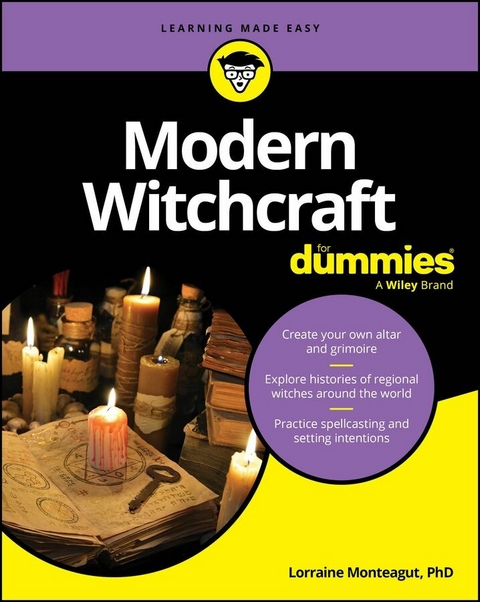
Modern Witchcraft For Dummies (eBook)
534 Seiten
For Dummies (Verlag)
978-1-394-30365-6 (ISBN)
A contemporary guide to the roots, paths and tools of witchcraft.
A new generation of witchcraft is here! Today, witchcraft encompasses many different paths and is one of the most rapidly growing sets of spiritual systems in the world. Modern Witchcraft For Dummies walks you through what it means to be a modern witch-going beyond the Euro-pagan traditions and Wicca-and how to ensure your witchcraft moves toward inclusivity and spiritual activism. Discover the roots and impact of witchcraft, consider the differences between 'open' and 'closed' practices, and explore the ethics of magical practice.
Within, you'll also:
- Explore histories of regional witches across the world
- Understand witchcraft archetypes and practices (with clear guidance on how to start your own practice)
- Discover the various types of witches and determine the type of witch you want to be
- Create your own altars and grimoires, set intentions, and practice your spellcasting and rituals (on your own or with a coven!)
Get ready to explore a world of powerful spiritual connectedness with Modern Witchcraft For Dummies. It's a must-read for witches, pagans, and the simply occult-curious.
Lorraine Monteagut, PhD, is a queer Latine witch, astrologer, and author. Lorraine studies the diverse backgrounds and traditions of contemporary magical practices. She is the creator of Witchy Heights (@witchyheights on Instagram or witchyheights.com), where she teaches folk magic, ritual astrology, and spiritual activism.
A contemporary guide to the roots, paths and tools of witchcraft. A new generation of witchcraft is here! Today, witchcraft encompasses many different paths and is one of the most rapidly growing sets of spiritual systems in the world. Modern Witchcraft For Dummies walks you through what it means to be a modern witch going beyond the Euro-pagan traditions and Wicca and how to ensure your witchcraft moves toward inclusivity and spiritual activism. Discover the roots and impact of witchcraft, consider the differences between open and closed practices, and explore the ethics of magical practice. Within, you'll also: Explore histories of regional witches across the world Understand witchcraft archetypes and practices (with clear guidance on how to start your own practice) Discover the various types of witches and determine the type of witch you want to be Create your own altars and grimoires, set intentions, and practice your spellcasting and rituals (on your own or with a coven!) Get ready to explore a world of powerful spiritual connectedness with Modern Witchcraft For Dummies. It's a must-read for witches, pagans, and the simply occult-curious.
Chapter 1
Reclaiming Witchcraft
IN THIS CHAPTER
Introducing concepts of modern witchcraft
Clarifying common terms, including neopaganism
Considering witchcraft outside of Wicca and European traditions
Witch is a bad word, historically speaking. It has carried negative connotations and been associated with evil practices. Modern witchcraft turns the witch into something new. Reclaiming movements have embraced the witch as a symbol of healing, empowerment, and resistance. Today’s witch defies neat definitions and shakes off the stigma of the past, constantly shifting to reflect the ideologies and challenges of the times. To call yourself a witch is to call back the power that was taken from all those who were cast to the margins or branded as dangerous “others.” Even now, identifying as a witch can be an act of courage. The shadow of the evil witch is still there.
This chapter serves as an introduction to modern witchcraft, in contrast to the historical record of oppression and persecution that witches and those accused of witchcraft have endured over the centuries. I cover key terms and introduce the myriad neopagan practices out there. The chapter ends with some context to consider if you’re looking to come out of the broom closet yourself.
Before Wicca, Beyond Wicca
First things first. Yes, witches are real. I am one, and if you’re reading this, you might be one too. Or maybe you’ve heard that people are walking around calling themselves witches, and you’re interested in learning what that’s all about. All are welcome here.
Take a moment to picture a witch.
Whatever you’ve imagined, it’s probably not what most witches look like. Maybe you’ve pictured what you imagine a Wiccan to look like; Wicca and witchcraft are often confused. Or maybe you’ve conjured an image that resembles something like what’s shown in Figure 1-1. While I do love a good broom, most witches don’t look like the stereotype unless they’re in costume.
Dugald Stewart Walker/The New York Public Library/Public domain
FIGURE 1-1: A pretty cool illustration of a witch.
Anyone can be a witch, and they can look like anything. If you want to avoid being cursed (only half joking), I suggest accepting the way everyone likes to self-identify, as long as it’s not harming anyone.
In fact, acceptance and individuality are core tenets of modern witchcraft. The modern witch, like its predecessors, resists classification. Most books on witchcraft grapple with definitions and histories in their first chapters. As a scholar of witchcraft, I consider this an important though sometimes frustrating task. Seeing how witches and authors of vastly different perspectives define the witch has helped me expand my views and refine my own identity as a modern witch.
Think of a few words that you associate with the term witch. This will reveal a lot about your underlying assumptions.
In the past, the label witch was hurled at those who didn’t fit neatly in society. These individuals may not have even identified as witches, but simply lived life differently. It’s no coincidence that most people who were called witches were female, elderly, disabled, or (gasp!) single hermits with penchants for gardening. Often, these “witches” challenged the status quo and were deemed a threat.
Understanding modern witchcraft is a matter of perspective. Knowing where you stand is more important than perfect definitions and histories. Your own beliefs, backgrounds, and desires are valid and probably compatible with today’s forms of witchcraft unless you follow a religion that explicitly forbids any kind of magic. There are even a good many Christian witches these days! Modern witchcraft is the confluence of many perspectives and beliefs.
The number of people worldwide who identify as witches isn’t precisely documented; it varies depending on cultural, religious, and individual interpretations of witchcraft. Modern witchcraft and related practices related to paganism and folk magic have seen significant growth, particularly in the United States and Europe. Some surveys suggest that hundreds of thousands to a few million people in the world identify as Wiccan or other kinds of neopagans.
Don’t mistake witchcraft for Wicca — they’re not the same thing. Witchcraft is a broad term that encompasses many different magical traditions and practices, whereas Wicca is a specific religion. In other words, all Wiccans are witches, but not all witches are Wiccans.
Coming to terms
When I was growing up, my understanding of witches was shaped greatly by Wicca because it was the main form of witchcraft portrayed on television, and the only witches I encountered in real life were Wiccans.
Although Wicca comes in many forms, including Gardnerian, Dianic, and Alexandrian, it’s generally a modern, nature-centered religion that celebrates the cycles of Earth, honors a dual divinity often represented as the goddess and the god, and incorporates rituals, magic, and seasonal festivals. Wicca is an eclectic religion that synthesizes elements from a variety of sources, including ancient pagan traditions, Western esotericism, and folklore. Find out more in Wicca & Witchcraft For Dummies by Diane Smith (Wiley).
As a child, I was especially drawn to Wiccan reimaginings of Greek mythology, a common gateway for many witch-curious folk! But I encountered the opposing beliefs of some of my Latin American family members, who viewed witches as inherently bad. They associated witches with monsters lurking in folk stories or the elusive “devil worshippers.”
Speak of the devil: Despite common misconceptions, many modern Satanists are nice, normal people. Most don’t even worship the devil. Members of the Church of Satan and the Satanic Temple typically reject the concept of a literal Satan, instead focusing on self-empowerment, individualism, and the rejection of oppressive systems.
Satanists who do worship the devil see their work as a reclamation of the horned gods of nature-based pagan traditions. Satanism is philosophically distinct from witchcraft, though the two are often conflated due to shared outsider status in mainstream culture.
These conflicting images fueled my curiosity and created a tension that I still wrestle with to this day. The cultural perceptions of witches are vast and often contradictory, ranging from empowered healers and wise figures to villains in folklore. These differing views reflect societal attitudes about power, gender, and spirituality.
To complicate things further, you might hear the term witch used interchangeably with other terms, though each carries its own unique context. These include the following:
- Sorcerer: A practitioner of magic who often uses their power for personal gain, associated with manipulating energy to their will.
- Warlock: Originally meaning “oath-breaker,” this term was historically used pejoratively to refer to diabolical practitioners. In modern contexts, some male witches have reclaimed the term, but others avoid it due to its negative connotations.
- Magician: A broader term for someone who performs magical acts, ranging from ritualistic magic to stage illusions.
- Wizard: Often linked to fantasy and literature, the wizard is typically depicted as a scholarly figure who studies and practices magic.
Pop culture further confuses the understandings of these terms. Fictional representations vary greatly and influence understandings of modern witchcraft.
The word witchcraft is also wrought to the whims of the moment. It’s often associated with feminine power due to its association with healing, midwifery, and nature worship, which are roles that women often fulfill.
However, witchcraft today is a gender-inclusive practice. Men, nonbinary individuals, and those of diverse gender identities also claim the title of witch, reflecting the universal appeal of its principles. Additionally, modern witchcraft challenges traditional gender norms, embracing fluidity and inclusivity in its rituals and communities.
Just as the idea of a witch is fluid and ever-changing, so too is the concept of magic. It’s the word people use when they don’t fully understand something. In witchcraft, magic operates on the belief that the cosmos is interconnected, a unified whole where energy can be moved and directed with intention. You might come across magic used interchangeably with many other terms, including these:
- The Occult: Occult means hidden. That’s how I use it — magic as something subtle, concealed, and full of potential — but it’s also tied to specific traditions of magical practice, including Thelema, the Hermetic Order of the Golden Dawn, and the Rosicrucians. (See Chapter 9, where I cover initiation into different kinds of occult traditions.)
- Animism: Animism is the belief that all things — living and nonliving — possess a spirit or consciousness. This includes animals, plants, stones, rivers, mountains, and even human-made objects. For witches, working with animism means recognizing and interacting with the spiritual essence of the natural world and the objects within it.
- Esotericism:...
| Erscheint lt. Verlag | 10.3.2025 |
|---|---|
| Sprache | englisch |
| Themenwelt | Geisteswissenschaften ► Religion / Theologie ► Christentum |
| Schlagworte | brujeria book • cosmic witch • Coven • divine witch • energy witch • folk magic • green witch • guide to the occult • guide to witchcraft • Manifestation • modern spellbook • modern wicca • Occult • occult book • occult guide • Pagan • santeria book • spellbook • vodun book • Wicca • wicca for beginners • witchcraft book • witchcraft for beginners • witchcraft guide |
| ISBN-10 | 1-394-30365-3 / 1394303653 |
| ISBN-13 | 978-1-394-30365-6 / 9781394303656 |
| Informationen gemäß Produktsicherheitsverordnung (GPSR) | |
| Haben Sie eine Frage zum Produkt? |
 EPUB (Adobe DRM)
Kopierschutz: Adobe-DRM
Adobe-DRM ist ein Kopierschutz, der das eBook vor Mißbrauch schützen soll. Dabei wird das eBook bereits beim Download auf Ihre persönliche Adobe-ID autorisiert. Lesen können Sie das eBook dann nur auf den Geräten, welche ebenfalls auf Ihre Adobe-ID registriert sind.
Details zum Adobe-DRM
Dateiformat: EPUB (Electronic Publication)
EPUB ist ein offener Standard für eBooks und eignet sich besonders zur Darstellung von Belletristik und Sachbüchern. Der Fließtext wird dynamisch an die Display- und Schriftgröße angepasst. Auch für mobile Lesegeräte ist EPUB daher gut geeignet.
Systemvoraussetzungen:
PC/Mac: Mit einem PC oder Mac können Sie dieses eBook lesen. Sie benötigen eine
eReader: Dieses eBook kann mit (fast) allen eBook-Readern gelesen werden. Mit dem amazon-Kindle ist es aber nicht kompatibel.
Smartphone/Tablet: Egal ob Apple oder Android, dieses eBook können Sie lesen. Sie benötigen eine
Geräteliste und zusätzliche Hinweise
Buying eBooks from abroad
For tax law reasons we can sell eBooks just within Germany and Switzerland. Regrettably we cannot fulfill eBook-orders from other countries.
aus dem Bereich