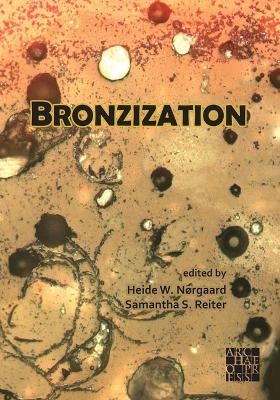
Bronzization: Essays in Bronze Age Archaeology
Archaeopress Archaeology (Verlag)
978-1-80327-921-3 (ISBN)
Bronzization is a collection of state-of-the-art articles which integrate new insights from the many advances in research on the subject into a new and up-to-date vision of the Bronze Age as a Europeanised or even globalised period. Though written by different authors, the papers form a cohesive whole, discussing new data and critically reflecting on old data in a new way. In so doing, they revise current understanding of the crucial prehistoric process of bronzization and bronzification in line with a holistic view of the new scientific advances the past decades have brought about.
The investigations of bronzization within the book show that it can take many forms and can be examined from many different perspectives. From the British Isles to Central Europe and from the Mediterranean to Scandinavia, Bronzization highlights case studies and examples which show how Europe was united in its unique representation of local differences and that that unity was highly dependent upon long-distance relationships of varying characters. The book includes contributions from the world’s foremost Bronze Age researchers who give concrete examples by which to compare local practices and global processes. While such connections have been hypothesised in the past, it is only now, at the current state of scientific research, that we can draw the first transnational insights into the globalised Bronze Age in this way. Furthermore, the book weaves in discussions linking the theoretical concept of bronzization with the latest scientific investigations on Bronze Age mobility. The unique range of authors, from natural scientists to classical archaeologists, mirrors the depth and breadth of variations from the Bronze Age world, allowing the reader to experience globalised research on the Bronze Age as a globalised period in and of itself.
Heide Wrobel Nørgaard is a Danish-based trained goldsmith and archaeologist whose expertise lies in the combination of scientific methods with traditional archaeological approaches. She is a specialist in the material culture of the Bronze and Early Iron Ages in Northern Europe with a focus on ancient craftsmanship and craft organisation. Nørgaard is curator and researcher at Moesgaard Museum and Aarhus University. She is chair of the European Association of Archaeologists’ newly established Archaeometallurgy Community and recipient of several national and international research grants. Samantha S. Reiter is Senior Researcher in Osteoarchaeology at the National Museum of Denmark. She is co-editor of The European Archaeologist newsletter, a co-chair of the European Association of Archaeologists’ storytelling Community (StoryArch) and a graduate of the Danish Royal Academy of Science’s Communication Academy. She has worked and excavated throughout Europe as well as the Near East, USA and Caribbean in various contexts, though has focussed primarily on European prehistory (especially the Bronze Age).
List of Figures
Tabula Gratulatoria
Introduction: Bronze, the Bronze Age and Bronzization – Samantha Scott Reiter and Heide W. Nørgaard
Helle Vandkilde – A groundbreaking pioneer in Danish archaeology – Katrine Balsgaard Juul
Part 1: A Globalised Bronze Age – theoretical reflections on the concept of bronzization
Chapter 1: Written in blood? An exploration of the possibility of European Identity in the Bronze Age through examination of political habitus, origin myth, material culture, economics, mobility, aDNA,
and linguistics – Samantha S. Reiter
Chapter 2: Bronze times, bronze minds: Thinking about ‘Bronzization’ – Laura Ahlqvist
Chapter 3: Local practices and global processes: Cornwall in the Bronze Age world – Catherine J. Frieman
Chapter 4: Shaft Grave period Greece in the interconnected world of Bronze Age Europe:
The need for a ‘glocalized’ perspective – Joseph Maran
Chapter 5: Did the Egtved girl feel homesick? Reflections on the unanswerable questions to the
Bronze Age – Marie-Louise Stig Sørensen
Chapter 6: Coping with crisis: diverging economic and social trajectories in the Nordic Bronze Age – Kristian Kristiansen
Part 2: A Mobile Bronze Age – the Archaeological and Scientific Evidence of Mobility
Chapter 7: Bronzization and the people: Bioarchaeological perspectives on Bronze Age individuals and populations in Southern Sweden – Anna Tornberg
Chapter 8: Nothing comes from nowhere. A discussion of the European Bronze Age’s cross-cultural communication, transfer of knowledge and trans-cultural artefacts – Paulina Suchowska-Ducke
Chapter 9: Late Bronze Age ‘Horsification’ connects south Scandinavia, Italy, and Greece – Flemming Kaul
Chapter 10: Bronze Age Russia: cultural receptivity and identity in the Yamnaya and Catacomb communities of the Lower Don region – Dalia Pokutta, Dmitry Zenyuk and Kerstin Lidén
Chapter 11: A network of watercrafts: New perspectives on the Bronze Age boat from Varpelev, Denmark – Ole Thirup Kastholm and Morten Ravn
Chapter 12: Narrating mobility and marital practices in the Early Bronze Age – Philipp W. Stockhammer
Part 3: Bronzification
Chapter 13: On the diffusion of technological knowledge in prehistory – Svend Hansen
Chapter 14: The Copper Age in the western Baltic – Anne Birgitte Gebauer, Mads Lou Bendtsen and Lasse Vilien Sørensen
Chapter 15: How the ‘bronzification’ of Scandinavia happened: From travelling bronze smiths to communities of practice – Lene Melheim and Heide W. Nørgaard
Chapter 16: Gilded Bronze Networks? The golden artefacts from Arildskov Boest, Denmark – Constanze Rassmann
Chapter 17a: The Nuragic civilization (1800-720 BCE): a fascinating Bronze Age culture in the middle of the Mediterranean Sea – Valentina Matta
Chapter 17b: Reflections on four Sardinian bronzes – Søren Dietz
Chapter 18: Bronze to Scandinavia – Heide W. Nørgaard, Johan Ling, Daniel Berger, Ernst Pernicka, Zofia Stos Gale and Lene Melheim
Part 4: The Coded Bronze Age – Society, Value and Worldview
Chapter 19: Take me to your leader: Authority and inequality in Late Bronze Age Britain – Mike Parker Pearson
Chapter 20: Gender as material expression in the Early and Late Bronze Age compared – Louise Felding
Chapter 21: What bronze can’t buy? The morality and ethics of metalwork destruction and deposition in Bronze Age Britain – Neil Wilkin
Chapter 22: Fragmenting metalwork in Late Bronze Age Europe – a secondary products revolution? – Anna Sörman
Chapter 23: Images and numbers – Who are the anthropomorphic figures depicted in Nordic Bronze Age rock art? – Christian Horn
Chapter 24: The prince and the myth of the serpent – Some new thoughts on the origin of Nordic Bronze Age mythology within the Nebra hoard – Harald Meller
Part 5: The Lived Bronze Age – of Settlements and Burials
Chapter 25: Burial mounds and the social practices of the Central European Early Bronze Age – Johannes Müller and Janusz Czebreszuk
Chapter 26: Mound durée: a manifestation of a timeless aristocratic ethos? – Casper Sørensen
Chapter 27: Burning flames – more than barrow building – Jutta Kneisel
Chapter 28: Sampling at Lista, Norway: Inconspicuous fragments of large-scale agrarian history – Christopher Prescott
Chapter 29: From architectural experiments to timber-consuming monuments: The changing building traditions at the dawn of the Nordic Bronze Age – Silja Arnfridardottir Christensen and Martin Egelund Poulsen
Chapter 30: The end of an era: a village from the end of the Bronze Age – Tobias Torfing, Anna Thusgaard Kristensen and Jesper Olsen
| Erscheinungsdatum | 14.05.2025 |
|---|---|
| Zusatzinfo | 166 figures, 18 tables (colour throughout) |
| Verlagsort | Oxford |
| Sprache | englisch |
| Maße | 205 x 290 mm |
| Gewicht | 2017 g |
| Themenwelt | Geisteswissenschaften ► Archäologie |
| Geschichte ► Allgemeine Geschichte ► Vor- und Frühgeschichte | |
| ISBN-10 | 1-80327-921-4 / 1803279214 |
| ISBN-13 | 978-1-80327-921-3 / 9781803279213 |
| Zustand | Neuware |
| Informationen gemäß Produktsicherheitsverordnung (GPSR) | |
| Haben Sie eine Frage zum Produkt? |
aus dem Bereich