


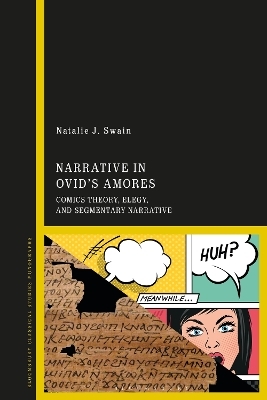
Narrative in Ovid's Amores
Comics Theory, Elegy, and Segmentary Narrative
Seiten
2026
Bloomsbury Academic (Verlag)
978-1-350-40724-4 (ISBN)
Bloomsbury Academic (Verlag)
978-1-350-40724-4 (ISBN)
Examines Ovid’s Amores through a comics-based methodology to demonstrate how Latin elegy uses its segmented format to build narrative across sequences and books of individual poems.
How are comics and Latin elegy related? Comics tell their stories by placing individual images in a sequence, and Latin elegy builds narrative through sequence, encouraging readers to connect poems in order to reveal narrativity. Despite this, there has yet to be a definitive methodology that inspires readers to examine the function of this narrative tool. Examining Ovid’s Amores, Swain argues a comics-based methodology can offer us important new insights into the ancient genre of Latin elegy.
This book applies theories such as the gutter (the space that exists between two comics panels), Groensteen’s braiding (the interaction of panels outside of a linear sequence), and the comics page-turn, all to release new readings that reveal the narrative found across the three books of this text. By analysing the way that Ovid creates a complex narrative mosaic in which key characters and motifs repeat across poems, this book explores how story segments are connected into a larger unified narrative.
How are comics and Latin elegy related? Comics tell their stories by placing individual images in a sequence, and Latin elegy builds narrative through sequence, encouraging readers to connect poems in order to reveal narrativity. Despite this, there has yet to be a definitive methodology that inspires readers to examine the function of this narrative tool. Examining Ovid’s Amores, Swain argues a comics-based methodology can offer us important new insights into the ancient genre of Latin elegy.
This book applies theories such as the gutter (the space that exists between two comics panels), Groensteen’s braiding (the interaction of panels outside of a linear sequence), and the comics page-turn, all to release new readings that reveal the narrative found across the three books of this text. By analysing the way that Ovid creates a complex narrative mosaic in which key characters and motifs repeat across poems, this book explores how story segments are connected into a larger unified narrative.
Natalie J. Swain is an Instructor in Classics at the University of Winnipeg, Canada. She has published on Latin literature and the reception of the ancient Mediterranean world in comics.
Dedication
Acknowledgements
Introduction: More than a Sum of Its Parts
1. Reading the Elegiac Gutter
2. Braiding Narrative Motifs... or “Innertextuality”
3. An Exception that Proves the Rule
4. Turn the Page
Conclusion: Beyond Snapshots
Glossary
Notes
Bibliography
Index
| Erscheinungsdatum | 05.12.2025 |
|---|---|
| Zusatzinfo | 11 bw illus |
| Verlagsort | London |
| Sprache | englisch |
| Maße | 156 x 234 mm |
| Themenwelt | Literatur ► Comic / Humor / Manga |
| Literatur ► Klassiker / Moderne Klassiker | |
| Geisteswissenschaften ► Geschichte ► Regional- / Ländergeschichte | |
| Geisteswissenschaften ► Sprach- / Literaturwissenschaft ► Anglistik / Amerikanistik | |
| Geisteswissenschaften ► Sprach- / Literaturwissenschaft ► Literaturwissenschaft | |
| ISBN-10 | 1-350-40724-0 / 1350407240 |
| ISBN-13 | 978-1-350-40724-4 / 9781350407244 |
| Zustand | Neuware |
| Informationen gemäß Produktsicherheitsverordnung (GPSR) | |
| Haben Sie eine Frage zum Produkt? |
Mehr entdecken
aus dem Bereich


aus dem Bereich
die Geschichte meiner Urgroßmutter
Buch | Hardcover (2025)
C.H.Beck (Verlag)
CHF 32,15
Träume und Macht : eine Biografie
Buch | Hardcover (2025)
C.H.Beck (Verlag)
CHF 61,60


