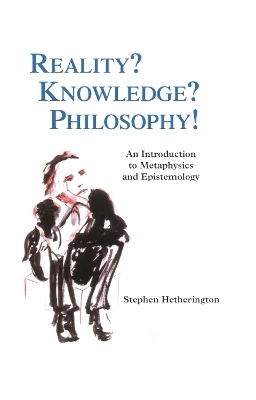
Reality? Knowledge? Philosophy!
Edinburgh University Press (Verlag)
978-0-7486-1665-7 (ISBN)
Fundamentally, what are we? And what, if anything, do we know? Minds, bodies; free will; evil; meaningful lives; harmful deaths: do such properties make us whatever we are? Truth; rationality; fallibility; knowledge; observation, reason; sceptical doubts: are these also vital to our being whatever we are? You do not understand yourself and others until you have done battle with those questions. And Reality? Knowledge? Philosophy! shows you how to do that. It can help you to gain a better philosophy of people’s lives. Become a better person too. Be surprised at how easily your thinking philosophically about reality and knowledge can lead to your reflecting on life’s ethical complications.Features* Offers a new way of approaching metaphysics and epistemology – via links to ethical and social questions.* Readable, clear and engaging.* Encourages discussion and independent thought.* Blends thought-provoking theories with questions applicable to everyday life.
Stephen Hetherington is an Associate Professor of Philosophy at the University of New South Wales, in Sydney, Australia. He has written three books on epistemology - Epistemology's Paradox (1992), Knowledge Puzzles (1996), and Good Knowledge, Bad Knowledge (2001).
Preface; Using This Book; Acknowledgments; 1.Persons; 1.1 Physicalism; 1.2 Immaterialism; 1.3 Dualism; 1.4 Questions of personal identity; 1.5 'No longer the same person'; 1.6 Conventionalism; 1.7 Descartes on what persons are; 1.8 Locke on personal identity; 1.9 Hume on personal identity; Further reading; 2. Free Will; 2.1 Determinism; 2.2 Fatalism; 2.3 What is free will?; 2.4 Indeterminism; 2.5 Evidence of free will?; 2.6 Moral responsibility; 2.7 Foreknowledge; 2.8 Hume's compatibilism; Further reading; 3. God and Evil; 3.1 The traditional problem of evil; 3.2 The world as a whole; 3.3 The evidence-problem of evil; 3.4 The free will defence; 3.5 Socrates's challenge; 3.6 Evil within people?; Further reading; 4. Life's Meaning; 4.1 Criteria of meaning?; 4.2 The myth of Sisyphus; 4.3 Plato's cave; 4.4 Nozick's machines; 4.5 Living ethically; 4.6 Living philosophically; 4.7 Aristotle on the best way to live; Further reading; 5. Death's Harm; 5.1 Objective harm?; 5.2 Epicurus and Lucretius on being dead; 5.3 Being deprived by being dead?; 5.4 Dying; 5.5 Never dying; 5.6 Brain death; Further reading;; 6. Properties; 6.1 The problem of universals; 6.2 Platonic Forms; 6.3 Label nominalism; 6.4 Class nominalism; 6.5 Resemblance nominalism; 6.6 Individualised properties; 6.7 Essentialism; Further reading; 7. Truth; 7.1 Caring about truth as such; 7.2 Correspondence; 7.3 Coherence; 7.4 Pragmatism; 7.5 Disagreement; 7.6 Claiming truth; 7.7 Social constructivism; 7.8 Social facts; Further reading; 8. Well Supported Views; 8.1 Objective support; 8.2 Fallibilism; 8.3 Reliabilism; 8.4 Popper and testability; 8.5 Intellectual virtue; 8.6 Agreement; 8.7 Epistemic relativism; Further reading; 9. Knowledge; 9.1 Knowledge's objectivity; 9.2 A traditional conception of knowledge; 9.3 Gettier's challenge; 9.4 Avoiding false evidence; 9.5 Knowing luckily; 9.6 Gradualism; 9.7 Fallible knowledge; 9.8 Education; 9.9 Taking knowledge seriously; Further reading; 10. Observational Knowledge; 10.1 Purely observational knowledge; 10.2 Observational limits?; 10.3 Empiricism; 10.4 Representationalism; 10.5 Berkeley's idealism; 10.6 Phenomenalism; 10.7 Perception and reliability; 10.8 Hume on causation; 10.9 Non-inferential knowledge; Further reading; 11. Pure Reason; 11.1 Rationalism; 11.2 A priori knowledge; 11.3 Plato's rationalism; 11.4 Descartes's rationalist method; 11.5 Kant on a priori knowledge; 11.6 Mill's radical empiricism; 11.7 Logical empiricism; 11.8 Fallible a priori knowledge; Further reading; 12. Sceptical Doubts; 12.1 Blended knowledge?; 12.2 Scepticisms; 12.3 Descartes's dreaming argument; 12.4 Descartes's evil genius; 12.5 Hume on induction; 12.6 Other minds; 12.7 Being freely rational; 12.8 Moore and commonsense; 12.9 Knowing fallibly; 12.10 Improved knowledge; 12.11 What you are; Further reading.
| Erscheint lt. Verlag | 11.8.2003 |
|---|---|
| Verlagsort | Edinburgh |
| Sprache | englisch |
| Maße | 156 x 234 mm |
| Gewicht | 274 g |
| Themenwelt | Geisteswissenschaften ► Philosophie ► Erkenntnistheorie / Wissenschaftstheorie |
| Geisteswissenschaften ► Philosophie ► Metaphysik / Ontologie | |
| ISBN-10 | 0-7486-1665-9 / 0748616659 |
| ISBN-13 | 978-0-7486-1665-7 / 9780748616657 |
| Zustand | Neuware |
| Informationen gemäß Produktsicherheitsverordnung (GPSR) | |
| Haben Sie eine Frage zum Produkt? |
aus dem Bereich