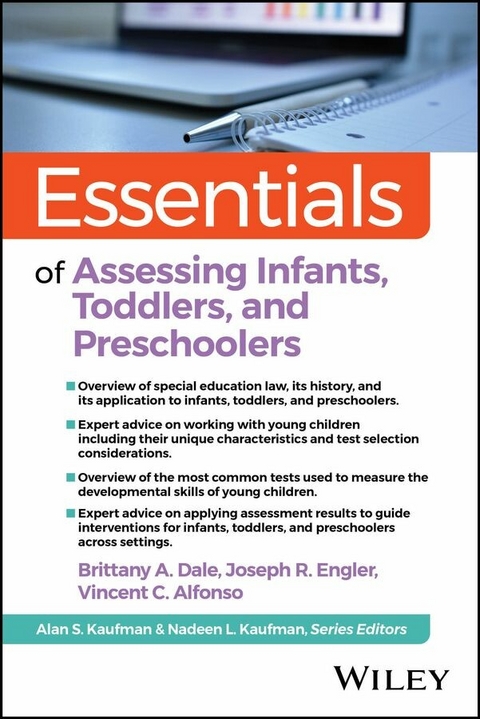
Essentials of Assessing Infants, Toddlers, and Preschoolers (eBook)
463 Seiten
Wiley (Verlag)
978-1-394-15208-7 (ISBN)
A practitioner-oriented guide to the most important assessments and evaluation techniques for children ages 0-5
Many assessment professionals leave their graduate education programs without any formal training in assessing infants and young children. Although there are assessment textbooks covering subsets of this age range, Essentials of Assessing Infants, Toddlers, and Pre-Schoolers is uniquely designed for busy practitioners, and it covers the full range of assessments for 0-5 years old.
With medical advances and new treatments, there is a higher prevalence of children with complex medical and psychological needs. Additionally, changing educational policies often affect assessment practices. Assessment professionals must have current information to effectively assess young children and assist in planning interventions. As with all volumes in the Essentials of Psychological Assessment series, this book consists of concise chapters featuring callout boxes highlighting key concepts, easy-to-learn bullet points, and extensive illustrative material, as well as test questions that help you gauge and reinforce your grasp of the information covered.
- Understand the issues unique to assessing children aged 0-5 years
- Get expert advice on assessing children with extremely early preterm birth, genetic conditions, and other unique situations
- Consider the future directions in the assessment of infants, toddlers, and preschoolers
- Quickly and easily locate pertinent information and access resources and tools to aid in performing professional duties
This straightforward manual includes thorough coverage on how assessment results guide effective interventions. Essentials of Assessing Infants, Toddlers, and Pre-Schoolers is a valuable addition to the libraries of developmental practitioners, school and clinical psychologists, pediatricians, speech-language pathologists, and others responsible for the assessment of very young children.
BRITTANY A. DALE, PH.D., HSPP, is an Associate Professor of Special Education - Autism at Ball State University. She is a licensed psychologist and school psychologist who specializes in the identification and assessment of neurodevelopmental disorders such as attention-deficit/hyperactivity disorder, autism spectrum disorder, and learning disabilities. Dr. Dale serves as the Clinical Supervisor in the Center for Autism Spectrum Disorders where local families can obtain diagnostic evaluations. Additionally, she is developing an Educational Advocacy Program to provide parent training in special education advocacy. Her research focuses on how special populations perform on various assessments used in psychoeducational evaluations.
JOSEPH R. ENGLER, PH.D., is a Professor of School Psychology and Associate Dean in the School of Education at Gonzaga University in Spokane, Washington. Dr. Engler received his B.A. from Minot State University in Minot, North Dakota and his Ph.D. from the University of South Dakota in Vermillion, South Dakota. Dr. Engler is a nationally certified school psychologist and has practiced throughout the United States. He has held professional association positions at the state and national level. His scholarly pursuits involve preschool assessment, SLD identification, and the role of parent involvement in education. He is a co-author on Essentials of Bayley-4 Assessment.
VINCENT C. ALFONSO, PH.D., is Dean of the College for Education and Engaged Learning at Montclair State University. This past August Dr. Alfonso began his term as president of the Trainers of School Psychologists. Dr. Alfonso is Fellow of Divisions 16, 5, and 43 of the American Psychological Association and Fellow of the Association for Psychological Science. In May 2021, Dr. Alfonso received the faculty award for Professional Contributions from Gonzaga University. Dr. Alfonso has published scholarly work for more than 30 years. His major areas of scholarly work are developmental disabilities including specific learning disabilities, early childhood assessment and intervention, and applied psychometrics. Two Wiley co-authored publications include the 2022 Essentials of Bayley-4 Assessment and soon-to-be published Essentials of Assessing Infants, Toddlers, and Preschoolers.
A practitioner-oriented guide to the most important assessments and evaluation techniques for children ages 0-5 Many assessment professionals leave their graduate education programs without any formal training in assessing infants and young children. Although there are assessment textbooks covering subsets of this age range, Essentials of Assessing Infants, Toddlers, and Pre-Schoolers is uniquely designed for busy practitioners, and it covers the full range of assessments for 0-5 years old. With medical advances and new treatments, there is a higher prevalence of children with complex medical and psychological needs. Additionally, changing educational policies often affect assessment practices. Assessment professionals must have current information to effectively assess young children and assist in planning interventions. As with all volumes in the Essentials of Psychological Assessment series, this book consists of concise chapters featuring callout boxes highlighting key concepts, easy-to-learn bullet points, and extensive illustrative material, as well as test questions that help you gauge and reinforce your grasp of the information covered. Understand the issues unique to assessing children aged 0-5 years Get expert advice on assessing children with extremely early preterm birth, genetic conditions, and other unique situations Consider the future directions in the assessment of infants, toddlers, and preschoolers Quickly and easily locate pertinent information and access resources and tools to aid in performing professional duties This straightforward manual includes thorough coverage on how assessment results guide effective interventions. Essentials of Assessing Infants, Toddlers, and Pre-Schoolers is a valuable addition to the libraries of developmental practitioners, school and clinical psychologists, pediatricians, speech-language pathologists, and others responsible for the assessment of very young children.
Two
UNIQUE CONSIDERATIONS AND FACTORS IN ASSESSING AND EVALUATING YOUNG CHILDREN
Assessing and evaluating (i.e., interpreting) young children's (i.e., 0–60 months) performance are two of the most rewarding experiences for those who engage in working with them, but at the same time, are not without unique considerations, factors, and, at times, challenges (Alfonso et al., 2022; Snow & Van Hemel, 2008), which is the primary focus of this chapter. As noted by Alfonso, Ruby, et al. (2020) assessing and evaluating young children are very different than assessing and evaluating school‐age children or adolescents. For example, many young children do not have sustained attention spans, can be awkward physically (e.g., gross motor functioning that is not coordinated), and have limited expressive language skills.
These characteristics are not problematic as they are typical of young children (Bergen & Woodin, 2011; Bracken & Theodore, 2020a; Brassard & Boehm, 2007; Fletcher, 2011; Sattler, 2018). Nevertheless, these characteristics and several others, along with unique considerations and factors, make assessing and evaluating young children challenging, requiring examiners to keep these variables in mind when working with them. This is especially pertinent during direct assessments such as when administering standardized, norm‐referenced tests like the Bayley Scales of Infant and Toddler Development, Fourth Edition (Bayley‐4; Alfonso et al., 2022; Aylward, 2020; Bayley & Aylward, 2019). Of course, examiners also administer rating scales, conduct interviews, and engage in behavioral observations (see Alfonso, Engler, et al., 2020 and Hojnoski & Missall, 2020 for further discussion of assessment methods). However, these methods tend to be more straightforward and often involve working with adults in the young child's life (Bracken & Theodore, 2020a).
This chapter introduces readers to many considerations, factors, and characteristics of young children to bear in mind when assessing and evaluating them. These considerations and factors are grouped into three categories: logistical, examiner, and child. In addition, a section of this chapter covers the characteristics of young children. Each category and its characteristics are discussed in the context of how they may impact the young child's assessment or test performance. Finally, we provide a discussion, albeit brief, on quantitative and qualitative characteristics of standardized, norm‐referenced tests as they continue to be used with young children (Benson et al., 2019; Oakland et al., 2016), even though some scholars question or do not support this method of assessment (e.g., Bagnato & Neisworth, 1994; Goodman, 1990; Lidz, 2002; Macy & Bagnato, 2013). Although each section of this chapter could very well be a chapter on its own, space limitations preclude in‐depth discussions of all concepts and topics herein. Interested readers may find other sources helpful as they delve into the world of assessing and evaluating young children. Some of these sources include Alfonso et al. (2022), Alfonso, Bracken, et al. (2020), Alfonso and Flanagan (1999, 2009), Bracken and Theodore (2020a,b), Bradley‐Johnson and Johnson (2007), Brassard and Boehm (2007), Engler and Alfonso (2020); Lidz (2002), Losardo and Notari‐Syverson (2011), Mowder et al. (2009), Nuttall (1999), and Sattler (2018).
LOGISTICAL CONSIDERATIONS AND FACTORS
There are a few critical logistical considerations and factors that can impact the young child's assessment or test performance as well as the examiner's evaluation of that performance. These include the assessment or testing location and materials, duration of the assessment or testing, and the presence of caregivers. Bracken and Theodore (2020b) discussed these at length; they are discussed briefly here and listed in Rapid Reference 2.1.
Rapid Reference 2.1 Logistical Considerations and Factors That May Affect a Young Child's Performance
- Assessment or testing location and materials
- Duration of assessment or testing
- Presence of caregivers
Assessment or Testing Location and Materials
Typically, when examiners are assessing or testing school‐age children or adolescents, they do so in schools or other educational settings that may or may not be suitable for the activity depending on resources. Nevertheless, these activities take place primarily in schools and most likely do not include caregivers or other professionals in the room (Sattler, 2018). Although young children may be assessed or tested in various educational settings, it is not uncommon for them to take place in the child's home, the examiner's office, or a medical facility (Bayley & Aylward, 2019). These locations may or may not be familiar to the young child and thus can certainly affect performance. A rule of thumb in young children's assessment is to engage in a multi‐source, multi‐method, and multi‐setting paradigm (Alfonso, Engler, et al., 2020). This paradigm assists in obtaining reliable and valid assessment data and evaluation of the young child as there should be ample data from which to draw conclusions and make data‐based recommendations.
Bracken and Theodore (2020b) stated, “The effective assessment environment should be cheerful, convey safety, capitalize on the child's curiosity, and stimulate the child's participation. For a testing environment to do these things, it must be child‐centered and friendly, and accommodate the needs of young children” (p. 66). Included in an effective assessment or testing environment are the furniture and table/chair arrangement, decorations, limited distractions, and climate control. For example, space for young children should include appropriately sized furniture that is comfortable and a table/chair arrangement that is conducive to engaging the young child and creating a safe assessment situation (Raiford & Coalson, 2014). It is not uncommon, however, for the assessment or testing to take place on the floor as that may be more comfortable and conducive for a reliable and valid assessment (Alfonso et al., 2005). For example, young children with physical challenges may be more comfortable on the floor (Sattler, 2018). Of course, the floor must be clean and if possible have carpeting that does not hamper the child's mobility.
In addition, assessment locations should be appealing with bright colored walls, toys, and other fun items for young children to assist with establishing and maintaining rapport (Bracken & Theodore, 2020b; Sattler, 2018). It is important, however, that assessment and testing locations are free from as many internal and external distractions as possible such as overly stimulating rooms or a location that is next to where there are many extraneous noises, respectively (Alfonso et al., 2022; Bayley & Aylward, 2019; Brassard & Boehm, 2007; Raiford & Coalson, 2014). Finally, the assessment or testing location should not be too hot or too cold as to interfere with the young child's performance or the examiner conducting a reliable and valid assessment. The temperature should be just right for the child and examiner.
Duration of the Assessment or Testing
Examiners must be aware of the young child's attention span, motivation, and any medical concerns when conducting the assessment or testing because these and other factors discussed later in this chapter may affect performance. All told, however, the direct, interactive assessment (i.e., testing) of young children should be kept to a time that ensures maximizing the validity of the results. This time (period) may range from as brief as 30 minutes to a longer time of 60 or more minutes depending on the child, materials used, and skillset of the examiner (Bayley & Aylward, 2019; Raiford & Coalson, 2014). Some measures for young children are highly engaging such as the Bayley‐4 (Alfonso et al., 2022). An older test that is no longer used, but the genius creation of Dorothea McCarthy, the McCarthy Scales of Children's Abilities (MSCA; McCarthy, 1972) incorporated physical activity in the middle of the testing and at the same time assessed fine and gross motor functioning of the young child (Kaufman, 1977). Examiners should not be fearful of assessing or testing the young child over two or even three sessions as this may be necessary for some children and increase the validity of assessment results (Alfonso et al., 2005, 2022). Other methods of assessing young children such as rating scales or interviews with caregivers can take place at times other than the direct, interactive testing of the child.
Presence of Caregivers or Other Professionals
We believe that assessment or testing of young children should not be a mystery to their caregivers or other professionals working with them. It is critical that caregivers are included in the assessment and even present in the room where the assessment or testing takes place (Alfonso et al., 2005). This is somewhat different from decades ago when it...
| Erscheint lt. Verlag | 5.3.2025 |
|---|---|
| Reihe/Serie | Essentials of Psychological Assessment |
| Sprache | englisch |
| Themenwelt | Geisteswissenschaften ► Psychologie ► Test in der Psychologie |
| Schlagworte | assessment book • Assessment infants • assessment preschool • assessment toddlers • children psychological assessment • children psychological intervention • essentials of psychological assessment • school psychologist • speech-language pathologist |
| ISBN-10 | 1-394-15208-6 / 1394152086 |
| ISBN-13 | 978-1-394-15208-7 / 9781394152087 |
| Informationen gemäß Produktsicherheitsverordnung (GPSR) | |
| Haben Sie eine Frage zum Produkt? |
 EPUB (Adobe DRM)
Kopierschutz: Adobe-DRM
Adobe-DRM ist ein Kopierschutz, der das eBook vor Mißbrauch schützen soll. Dabei wird das eBook bereits beim Download auf Ihre persönliche Adobe-ID autorisiert. Lesen können Sie das eBook dann nur auf den Geräten, welche ebenfalls auf Ihre Adobe-ID registriert sind.
Details zum Adobe-DRM
Dateiformat: EPUB (Electronic Publication)
EPUB ist ein offener Standard für eBooks und eignet sich besonders zur Darstellung von Belletristik und Sachbüchern. Der Fließtext wird dynamisch an die Display- und Schriftgröße angepasst. Auch für mobile Lesegeräte ist EPUB daher gut geeignet.
Systemvoraussetzungen:
PC/Mac: Mit einem PC oder Mac können Sie dieses eBook lesen. Sie benötigen eine
eReader: Dieses eBook kann mit (fast) allen eBook-Readern gelesen werden. Mit dem amazon-Kindle ist es aber nicht kompatibel.
Smartphone/Tablet: Egal ob Apple oder Android, dieses eBook können Sie lesen. Sie benötigen eine
Geräteliste und zusätzliche Hinweise
Buying eBooks from abroad
For tax law reasons we can sell eBooks just within Germany and Switzerland. Regrettably we cannot fulfill eBook-orders from other countries.
aus dem Bereich