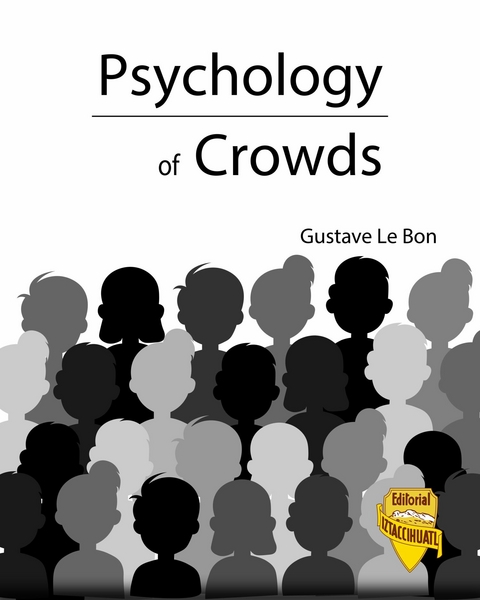
Psychology of Crowds (eBook)
256 Seiten
Iztaccíhuatl (Verlag)
979-8-3129-6399-1 (ISBN)

Gustave Le Bon (1841-1931) was a French social psychologist and author of The Crowd: A Study of the Popular Mind. He explored mass psychology, collective behavior, and the influence of leaders on crowds, contributing to early theories of group dynamics and political influence.
Gustave Le Bon (1841–1931) was a French social psychologist and author of The Crowd: A Study of the Popular Mind. He explored mass psychology, collective behavior, and the influence of leaders on crowds, contributing to early theories of group dynamics and political influence.
Between the extreme limits of this series would find a place all the forms of prestige resulting from the different elements composing a civilisation—sciences, arts, literature, &c.—and it would be seen that prestige constitutes the fundamental element of persuasion. Consciously or not, the being, the idea, or the thing possessing prestige is immediately imitated in consequence of contagion, and forces an entire generation to adopt certain modes of feeling and of giving expression to its thought. This imitation, moreover, is, as a rule, unconscious, which accounts for the fact that it is perfect. The modern painters who copy the pale colouring and the stiff attitudes of some of the Primitives are scarcely alive to the source of their inspiration. They believe in their own sincerity, whereas, if an eminent master had not revived this form of art, people would have continued blind to all but its naive and inferior sides. Those artists who, after the manner of another illustrious master, inundate their canvasses with violet shades do not see in nature more violet than was detected there fifty years ago; but they are influenced, "suggestioned," by the personal and special impressions of a painter who, in spite of this eccentricity, was successful in acquiring great prestige. Similar examples might be brought forward in connection with all the elements of civilisation.
It is seen from what precedes that a number of factors may be concerned in the genesis of prestige; among them success was always one of the most important. Every successful man, every idea that forces itself into recognition, ceases, ipso facto, to be called in question. The proof that success is one of the principal stepping-stones to prestige is that the disappearance of the one is almost always followed by the disappearance of the other. The hero whom the crowd acclaimed yesterday is insulted to-day should he have been overtaken by failure. The reaction, indeed, will be the stronger in proportion as the prestige has been great. The crowd in this case considers the fallen hero as an equal, and takes its revenge for having bowed to a superiority whose existence it no longer admits. While Robespierre was causing the execution of his colleagues and of a great number of his contemporaries, he possessed an immense prestige. When the transposition of a few votes deprived him of power, he immediately lost his prestige, and the crowd followed him to the guillotine with the self-same imprecations with which shortly before it had pursued his victims. Believers always break the statues of their former gods with every symptom of fury.
Prestige lost by want of success disappears in a brief space of time. It can also be worn away, but more slowly by being subjected to discussion. This latter power, however, is exceedingly sure. From the moment prestige is called in question it ceases to be prestige. The gods and men who have kept their prestige for long have never tolerated discussion. For the crowd to admire, it must be kept at a distance.
CHAPTER IV
LIMITATIONS OF THE VARIABILITY OF THE BELIEFS AND OPINIONS OF CROWDS
1. FIXED BELIEFS. The invariability of certain general beliefs—They shape the course of a civilisation—The difficulty of uprooting them—In what respect intolerance is a virtue in a people—The philosophic absurdity of a belief cannot interfere with its spreading. 2. THE CHANGEABLE OPINIONS OF CROWDS. The extreme mobility of opinions which do not arise from general beliefs—Apparent variations of ideas and beliefs in less than a century—The real limits of these variations—The matters effected by the variation—The disappearance at present in progress of general beliefs, and the extreme diffusion of the newspaper press, have for result that opinions are nowadays more and more changeable—Why the opinions of crowds tend on the majority of subjects towards indifference—Governments now powerless to direct opinion as they formerly did—Opinions prevented to-day from being tyrannical on account of their exceeding divergency.
1. FIXED BELIEFS
A close parallel exists between the anatomical and psychological characteristics of living beings. In these anatomical characteristics certain invariable, or slightly variable, elements are met with, to change which the lapse is necessary of geological ages. Side by side with these fixed, indestructible features are to be found others extremely changeable, which the art of the breeder or horticulturist may easily modify, and at times to such an extent as to conceal the fundamental characteristics from an observer at all inattentive.
The same phenomenon is observed in the case of moral characteristics. Alongside the unalterable psychological elements of a race, mobile and changeable elements are to be encountered. For this reason, in studying the beliefs and opinions of a people, the presence is always detected of a fixed groundwork on which are engrafted opinions as changing as the surface sand on a rock.
The opinions and beliefs of crowds may be divided, then, into two very distinct classes. On the one hand we have great permanent beliefs, which endure for several centuries, and on which an entire civilisation may rest. Such, for instance, in the past were feudalism, Christianity, and Protestantism; and such, in our own time, are the nationalist principle and contemporary democratic and social ideas. In the second place, there are the transitory, changing opinions, the outcome, as a rule, of general conceptions, of which every age sees the birth and disappearance; examples in point are the theories which mould literature and the arts—those, for instance, which produced romanticism, naturalism, mysticism, &c. Opinions of this order are as superficial, as a rule, as fashion, and as changeable. They may be compared to the ripples which ceaselessly arise and vanish on the surface of a deep lake.
The great generalised beliefs are very restricted in number. Their rise and fall form the culminating points of the history of every historic race. They constitute the real framework of civilisation.
It is easy to imbue the mind of crowds with a passing opinion, but very difficult to implant therein a lasting belief. However, a belief of this latter description once established, it is equally difficult to uproot it. It is usually only to be changed at the cost of violent revolutions. Even revolutions can only avail when the belief has almost entirely lost its sway over men's minds. In that case revolutions serve to finally sweep away what had already been almost cast aside, though the force of habit prevented its complete abandonment. The beginning of a revolution is in reality the end of a belief.
The precise moment at which a great belief is doomed is easily recognisable; it is the moment when its value begins to be called in question. Every general belief being little else than a fiction, it can only survive on the condition that it be not subjected to examination.
But even when a belief is severely shaken, the institutions to which it has given rise retain their strength and disappear but slowly. Finally, when the belief has completely lost its force, all that rested upon it is soon involved in ruin. As yet a nation has never been able to change its beliefs without being condemned at the same time to transform all the elements of its civilisation. The nation continues this process of transformation until it has alighted on and accepted a new general belief: until this juncture it is perforce in a state of anarchy. General beliefs are the indispensable pillars of civilisations; they determine the trend of ideas. They alone are capable of inspiring faith and creating a sense of duty.
Nations have always been conscious of the utility of acquiring general beliefs, and have instinctively understood that their disappearance would be the signal for their own decline. In the case of the Romans, the fanatical cult of Rome was the belief that made them masters of the world, and when the belief had died out Rome was doomed to die. As for the barbarians who destroyed the Roman civilisation, it was only when they had acquired certain commonly accepted beliefs that they attained a measure of cohesion and emerged from anarchy.
Plainly it is not for nothing that nations have always displayed intolerance in the defence of their opinions. This intolerance, open as it is to criticism from the philosophic standpoint, represents in the life of a people the most necessary of virtues. It was to found or uphold general beliefs that so many victims were sent to the stake in the Middle Ages and that so many inventors and innovators have died in despair even if they have escaped martyrdom. It is in defence, too, of such beliefs that the world has been so often the scene of the direst disorder, and that so many millions of men have died on the battlefield, and will yet die there.
There are great difficulties in the way of establishing a general belief, but when it is definitely implanted its power is for a long time to come invincible, and however false it be philosophically it imposes itself upon the most luminous intelligence. Have not the European peoples regarded as incontrovertible for more than fifteen centuries religious legends which, closely examined, are as barbarous[21] as those of Moloch? The frightful absurdity of the legend of a God who revenges himself for the disobedience of one of his creatures by inflicting horrible tortures on his son remained unperceived during many centuries. Such potent geniuses as a Galileo, a Newton, and a Leibnitz never supposed for an instant that the truth of such dogmas could be called in question. Nothing can be more typical than this fact of the hypnotising effect of general beliefs, but at...
| Erscheint lt. Verlag | 5.3.2025 |
|---|---|
| Verlagsort | Ciudad de México |
| Sprache | englisch |
| Themenwelt | Geisteswissenschaften ► Psychologie ► Sozialpsychologie |
| Schlagworte | Collective Mind. • Crowd Behavior • Groupthink • Gustave Le Bon • Influence • Leadership • Manipulation • Mass influence • mass psychology • Social Psychology |
| ISBN-13 | 979-8-3129-6399-1 / 9798312963991 |
| Informationen gemäß Produktsicherheitsverordnung (GPSR) | |
| Haben Sie eine Frage zum Produkt? |
 EPUB (Ohne DRM)
Digital Rights Management: ohne DRM
Dieses eBook enthält kein DRM oder Kopierschutz. Eine Weitergabe an Dritte ist jedoch rechtlich nicht zulässig, weil Sie beim Kauf nur die Rechte an der persönlichen Nutzung erwerben.
Dateiformat: EPUB (Electronic Publication)
EPUB ist ein offener Standard für eBooks und eignet sich besonders zur Darstellung von Belletristik und Sachbüchern. Der Fließtext wird dynamisch an die Display- und Schriftgröße angepasst. Auch für mobile Lesegeräte ist EPUB daher gut geeignet.
Systemvoraussetzungen:
PC/Mac: Mit einem PC oder Mac können Sie dieses eBook lesen. Sie benötigen dafür die kostenlose Software Adobe Digital Editions.
eReader: Dieses eBook kann mit (fast) allen eBook-Readern gelesen werden. Mit dem amazon-Kindle ist es aber nicht kompatibel.
Smartphone/Tablet: Egal ob Apple oder Android, dieses eBook können Sie lesen. Sie benötigen dafür eine kostenlose App.
Geräteliste und zusätzliche Hinweise
Buying eBooks from abroad
For tax law reasons we can sell eBooks just within Germany and Switzerland. Regrettably we cannot fulfill eBook-orders from other countries.
aus dem Bereich