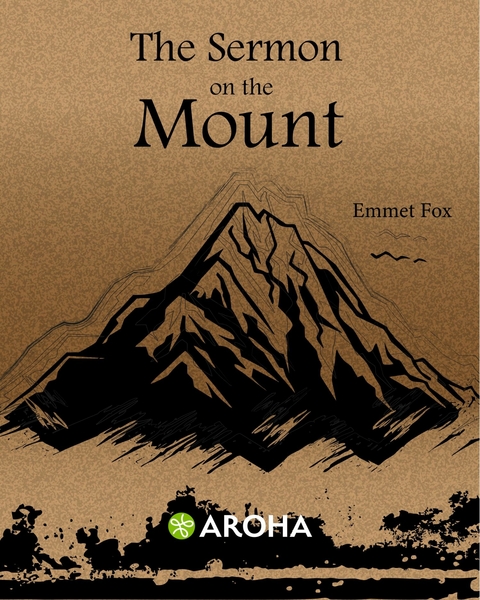
The Sermon on the Mount (eBook)
264 Seiten
Aroha (Verlag)
979-8-3130-7976-9 (ISBN)
Emmet Fox (1886-1951) was an Irish New Thought teacher and spiritual writer, known for The Sermon on the Mount. His works emphasize positive thinking, divine power, and personal transformation through faith, influencing self-help movements and spiritual development.
Emmet Fox (1886–1951) was an Irish New Thought teacher and spiritual writer, known for The Sermon on the Mount. His works emphasize positive thinking, divine power, and personal transformation through faith, influencing self-help movements and spiritual development.
The Beatitudes
And seeing the multitudes, he went up into a mountain: and when he was set, his disciples came unto him:
And he opened his mouth, and taught them, saying,
Blessed are the poor in spirit: for theirs is the kingdom of heaven.
Blessed are they that mourn: for they shall be comforted.
Blessed are the meek: for they shall inherit the earth.
Blessed are they which do hunger and thirst after righteousness: for they shall be filled.
Blessed are the merciful: for they shall obtain mercy.
Blessed are the pure in heart: for they shall see God.
Blessed are the peacemakers: for they shall be called the children of God.
Blessed are they which are persecuted for righteousness’ sake: for theirs is the kingdom of heaven.
Blessed are ye, when men shall revile you, and persecute you, and shall say all manner of evil against you falsely, for my sake.
Rejoice, and be exceeding glad: for great is your reward in heaven: for so persecuted they the prophets which were before you.
(MATTHEW V)
THE Sermon on the Mount opens with the Eight Beatitudes. This, of course, is one of the best-known sections of the Bible. Even people whose knowledge of the Scriptures is confined to half a dozen of the most familiar chapters are sure to know the Beatitudes. They hardly ever understand them, unfortunately, and as a rule look upon them as a counsel of perfection, without any real application to everyday life. But this is only because they lack the Spiritual Key.
The Beatitudes are actually a prose poem in eight verses which is complete in itself, and it constitutes what is practically a general summary of the whole Christian teaching. It is a spiritual, more than a literary synopsis, summarizing the spirit of the teaching rather than the letter. A general summing up, such as this, is highly characteristic of the old Oriental mode of approach to a religious and philosophical teaching, and it naturally recalls the Eight-fold Path of Buddhism, the Ten Commandments of Moses, and other such compact groupings of ideas.
Jesus concerned himself exclusively with the teaching of general principles, and these general principles always had to do with mental states, for he knew that if one’s mental states are right, everything else must be right too, whereas, if these are wrong, nothing else can be right. Unlike the other great religious teachers, he gives us no detailed instructions about what we are to do or are not to do; he does not tell us either to eat or to drink, or to refrain from eating or drinking certain things; or to carry out various ritual observances at certain times and seasons. Indeed, the whole current of his teaching is anti-ritualistic anti-formalist. He had little patience at any time with the Jewish priesthood and its theory of salvation through the Temple observances. “The hour cometh when ye shall neither in this mountain, nor yet at Jerusalem, worship the Father…. The hour cometh and now is when the true worshipper shall worship the Father in spirit and in truth; for the Father seeketh such to worship him. God is spirit and they that worship him must worship Him in spirit and in truth.”
The Pharisees, with their appalling code of outward detailed observances, were the only people towards whom he was really intolerant. A conscientious Pharisee of those days—and most of them were extremely conscientious, according to their lights—had an enormous number of outer details to attend to every day before he could feel that he had satisfied the requirements of God. A modern rabbi has estimated the number of such details at not less than six hundred, and as it is obvious that no human being could really carry out this sort of thing in practice, the natural result would be that the victim, conscious of falling far short of the accomplishment of his duties, must necessarily labor under a chronic sense of sin. Now, to believe yourself to be sinful is, for practical purposes, to be sinful, with all the consequences that follow upon that condition. The policy of Jesus contrasts with this in that his object is rather to wean the heart from relying upon outer things at all, either for pleasurable gratification or for spiritual salvation, and to inculcate a new attitude of mind altogether; and this policy is graphically set forth in the Beatitudes.
Blessed are the poor in spirit: for theirs is the kingdom of heaven.
Here, in the very beginning, we have to take into account a point of great practical importance in the study or the Bible, namely, that is written in a peculiar idiom of its own, and that terms and expressions, and sometimes actual words, are used in the Bible in a sense that is distinctly different from that of everyday usage. This is quite apart from the fact, for which we have also to be on the lookout, that certain English words have changed in meaning since the Bible was translated.
The Bible is really a textbook of metaphysics, a manual for the growth of the soul, and it looks at all questions from this point of view. It is impossible to emphasize this point too much. For this reason it takes the broadest view of every subject. It sees all things in their relationship to the human soul, and it uses many common terms in a far wider sense than that given to them by common use. For example, the word “bread” in the Bible means, not merely any kind of physical food, which is the broadest interpretation that is put upon it in general literature, but all things that man requires—all physical things, such as clothing, shelter, money, education, companionship, and so forth; and, above all, it stands for spiritual things such as spiritual perception, spiritual understanding, and preeminently spiritual realization. “Give us this day our daily bread.” “I am the bread of life.” “Unless ye eat this bread….”
Another example is the word “prosperity.” In the scriptural sense, “prosperity,” and “prosper,” signify a very great deal more than the acquirement of material possessions. They really mean success in prayer. From the point of view of the soul, success in prayer is the only kind of prosperity worth having: and if our prayers are successful, we shall naturally have all the material things that we need. A certain quantity of material goods is essential on this plane, of course, but material wealth is really the least important thing in life, and this the Bible implies by giving the word “prosperous” its true meaning.
To be poor in spirit does not in the least mean the thing we call “poor spirited” nowadays. To be poor in spirit means to have emptied yourself of all desire to exercise personal self-will, and, what is just as important, to have renounced all preconceived opinions in the wholehearted search for God. It means to be willing to set aside your present habits of thought, your present views and prejudices, your present way of life if necessary; to jettison, in fact, anything and everything that can stand in the way of your finding God.
One of the saddest passages in all literature is the story of the Rich Young Man who missed one of the great opportunities of history, and “turned away sorrowful because he had great possessions.” This is really the story of mankind in general. We reject the salvation that Jesus offers us—our chance of finding God—because we “have great possessions” not in the least because we are very rich in terms of money, for indeed most people are not, but because we have great possessions in the way of preconceived ideas—confidence in our own judgment, and in the ideas with which we happen to be familiar; spiritual pride, born of academic distinction; sentimental or material attachment to institutions and organizations; habits of life that we have no desire to renounce; concern for human respect, or perhaps fear of public ridicule; or a vested interest in worldly honor and distinction. And these possessions keep us chained to the rock of suffering that is our exile from God.
The Rich Young Man is one of the most tragic figures in history; not because he happened to be wealthy, for wealth in itself is neither good nor bad, but because his heart was enslaved by that love of money which Paul tells us is the root of all evil. He could have been a multimillionaire in silver and gold, and, as long as his heart was not set upon it, he would have been just as free as the poorest beggar to enter the Kingdom of Heaven. His trust, however, was in his riches, and this shut the gate.
Why was not the Christ Message received with acclaim by the Ecclesiastics of Jerusalem? Because they had great possessions—possessions of Rabbinical learning, possessions of public honor and importance, authoritative offices as the official teachers of religion—and these possessions they would have had to sacrifice in order to accept the spiritual teaching. The humble and unlearned folk who heard the Master gladly were happy in having no such possessions to tempt them away from the Truth.
Why was it in modern times when the same simple Christ Message of the immanence and availability of God, and of the Inner Light that burns forever in the soul of man, once more made its appearance in the world, it was again, for the most part, among the simple and unlettered that it was gladly received? Why was it not the Bishops, and Deans, and Moderators, and Ministers, and Presbyteries, who gave it to the world? Why was not Oxford, or Cambridge, or Harvard, or Heidelberg, the great broadcasting...
| Erscheint lt. Verlag | 6.3.2025 |
|---|---|
| Verlagsort | Ciudad de México |
| Sprache | englisch |
| Themenwelt | Geisteswissenschaften ► Religion / Theologie ► Christentum |
| Schlagworte | Beatitudes • Bible • Christianity • Compassion • ethics • Faith • Jesus • Morality. • Spirituality • Teachings • wisdom |
| ISBN-13 | 979-8-3130-7976-9 / 9798313079769 |
| Informationen gemäß Produktsicherheitsverordnung (GPSR) | |
| Haben Sie eine Frage zum Produkt? |
 EPUB (Ohne DRM)
Digital Rights Management: ohne DRM
Dieses eBook enthält kein DRM oder Kopierschutz. Eine Weitergabe an Dritte ist jedoch rechtlich nicht zulässig, weil Sie beim Kauf nur die Rechte an der persönlichen Nutzung erwerben.
Dateiformat: EPUB (Electronic Publication)
EPUB ist ein offener Standard für eBooks und eignet sich besonders zur Darstellung von Belletristik und Sachbüchern. Der Fließtext wird dynamisch an die Display- und Schriftgröße angepasst. Auch für mobile Lesegeräte ist EPUB daher gut geeignet.
Systemvoraussetzungen:
PC/Mac: Mit einem PC oder Mac können Sie dieses eBook lesen. Sie benötigen dafür die kostenlose Software Adobe Digital Editions.
eReader: Dieses eBook kann mit (fast) allen eBook-Readern gelesen werden. Mit dem amazon-Kindle ist es aber nicht kompatibel.
Smartphone/Tablet: Egal ob Apple oder Android, dieses eBook können Sie lesen. Sie benötigen dafür eine kostenlose App.
Geräteliste und zusätzliche Hinweise
Buying eBooks from abroad
For tax law reasons we can sell eBooks just within Germany and Switzerland. Regrettably we cannot fulfill eBook-orders from other countries.
aus dem Bereich