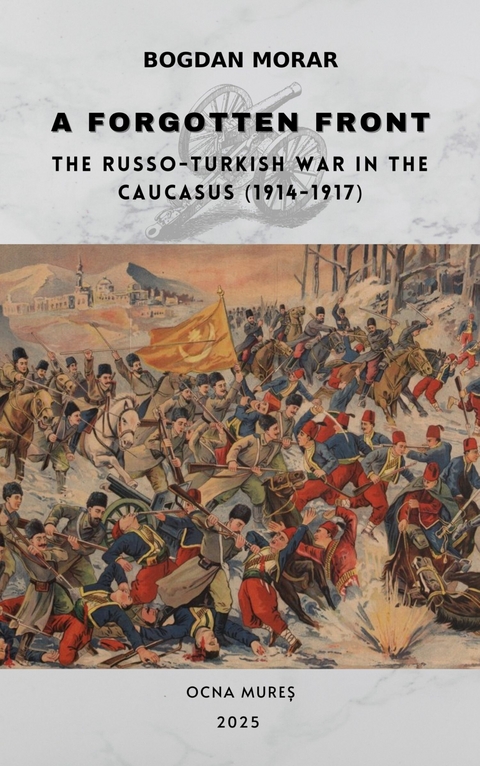
A Forgotten Front (eBook)
271 Seiten
Morar Bogdan (Verlag)
9789730415162 (ISBN)
Witness to numerous battles throughout history, the Caucasus endured another harsh war between November 1914 and December 1917. This work, about 'a quasi - ignored front, makes known to the public, to a greater extent, a particularly important segment of the history of the First World War in the eastern parts of Europe, at the confluence with Asia, a front that had a considerable role in the equation of the deployment of forces between Turkey and Russia' ( prof. univ. dr. Ioan Bolovan). At the same time, the book also deals with other related topics: the military operations in Persia (1915 - 1917), the connection of the Russian front in the Caucasus with the British one in Mesopotamia (Iraq) and, last but not least, the deportation and massacre of Armenians in Eastern Anatolia.
Preface
“The mountain range that stretches from the Taman Peninsula to the Apheron Peninsula is called the Caucasus or the Greater Caucasus. In a broader sense, the Caucasus includes the entire isthmus that separates the Black Sea from the Caspian Sea. The terms Ciscaucasia and Transcaucasia are of Russian origin. Ciscaucasia designates the territories that, from Russia, are located on this side of the Greater Caucasus and Transcaucasia, those located on the other side (the current republics of Georgia, Armenia and Azerbaijan)”1. Trampled by Mongol, Persian, Ottoman or Russian armies, this connecting area between Europe and Africa has been the scene of numerous battles throughout history. Most of the Caucasus came under the rule of the Russian Empire in the mid-19th century. In the period 1850-1900 Ciscaucasia and Transcaucasia witnessed a great process of emigration when the local Muslims were helped by the Russians to leave their homeland. Their place was taken mainly by Russians, Cossacks and Armenians.
In the 19th century, a series of wars took place between the Russian and Ottoman Empires. In each of these wars, the Tsarist troops faced the Turkish ones on the Caucasian Front. The losses suffered by Turkey after the war of 1877-1878 paved the way for Turkey's entry into the First World War. Again, the Caucasus became the scene of another war between the empires mentioned above. This book presents the events that took place in the First World War on the Caucasian Front from a military point of view. At the same time, the book also provides the reader with an analysis of the situation of the Ottoman Empire in the period preceding its entry into the war precisely so that the reader can understand why this empire entered the First World War and why it fought again with Russia in the Caucasus. The subject of the Caucasus campaign during the First World War has not been addressed in many works in universal military historiography. This is because the Russian-Ottoman Front in the Caucasus was of interest only to Russian and Turkish historians. As a result, the most important books that have dealt with this subject are in Turkish and Russian. The research work that made this book possible led me to divide the sources I had access to into the following categories:
a. works whose authors participated in the battles on the Caucasian Front and reported the events as truthfully as possible:
1. N.G. Korsun2, Первая Мировая Война на Кавказском Фронте. Оперативно-стратегический очерк (The First World War on the Caucasian Front 1914-1917, Strategic and Operational Outline), Military Publishing House of the U.S.S.R., 1946. The author, who was an officer of the RAC, made full use of the archive of the former Caucasian Military District from which he obtained valuable data that helped him in writing the book. Probably this book of N.G. Korsun is the most complete and concise work dealing with the Caucasian Front of the First World War. In this way I would like to thank the administrators of the militera.lib.ru website who made a special effort to make this particularly important work available to interested readers;
2. N.G. Korsun, Сарыкамышская Операция (Sarikamish Operation), Publishing House of the Commissariat of Defense of the USSR, Moscow, 1937;
3. N.G. Korsun, Эрзерумская Операция (Erzurum Operation), Publishing House of the Commissariat of Defense of the USSR, Moscow, 1938;
4. E.V. Maslovski3, Великая война на Кавказском Фронте. 1914-1917 гг. (The Great War on the Caucasian Front. 1914-1917), Publishing House Vece, Moscow, 2015. E.V. Maslovsky was a direct participant in all military operations on the Caucasian Front in the period 1914-1917. He praised in his book the role played by gen. Yudenich in all the important battles that took place in the Caucasus. After the victory of the Bolsheviks in Russia, E.V. Maslovsky was forced to emigrate to France. The first edition of the book was published in Paris in 1933. Being far from Russia the author did not have access to the archives and had to rely on the memoirs of former colleagues in the Caucasian Army to reconstruct some of the events he recounted in his book.
5. Felix Guse4, Birinci Dünya Savaşi’nda Kafkas Cephesi’ndeki Muharebeler (Battles on the Caucasian Front in the First World War), Turkish Army General Staff Printing House, Ankara, 2007. Felix Guse was the Chief of Staff of the 3rd Ottoman Army on the Caucasus Front. His memoirs are particularly important for finding out the Ottoman and German versions of what happened on this front during the First World War.
6. Ali Ihsan (Sâbis)5, Harp Hatıralarım Birinci Cihan Harbi (My Memories of the First World War), vol. I and II, Nehir Yayınlan, Istanbul, 1990.
7. V.L. Levitsky, На Кавказском фронте Первой Мировой. Воспоминания капитана 155-го пехотного Кубинского полка. 1914–1917 (On the Caucasian Front of the First World War. Memoirs of a captain of the 155th Kuba infantry regiment 1914–1917), Kuchkovo Pole Publishing House, Moscow, 2014.
8. Garegin Pasdermadjian, Why Armenia should be free, Hairenik Publishing Company, Boston, 1918.
b. works developed based on information about the Caucasian Front obtained from Russian or Turkish Archives:
1. A.M. Zaionchikovski6, Первая Мировая Война 1914–1918 гг. (First World War 1914-1918), Poligon Publishing House, St. Petersburg, 2002. The author, a general of the Tsarist army, participated in the military operations of the First World War as commander of an army on the Romanian Front. As a historian, A.M. Zaionchikovskiy reported on the events on some fronts of the First World War either as a direct participant or based on orders, dispatches and notes issued by the Stavka.
2. Birinci Dünya Harbi’nde Türk Harbi Kafkas Cephesi (The Turkish Caucasus Front in the First World War - operations of the 3rd Ottoman Army), Turkish Army General Staff Printing House, Books I and II, Ankara, 1993. It is a book printed in Ankara by military history specialists from the Turkish Army General Staff. For the events on the Caucasian Front, the authors made full use of the ATASE archive.
3. Вооруженные Силы России в Первой Мировой Войне 1914–1917 (Russian Armed Forces in the First World War 1914-1917), vol. I and II, Megapolis Publishing House, Moscow, 2014. The work mainly used information from the RGVIA archive to recount in as much detail as possible the events on all the fronts on which Tsarist Russia fought in the First World War.
c. works based on information obtained from other event participants:
1. W.E.D. Allen, Paul Muratoff, Caucasian Battlefields, a history of the wars on the Turkish-Caucasian border, 1828-1921, Cambridge University Press, New York, 1953. The authors wrote the book in 1953. The information was collected by W.E.D. Allen from Turkey7 and by Paul Muratoff from a number of former Russian military commanders who emigrated to Western Europe.
2. Anton A. Kersnovski, История русской армии (History of the Russian Army), vol. IV, Golos Publishing House, Moscow, 1994. One of the best and most documented books on the Tsarist army. It contains valuable information about the Russian troops who fought on the Caucasus front during World War I. The author emigrated to Serbia in 1920 and then to France. His most important book, History of the Russian Army, was originally published in Belgrade between 1933 and 1938.
3. P.N. Strelianov (Kalabuhov), Казаки в Персии 1909-1918 rr. (Cossacks in Persia, 1909-1918), Tsentrpoligraf Publishing House, Moscow, 2007;
4. Edward J. Erickson, Ordered to die, a history of the Ottoman Army in the First World War, Greenwood Publishing, Westport, 2001. The author, a gen. of U.S. Army who served in NATO troops deployed in Turkey, wrote this book based mainly on Ottoman sources. Since some of the Turkish archives are still blocked, we can assume that the author did not have all the information necessary for his study to be complete.
d. memoirs of some members of the armies allied with Turkey who were in the Ottoman Empire during the First World War:
1. Otto Liman von Sanders, Five years in Turkey, United States Naval Institute, Annapolis, 1927. An excellent memoir by the head of the German Military Mission in the Ottoman Empire from 1913 to 1918. This german gen., who led the Ottoman troops during the Gallipoli Operation (1915-1916), criticized the way the Turkish troops were organized on the Caucasus Front. With very few reservations, the information provided by Otto Liman von Sanders can be taken into account for the preparation of the present work.
2. Joseph Pomiankovski, Der...
| Erscheint lt. Verlag | 25.2.2025 |
|---|---|
| Sprache | englisch |
| Themenwelt | Sachbuch/Ratgeber ► Geschichte / Politik ► Allgemeines / Lexika |
| Geschichte ► Allgemeine Geschichte ► 1918 bis 1945 | |
| Schlagworte | Caucasus • First World War • Ottoman Empire • Russian Empire |
| ISBN-13 | 9789730415162 / 9789730415162 |
| Informationen gemäß Produktsicherheitsverordnung (GPSR) | |
| Haben Sie eine Frage zum Produkt? |
 EPUB (Ohne DRM)
Digital Rights Management: ohne DRM
Dieses eBook enthält kein DRM oder Kopierschutz. Eine Weitergabe an Dritte ist jedoch rechtlich nicht zulässig, weil Sie beim Kauf nur die Rechte an der persönlichen Nutzung erwerben.
Dateiformat: EPUB (Electronic Publication)
EPUB ist ein offener Standard für eBooks und eignet sich besonders zur Darstellung von Belletristik und Sachbüchern. Der Fließtext wird dynamisch an die Display- und Schriftgröße angepasst. Auch für mobile Lesegeräte ist EPUB daher gut geeignet.
Systemvoraussetzungen:
PC/Mac: Mit einem PC oder Mac können Sie dieses eBook lesen. Sie benötigen dafür die kostenlose Software Adobe Digital Editions.
eReader: Dieses eBook kann mit (fast) allen eBook-Readern gelesen werden. Mit dem amazon-Kindle ist es aber nicht kompatibel.
Smartphone/Tablet: Egal ob Apple oder Android, dieses eBook können Sie lesen. Sie benötigen dafür eine kostenlose App.
Geräteliste und zusätzliche Hinweise
Buying eBooks from abroad
For tax law reasons we can sell eBooks just within Germany and Switzerland. Regrettably we cannot fulfill eBook-orders from other countries.
aus dem Bereich