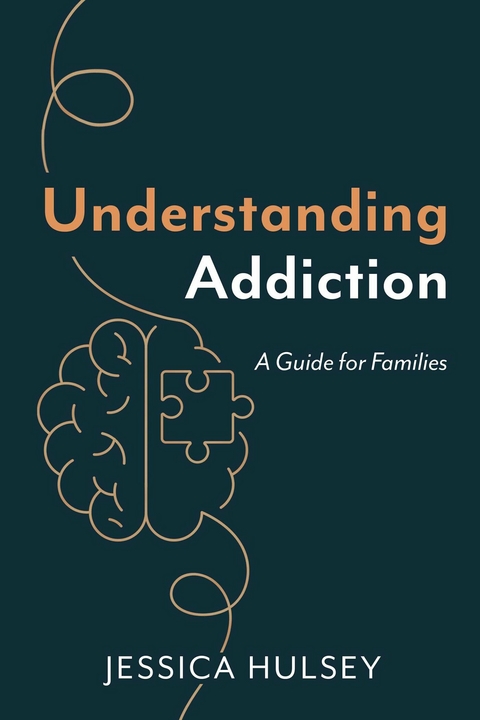
Understanding Addiction (eBook)
328 Seiten
Bookbaby (Verlag)
979-8-3509-8526-9 (ISBN)
Jessica Hulsey is the founder of the Addiction Policy Forum, a national nonprofit organization that helps patients, families, and communities affected by the disease. She is a national expert with more than 25 years in the field and has worked with America's top scientists to translate the science of addiction into digestible information for patients, families, and other key audiences. Jessica has conducted numerous CME trainings for medical professionals and other key stakeholder groups, including judicial leaders, corrections officials and staff, prosecutors, law enforcement, families impacted by addiction and nurses and other health care professionals. Jessica's career focusing on addiction comes from personal experience. Both her parents struggled with heroin addiction, which led to homelessness, foster care, and eventually her mother's incarceration, after which she was raised by her grandparents. Jessica began working in the field at 15 years old through a community anti-drug coalition in southern California, then continued through national boards, speaking engagements, and moving to Washington, DC after graduating from Princeton in 1998. She has hosted forums and drug policy events with Presidents, spoken at the Presidents' Summit for America's Future with former presidents, and was profiled in a book by Governor John Kasich (R-Ohio) called 'Courage Is Contagious: Ordinary People Doing Extraordinary Things to Change the Face of America'. Jessica has been featured in a Lifetime Network series, Discovery Health Channel profile, Cosmopolitan, LA Times, NY Times, MSNBC, and USA Today. She has also testified before the House Ways and Means Committee and The President's Commission on the Opioid Crisis, as well as the U.S. Senate's Committee on Health, Education, Labor and Pensions and the U.S. House of Representatives' Committee on Energy and Commerce. Prior to that, Jessica worked on the passage of the Comprehensive Addiction and Recovery Act, the Second Chance Act, and the Drug-Free Communities Act. Jessica serves on the HEAL Community Partner Committee, the DEA Educational Foundation Board of Directors, Ohio Governor Mike DeWine's Recovery Ohio Advisory Council, and OneFifteen's Advisory Council. She also previously served on the National Advisory Council on Drug Abuse (NACDA) for the National Institute on Drug Abuse (NIDA).
In "e;Understanding Addiction: A Guide for Families,"e; Jessica Hulsey shares her own family's struggles with addiction to help dispel myths and misinformation about addiction. Based on decades of research and experience, she offers pragmatic suggestions for dealing with substance use disorders, from understanding levels of severity and diagnosis, evidence-based treatment options, relapse prevention strategies, and resources for family members. This is more than just a guidebook, it's a bridge to understanding addiction through a health lens, a clear explanation of the science, and offers concrete resources on how to approach difficult conversations with a loved one about their substance use disorder. The guide includes tools to tackle damaging misinformation, from "e;tough love"e; strategies to waiting for someone to hit rock bottom. This compassionate guide will show you how to support someone with a substance use disorder.
Chapter 1:
Addiction 101
How My Education Started
My understanding of addiction happened through motherhood, of all things. I had that intense new-mom obsession with all three of my sons, which hasn’t subsided much. My firstborn, Conner, came two weeks early, a surprise. Thirteen hours of labor, all sweaty and exhausted, decked out in a tan hospital room, residents buzzing around, traceable by the squeaks of their shoes on the linoleum floors. I marveled at him, resting on my stomach, eyes already open. But in a blink, the nurses were carrying him down the hallway to bask in some lights since he had a bit of jaundice. Fifteen minutes passed, then 20, and by the 30-minute mark, I was vibrating with a new, unexpected frenzy. The nurses intervened as I was scooting to the side of the bed, wrapping cords and IVs around the wheeled pole by my bed, ready to use it to stomp down the halls in search of my baby. Even there in the hospital room, family and friends milling about to welcome him, when they would ask to hold him, I had to resist the instinct to hiss. I would joke that when I blinked my eyes, I would see his adorable, round, pudgy face as if it were tattooed to the back of my eyelids. It may have been hormone-induced, regular run-of-the-mill mom-crushing, but I was in love. He was my everything. The world seemed to shine brighter with him in it, brighter still when his little brothers would arrive over the next four years.
For Jack, my second-born, they said at his preschool that it was the most intense case of separation anxiety they’d ever seen when he started school at two years old. I was relieved to hear this, as the feeling was mutual. After five hours on day one, the poor teachers broke down and finally called me; gingerly suggesting that it was time for me to come and pick him up. I arrived to carry a still-inconsolable little cutie, bereft at just a few hours apart. Jack’s first sentence was “Only mommy,” which sorta summed it up. We finally tackled those tsunami-sized separation waves by making what we called magic necklaces, where every week I would use a picture of us together and decorate it up with a frame and glitter and stickers to hang around his neck on a piece of yarn. When he would miss me, I told him, I would magically be with him through our necklace. And then Tyler, my baby. The first night he finally slept in his crib I crawled in and slept beside him, all contorted to fit into the crib, my back pressed up against the slats watching him breathe. A few days later I graduated from the crib to sleeping on the floor of his nursery, my husband walking in and chuckling at the ridiculous enormity of my love and attachment to our youngest.
Being their mom is the central thing in my life. The rest of the world seemed to have softer edges with my boys in the frame, my focus affixed. And this—motherhood—was my prelude to finally understanding addiction.
One night while doing laundry, folding one of those adorable little baby sacks they wear so you could skip the buttons in the middle of the night and just plop down the bag-like skirt over the fresh diaper and secret them back to bed. That night, smelling the clean scent of a caterpillar get-up, marveling over my boys, I thought of my own mom with me as a baby, her firstborn. How enormous is this love I feel, how enormous must the power of addiction be to overcome that? All she missed. The thought left me breathless, imagining any power on earth that could overwhelm this. For me perhaps it wasn’t my heart, but my empathy, my ability to feel for the first time just a glimmer of what the power of addiction just might be, a hijacker who had kept us apart for so long, who had stolen these moments from me and my mom, from climbing into cribs to making magic necklaces. How immense and ferocious must addiction be to outweigh even motherhood? Maybe I had had ice or a wall around my heart, self-protection from lack of understanding, hurt or disbelief.
So, I set out to learn about addiction, how it can overwhelm the most primal, fundamental parts of us, like motherhood. My grandma had been right, it’s a disease, and I dug into learning and translating what that meant and how it affects those struggling with the illness.
Addiction and the Brain
I found a famous scientist in the addiction field, Dr. Nora Volkow, a Mexican-born neuroscientist with curly, untamed blonde hair that has too much energy to lie down. The head of the agency at the National Institutes of Health (NIH) that studies addiction, Nora spoke to me unpretentiously and patiently. I had so many questions. As a psychiatrist, she had been intrigued by the behaviors of patients she saw who struggled with addiction. In the 1990s, she started running brain scans of those struggling with addiction, and they showed the effects of substance use disorders. The scans, blobs of yellow, blue, and red. The proof. Like other diseases, from heart disease to cancer, the scans showed the physiological effects of addiction. She taught me that there are two main parts of the brain affected by drug use: the limbic system and the cortex. It sounded like Latin to my unscientific ears, but I learned.
Addiction can change the brain’s survival hardwiring – the dopamine reward system.
Turns out the limbic system—this primal, mammalian part of the brain—is responsible for our basic survival instincts. When we humans do the most basic, fundamental things to stay alive—like eat, drink, find shelter, have sex, or care for our young—our brains reinforce these behaviors through a release of dopamine from this region. Pleasure. Reward. Then we record a memory of that feeling so we seek it again. This is our survival hardwiring. And then there is the pre-frontal cortex, which is what separates us from other animals and controls decision-making and impulse control. When you use drugs or alcohol, the same dopamine process in the survival center activates. And with too much use, that substance can hijack that part of the brain. It changes the brain and weakens this reward-producing survival contraption to make it believe that the primary need for survival is the drug—more important than food, than shelter, than taking care of your baby. And the hijacker is hungry, it needs more and more to reach the same level of reward or feeling of pleasure, so the brain becomes increasingly damaged.
Hijacker. Addiction. That which can override even our maternal instincts. All the whys, the confusion, the hurt, explained by one petite, lovely scientist and her pictures of the brain. The answer to the mystery.
I thawed, like an unexpected warm day in winter. I felt the weight of being stricken with anything that could possibly outweigh my love for my son. It left me speechless. I called my mom, drawn to her for more connection, but also to signal a deep moment of sadness for what she had endured. And I truly found my mom, the lines of her becoming clearer through motherhood, my heart breaking for her and all she had lost. It began a chain reaction of forgiveness and closeness. It blossomed, slowly at first, and then lavishly, like something amazing that had been buried under a heap of dirt to surprise all passersby when it unfurls, lovely.
Epiphanies in books and movies are so simple, tidy. One beautifully written scene that reveals enormous character growth in one beautifully described moment. Like Scrooge in Dicken’s Christmas Carol, an epiphany after visits from the ghosts of Christmas past, present and future, which transformed his view of his life and how he treats the people in it. George Bailey’s epiphany in Frank Capra’s It’s a Wonderful Life, realizing all that he has and all that he’d accomplished, the little things we take for granted that have an immense impact. Or Dumbo’s epiphany, realizing it wasn’t the feather that made him fly at all. Finally understanding addiction, a health condition, a disease, was my epiphany.
Understanding Substance Use Disorders
Throughout this book, we’ll dig into key topics about addiction and answer common questions that family members and caregivers have about substance use disorders (SUD), the medical term for addiction. This isn’t an excerpt from a medical textbook or a scientific journal. Instead, I’ve sat down with physicians and researchers in the addiction field to translate the science into understandable terms that I hope you find helpful.
The medical term for addiction is a substance use disorder (SUD).
The first thing to note is that this is a very common illness in the United States, with millions of families currently struggling. You and your family are not alone. Almost half of Americans report having a family member or close friend with an addiction, and more than 48 million people aged 12 or older—one in six people in the United States—meet the diagnostic criteria for a substance use disorder.1 In comparison, there are approximately 30 million people in the United States with heart disease, 29 million people with a diabetes diagnosis, and 2 million new cancer cases each year.
Addiction is characterized by a loss of control over a person’s substance use and continued use despite consequences.
Addiction is a medical condition that affects the brain and can change a person’s behavior. It’s...
| Erscheint lt. Verlag | 17.4.2025 |
|---|---|
| Sprache | englisch |
| Themenwelt | Geisteswissenschaften ► Psychologie ► Sucht / Drogen |
| ISBN-13 | 979-8-3509-8526-9 / 9798350985269 |
| Informationen gemäß Produktsicherheitsverordnung (GPSR) | |
| Haben Sie eine Frage zum Produkt? |
 EPUB (Ohne DRM)
Größe: 1,4 MB
Digital Rights Management: ohne DRM
Dieses eBook enthält kein DRM oder Kopierschutz. Eine Weitergabe an Dritte ist jedoch rechtlich nicht zulässig, weil Sie beim Kauf nur die Rechte an der persönlichen Nutzung erwerben.
Dateiformat: EPUB (Electronic Publication)
EPUB ist ein offener Standard für eBooks und eignet sich besonders zur Darstellung von Belletristik und Sachbüchern. Der Fließtext wird dynamisch an die Display- und Schriftgröße angepasst. Auch für mobile Lesegeräte ist EPUB daher gut geeignet.
Systemvoraussetzungen:
PC/Mac: Mit einem PC oder Mac können Sie dieses eBook lesen. Sie benötigen dafür die kostenlose Software Adobe Digital Editions.
eReader: Dieses eBook kann mit (fast) allen eBook-Readern gelesen werden. Mit dem amazon-Kindle ist es aber nicht kompatibel.
Smartphone/Tablet: Egal ob Apple oder Android, dieses eBook können Sie lesen. Sie benötigen dafür eine kostenlose App.
Geräteliste und zusätzliche Hinweise
Buying eBooks from abroad
For tax law reasons we can sell eBooks just within Germany and Switzerland. Regrettably we cannot fulfill eBook-orders from other countries.
aus dem Bereich