


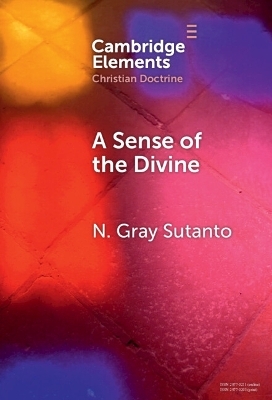
A Sense of the Divine
An Affective Model of General Revelation from the Reformed Tradition
Seiten
2025
Cambridge University Press (Verlag)
978-1-009-52788-0 (ISBN)
Cambridge University Press (Verlag)
978-1-009-52788-0 (ISBN)
How should one make sense of the Christian confession that God has instilled a 'sense of divinity' in every person? This Element advances an affective model of general revelation, which draws from the writings of the neo-Calvinist branch of the Reformed tradition.
How should one make sense of the Christian confession that God has instilled a 'sense of divinity' in every person? While other approaches have identified the sense with a perceptual or cognitive faculty or with the empirical reports of theistic belief, this Element advances an affective model of general revelation, which draws from the writings of the neo-Calvinist branch of the Reformed tradition. The author argues that the sense of divinity refers to an implanted 'feeling of divinity', a sensus numinis, and that this model makes better sense of the Christian witness, theologically re-orients the empirical findings from the cognitive science of religion, and eludes influential objections against the doctrine of general revelation.
How should one make sense of the Christian confession that God has instilled a 'sense of divinity' in every person? While other approaches have identified the sense with a perceptual or cognitive faculty or with the empirical reports of theistic belief, this Element advances an affective model of general revelation, which draws from the writings of the neo-Calvinist branch of the Reformed tradition. The author argues that the sense of divinity refers to an implanted 'feeling of divinity', a sensus numinis, and that this model makes better sense of the Christian witness, theologically re-orients the empirical findings from the cognitive science of religion, and eludes influential objections against the doctrine of general revelation.
1. General Revelation: The Questions and Initial Statement; 2. A Minimal Account: Historical Witnesses; 3. An Affective Model of General Revelation; 4. Re-Orienting the Findings of the Cognitive Science of Religion: Affect and Propositions; 5. Can Knowledge Precede Propositions? On Phenomenology; 6. Objections: Barth, Schilder, and McFarland; 7. Conclusion.
| Erscheinungsdatum | 13.05.2025 |
|---|---|
| Reihe/Serie | Elements in Christian Doctrine |
| Zusatzinfo | Worked examples or Exercises |
| Verlagsort | Cambridge |
| Sprache | englisch |
| Themenwelt | Religion / Theologie ► Christentum ► Kirchengeschichte |
| ISBN-10 | 1-009-52788-6 / 1009527886 |
| ISBN-13 | 978-1-009-52788-0 / 9781009527880 |
| Zustand | Neuware |
| Informationen gemäß Produktsicherheitsverordnung (GPSR) | |
| Haben Sie eine Frage zum Produkt? |
Mehr entdecken
aus dem Bereich


aus dem Bereich
eine andere Geschichte der Papststadt
Buch | Softcover (2024)
C.H.Beck (Verlag)
CHF 25,20
die Macht des Dunklen in unserer Zeit und wie wir ihr entgegentreten
Buch | Hardcover (2025)
Verlag Herder
CHF 27,90


