


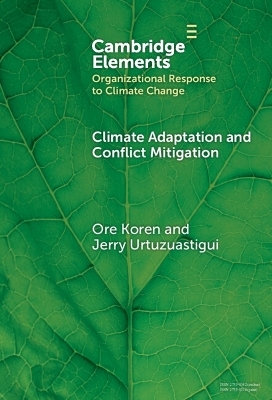
Climate Adaptation and Conflict Mitigation
The Case of South Sudan
Seiten
2025
Cambridge University Press (Verlag)
978-1-009-51076-9 (ISBN)
Cambridge University Press (Verlag)
978-1-009-51076-9 (ISBN)
The Element analyzes how international nongovernmental organizations' (INGO) climate adaptation interventions influence civil war and local social conflicts. It draws on original high-resolution data on INGO-driven adaptation and food security efforts, alongside climate, conflict, and development data.
As climate change intensifies, conflict-prone tropical regions face heightened vulnerabilities, yet little is known about how climate adaptation and food security efforts affect conflict dynamics. Using South Sudan – a country highly susceptible to climate stress and conflict – as a test case, this Element analyzes how international nongovernmental organizations' (INGO) climate adaptation interventions influence civil war and local social conflicts. It develops a theoretical framework linking climate adaptation to conflict, positing both positive and negative externalities. Drawing on original high-resolution data on INGO-driven adaptation and food security efforts, alongside climate, conflict, and development data, findings are substantiated with interviews from policy workers in South Sudan. The results indicate that while adaptation generally does not reduce conflict, interventions that promote preparedness and are implemented during periods of high climate stress can mitigate social conflicts between militias, pastoralists, and farmers. These insights provide guidance for designing climate adaptation strategies that reduce conflict risks.
As climate change intensifies, conflict-prone tropical regions face heightened vulnerabilities, yet little is known about how climate adaptation and food security efforts affect conflict dynamics. Using South Sudan – a country highly susceptible to climate stress and conflict – as a test case, this Element analyzes how international nongovernmental organizations' (INGO) climate adaptation interventions influence civil war and local social conflicts. It develops a theoretical framework linking climate adaptation to conflict, positing both positive and negative externalities. Drawing on original high-resolution data on INGO-driven adaptation and food security efforts, alongside climate, conflict, and development data, findings are substantiated with interviews from policy workers in South Sudan. The results indicate that while adaptation generally does not reduce conflict, interventions that promote preparedness and are implemented during periods of high climate stress can mitigate social conflicts between militias, pastoralists, and farmers. These insights provide guidance for designing climate adaptation strategies that reduce conflict risks.
1. Introduction; 2. Typology and definitions; 3. Pathways to conflict and conflict mitigation; 4. Empirical analysis; 5. Lessons for climate and climate adaptation-conflict research and policy; 6. Conclusion; References.
| Erscheinungsdatum | 31.05.2025 |
|---|---|
| Reihe/Serie | Organizational Response to Climate Change: Businesses, Governments |
| Zusatzinfo | Worked examples or Exercises |
| Verlagsort | Cambridge |
| Sprache | englisch |
| Gewicht | 296 g |
| Themenwelt | Geschichte ► Teilgebiete der Geschichte ► Militärgeschichte |
| Naturwissenschaften ► Biologie ► Ökologie / Naturschutz | |
| Sozialwissenschaften ► Politik / Verwaltung | |
| ISBN-10 | 1-009-51076-2 / 1009510762 |
| ISBN-13 | 978-1-009-51076-9 / 9781009510769 |
| Zustand | Neuware |
| Informationen gemäß Produktsicherheitsverordnung (GPSR) | |
| Haben Sie eine Frage zum Produkt? |
Mehr entdecken
aus dem Bereich



aus dem Bereich
von der Wiederbewaffnung bis zur Zeitenwende
Buch | Softcover (2025)
C.H.Beck (Verlag)
CHF 16,80
von der Frühen Neuzeit bis zur Gegenwart
Buch | Hardcover (2025)
C.H.Beck (Verlag)
CHF 69,85


