


Youth Development in Context (eBook)
IX, 137 Seiten
Springer-Verlag
978-3-031-80549-3 (ISBN)
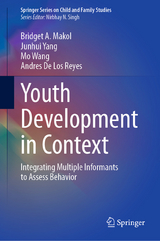
This book investigates the most common approach to assessing behavior in youth development. It explores use of multiple informants who each observe youth in the social contexts that typify their everyday lives, including parents, teachers, peers, and youth themselves. The volume characterizes the most common outcome from taking this assessment approach — the discrepant results or estimates about behavior that informants’ reports often produce. Grounded in the Operations Triad Model — the foundational framework for contemporary scholarship about discrepant results — this book focuses on strategies that discrepant results compel scholars to implement, namely strategies for integrating these results. The book highlights that the integrative strategies scholars have historically used prevent them from capitalizing on the valid data that discrepant results often contain. This authoritative, thoroughly resourced, and methodologically rigorous book provides readers with integrative strategies that align with scholarship in youth development. In doing so, the book provides readers with a paradigm for testing competing data integration strategies, using a sophisticated suite of Monte Carlo Simulation and measurement validation tools that are applicable to a host of assessment scenarios in scholarship on youth development.
Key areas of coverage include:
- Use of multiple informants to assess behavior in youth development.
- The frequent observation of discrepant results when assessing behavior in youth development.
- Theoretical models for explaining discrepant results in behavior assessments and how they inform strategies for integrating assessment data.
- Key distinctions in the assumptions that underlie the use of competing integrative strategies.
- Application of Monte Carlo Simulation strategies for testing competing integrative strategies.
- Implementation of measurement validation strategies that put competing integrative strategies to the test, within data conditions that typify research in youth development.
Youth Development in Context is an essential resource for researchers, professors, graduate students as well as clinicians, therapists, and other professionals in developmental psychology, social work, public health, pediatrics, family studies, child and adolescent psychiatry, school and educational psychology, and all interrelated disciplines.
This book investigates the most common approach to assessing behavior in youth development. It explores use of multiple informants who each observe youth in the social contexts that typify their everyday lives, including parents, teachers, peers, and youth themselves. The volume characterizes the most common outcome from taking this assessment approach — the discrepant results or estimates about behavior that informants’ reports often produce. Grounded in the Operations Triad Model — the foundational framework for contemporary scholarship about discrepant results — this book focuses on strategies that discrepant results compel scholars to implement, namely strategies for integrating these results. The book highlights that the integrative strategies scholars have historically used prevent them from capitalizing on the valid data that discrepant results often contain. This authoritative, thoroughly resourced, and methodologically rigorous book provides readers with integrative strategies that align with scholarship in youth development. In doing so, the book provides readers with a paradigm for testing competing data integration strategies, using a sophisticated suite of Monte Carlo Simulation and measurement validation tools that are applicable to a host of assessment scenarios in scholarship on youth development.
Key areas of coverage include:
- Use of multiple informants to assess behavior in youth development.
- The frequent observation of discrepant results when assessing behavior in youth development.
- Theoretical models for explaining discrepant results in behavior assessments and how they inform strategies for integrating assessment data.
- Key distinctions in the assumptions that underlie the use of competing integrative strategies.
- Application of Monte Carlo Simulation strategies for testing competing integrative strategies.
- Implementation of measurement validation strategies that put competing integrative strategies to the test, within data conditions that typify research in youth development.
Youth Development in Context is an essential resource for researchers, professors, graduate students as well as clinicians, therapists, and other professionals in developmental psychology, social work, public health, pediatrics, family studies, child and adolescent psychiatry, school and educational psychology, and all interrelated disciplines.
| Erscheint lt. Verlag | 24.2.2025 |
|---|---|
| Reihe/Serie | Springer Series on Child and Family Studies |
| Zusatzinfo | IX, 137 p. 16 illus., 14 illus. in color. |
| Sprache | englisch |
| Themenwelt | Geisteswissenschaften ► Psychologie ► Entwicklungspsychologie |
| Geisteswissenschaften ► Psychologie ► Klinische Psychologie | |
| Medizin / Pharmazie ► Medizinische Fachgebiete ► Pädiatrie | |
| Medizin / Pharmazie ► Medizinische Fachgebiete ► Psychiatrie / Psychotherapie | |
| Sozialwissenschaften ► Pädagogik | |
| Schlagworte | Behavioral assessment, youth • Clinical assessment, children, adolescents • Context and behavioral assessment • Data analytic plan, youth, behavior, assessment • Data science, behavior, youth, assessment • Developmental assessment, youth, behavior • Discrepant results, behavior assessment, youth • Factor analysis, behavior assessment, youth • Implementation science, youth, behavior, assessment • Informant discrepancies, behavior, youth, assessment • Monte Carlo Simulation, youth, behavior, assessment • Multiple informants, behavior, observations, youth • Needs-to-goals gap, youth, assessment, behavior • Operations triad model, behavior, youth, assessment • Peer relations, youth, behavior, assessment development • Principal component analysis, youth, behavior, development • Research methods, youth, assessment, behavior, development • Social anxiety, youth, behavior, development, assessment • Structural equation model, youth, behavior, development • Youth development, behavior, assessment |
| ISBN-10 | 3-031-80549-6 / 3031805496 |
| ISBN-13 | 978-3-031-80549-3 / 9783031805493 |
| Informationen gemäß Produktsicherheitsverordnung (GPSR) | |
| Haben Sie eine Frage zum Produkt? |
 PDF (Wasserzeichen)
DRM: Digitales Wasserzeichen
Dieses eBook enthält ein digitales Wasserzeichen und ist damit für Sie personalisiert. Bei einer missbräuchlichen Weitergabe des eBooks an Dritte ist eine Rückverfolgung an die Quelle möglich.
Dateiformat: PDF (Portable Document Format)
Mit einem festen Seitenlayout eignet sich die PDF besonders für Fachbücher mit Spalten, Tabellen und Abbildungen. Eine PDF kann auf fast allen Geräten angezeigt werden, ist aber für kleine Displays (Smartphone, eReader) nur eingeschränkt geeignet.
Systemvoraussetzungen:
PC/Mac: Mit einem PC oder Mac können Sie dieses eBook lesen. Sie benötigen dafür einen PDF-Viewer - z.B. den Adobe Reader oder Adobe Digital Editions.
eReader: Dieses eBook kann mit (fast) allen eBook-Readern gelesen werden. Mit dem amazon-Kindle ist es aber nicht kompatibel.
Smartphone/Tablet: Egal ob Apple oder Android, dieses eBook können Sie lesen. Sie benötigen dafür einen PDF-Viewer - z.B. die kostenlose Adobe Digital Editions-App.
Buying eBooks from abroad
For tax law reasons we can sell eBooks just within Germany and Switzerland. Regrettably we cannot fulfill eBook-orders from other countries.
aus dem Bereich


