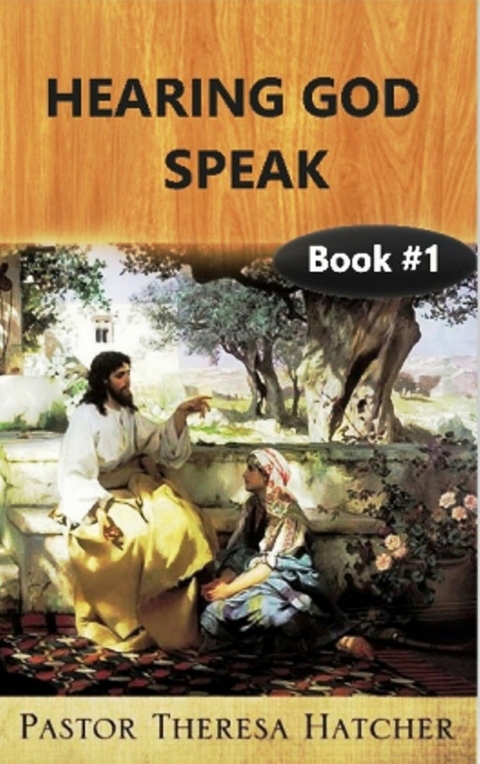
Hearing God Speak (eBook)
154 Seiten
S.E.L.F. Publishing (Verlag)
979-8-9880653-3-3 (ISBN)
Sister Theresa Hatcher is an ordained Evangelist and Pastor. She was born in January 1948 in Jena, Louisiana. Born of Levi Charlie Bethley Hatcher, Jr. and Mary C. Hatcher. She attended Southern University for one year and the University of Nevada. Later, she received a Master of Theology from Covington Theological Seminary in Rossville, GA. Pastor Hatcher accepted the Lord as a child. She was baptized in water at the age of twelve and filled with the Holy Ghost at the age of twenty. She has been in ministry since, working and ministering for over thirty years. Pastor Hatcher worked overseas for the U.S. Department of State. In addition to Pastor Theresa Hatcher's native language of English, she also speaks French and Spanish.
CHAPTER ONE
GOD SAVES FROM DEATH
"And I say unto you, Ask, and it shall be given you; seek, and ye shall find; knock, and it shall be opened unto you."St. Luke 11:9
If you'll pray, I will open the door
Although it happened over 50 years ago, it is still as vivid in my mind as it was the day it happened. It was February, the winter of 1953.It was the first time in my life that I remember, hearing Gods peak. My brother Levi Mark (called Little Brother), was only four years old, and I was five and a half. It was the morning, Little Brother and I, came face to face with death. Until that day, I knew nothing of fear. I knew nothing of an evil creature known as the Devil, who went about attempting to destroy people's lives.
After reading this testimony, one might ask: "What would a five-year-old child know about God? Or "How would a five-year-old child recognize God's voice?" That might be a point well taken under ordinary circumstances, but what happened that winter morning, in the woods of Mars Hill Community, in the city of Jena, Louisiana, was far from ordinary.
The lives of the Hatcher family were very simple. The smaller children often ran naked through the woods. For the most part, we ate the food that was raised on our farm, or that we found in the woods. Mama and Daddy went to town once a week to buy the food that we could not raise, such as rice. At that time, we cooked on a wood-burning stove. We warmed ourselves by a wood-burning heater.
We never owned a car, but Daddy sometimes paid people to take us to different places, especially to visit his Sister, Nancy Mae (called Aunt Mennya) and her husband; Uncle Jesse Griffin. We would also visit Aunt Mennya's daughter Delcene, and her husband Horace Reed. Delcene and Horace had three children, with whom I enjoyed playing: Vernetta, Natalie, and Denise. Later, they would have a son, Malcom Adrian Reed. They all lived about 50 miles from us, in Alexandria, Louisiana. It was always fun to visit them. We would also visit our grandfather, Robert Cooper (called Grandpa Robert), and our grandmother, Clarice Cooper (called Big Mama), Our Aunt Vivian (called Tee-Tee), Aunt Emma, and our cousin Evelyn, and her children. They lived in Oakdale, Louisiana, not far from Alexandria.
Our family was forced to move to Marshill Community from Trout, Louisiana, when Daddy stopped working at the Saw Mill and started working on the railroad. At that time, the Negro (Black) school, Marshill Elementary, was also in the woods not far from our land. The principal's name was Mr. Marsh. According to my sisters, Mary Lee and Louise; Mr. Marsh was the person who moved them from Trout, to Marshill. Mr. Marsh also allowed our family to sleep in the school's cafeteria while our shotgun house was being built. When school was about to start, in the fall of 1943, our family moved to our partially built house, and placed boards on the ground and slept on them. That went on for about 30 days.
I also understood from my older sisters and brothers, that they finished building the house around October 1943. At that time, there were only three rooms, which would later grow into six rooms. When they finished the house, our mother and father had only five children, Maxine, Jase Booker (called J.B.), Louise, Elizabeth, and the baby, Mary Lee.
Our shotgun house set in the midst of the forest, surrounded by about five acres of farm land. The land in front of the house was divided by a trail which ran from the gate to the front yard. Our house was never painted. It was a rain-washed shack, with a tin roof, which sat up on blocks about two feet above the ground. This protected us from the threatening Louisiana flood waters that sometimes invaded the land. We liked playing under the house, and our chickens also liked hiding there.
Over the years, the farm land increased as Daddy extended his fences northward, southward, eastward and westward. But, there were never issues with boundaries as our nearest neighbors were on the other side of the Creek, and the land around us belonged to the oil company. While Daddy worked on the railroad, or at the saw mill, to make a living, his real passion was always farming. We raised most of the food we ate. In later years, Daddy would also raise cotton in an effort to increase our income.
I was born in January 1948. By 1953, when Little Brother and I became trapped in the old ice box, Daddy and Mama had eleven children. Sherman, who was then the baby, Robert Lee, Little Brother, and I, were all under six years of age and had not yet started school. The children who were then in school were; Josephine, Charlie Lewis, Mary Lee, Elizabeth, Louise, J.B., and Maxine. After Sherman, was born, Mama and Daddy would have four more children: Carolyn, Millicent, Bonita Yvonne, and the baby girl, Jenny. They lost two children at their births, which we honor in the written version of Chapter Sixteen, The Family Tree. I was the last child born in the house in the woods, those born after me, were born in various hospitals. The best way to describe the land where we lived would be to start from "the gate" where one would normally approach the house, whether walking or riding in a car. At the gate was our handmade, wire, basketball goal nailed to a pine tree. Our basketballs were normally pine cones, which of course fell from the pine trees. The gate is where we played see-saw, jump rope, springboard, or we would sometimes draw a game on the ground and play Hop-Scotch.
At the gate, was a storage shed, which Daddy and the boys, built. The shed sat about four feet above the ground, where we normally stored food for the animals. Also at the gate was a large vegetable garden off to the right as one faced the house. This was also where our ever-hungry hogs lived, our cows, the mule and our horse. This was the place where we walked through rain, shine, sleet, and snow to milk the cows. Before milking the cow, we would allow her calf to suck. According to Daddy, this would bring the milk down. We would then take warm water in the milk bucket, and a rag and wash the cow's bags. The cow was then ready to be milked. Our cow had a defense to punish those who took her baby's milk. She would either slap us with her tail, or sometimes, just as we finished milking her, she would kick the milk over. That got us into a lot of trouble.
Like I said earlier, there was a trail, leading from the gate, to the front yard. I would say that we had a historic front yard, which was planted by Mama. There were two bird houses on either side of the yard. To protect the birds from cats and other critters, the bird houses sat atop poles, wrapped with tin, about eight feet above the ground. I remember when my mother built them. Each bird house measured about 8" x 12," with a pitched roof and each house had its own little front porch, and two rounded door-ways on either side, so that the birds could enter and leave with ease. In the summer, Robins and sometimes, Blue Jays, nested there, but they went away during the cold winter months. I missed their singing when they left, and would long to see them return in the spring.
Hedge bushes formed a fence for the front yard. Around the yard were various flowering bushes, in pink, lavender, and white. Facing the house, to the left side of the porch were two beautiful flowering trees, which each grew to over six feet tall, and about four feet around. One of them bore lilac-colored flowers, which looked like perfect clusters of grapes. The other tree was called Crepe Myrtle. It bore pink flowers. The front porch was a very important part of the house. It had a slanted roof, and was the width of the front room, about 15ft x 15ft. Since there was no air conditioning, in the summer, the family spent a lot of time on the front porch. When we had visitors that is where we normally sat. From the porch, we entered the front room. During the early years, there was a rocking chair and a few other chairs in the front room, and an old wood-burning heater.
When Little Brother and I were small, Daddy added the other three rooms, on the right side of the front porch. Our house had no hall ways. From the front porch, we walked through the front room, then into the middle room where some of the older girls slept. There were two double beds in that room. In one bed slept Maxine, and Louise. Robert Lee, who was then, about three years old, slept with Mary Lee, and Elizabeth. Later, Robert Lee slept with Josephine and me.
After the girls' room, was the kitchen, where Mama and the bigger girls cooked on a wood-burning stove. Our wooden dining table, which I estimate to have been about 3 ft W x 6 ft L, was also in the kitchen. It was made by our mother and father, along with the two benches, which measured about 1ft W x 6ft L, and sat at either side of the table. The kitchen was a place we spent a lot of time. We were required to sit down at the table for meals. The dishes had to be washed, and the floor mopped every night. There were actually three doors, leading from the kitchen; one led to the back porch, which was about the same size as the front porch. In the summer, the back porch was where we sometimes bath in our No. 3 bathtub. The other door led to the left side of the house and to the edge of the field. In the earlier days, the third door led to the backyard, but later to the boy's room.
A few feet from the back porch, was the sweet potato house, afterward, the back field. At the very back of the field, next to the fence, was a large plum tree which spanned about ten feet. It bore delicious wild plums. Scattered about the land at the back of the...
| Erscheint lt. Verlag | 14.2.2025 |
|---|---|
| Sprache | englisch |
| Themenwelt | Geisteswissenschaften ► Religion / Theologie ► Christentum |
| ISBN-13 | 979-8-9880653-3-3 / 9798988065333 |
| Informationen gemäß Produktsicherheitsverordnung (GPSR) | |
| Haben Sie eine Frage zum Produkt? |
 EPUB (Ohne DRM)
Größe: 627 KB
Digital Rights Management: ohne DRM
Dieses eBook enthält kein DRM oder Kopierschutz. Eine Weitergabe an Dritte ist jedoch rechtlich nicht zulässig, weil Sie beim Kauf nur die Rechte an der persönlichen Nutzung erwerben.
Dateiformat: EPUB (Electronic Publication)
EPUB ist ein offener Standard für eBooks und eignet sich besonders zur Darstellung von Belletristik und Sachbüchern. Der Fließtext wird dynamisch an die Display- und Schriftgröße angepasst. Auch für mobile Lesegeräte ist EPUB daher gut geeignet.
Systemvoraussetzungen:
PC/Mac: Mit einem PC oder Mac können Sie dieses eBook lesen. Sie benötigen dafür die kostenlose Software Adobe Digital Editions.
eReader: Dieses eBook kann mit (fast) allen eBook-Readern gelesen werden. Mit dem amazon-Kindle ist es aber nicht kompatibel.
Smartphone/Tablet: Egal ob Apple oder Android, dieses eBook können Sie lesen. Sie benötigen dafür eine kostenlose App.
Geräteliste und zusätzliche Hinweise
Buying eBooks from abroad
For tax law reasons we can sell eBooks just within Germany and Switzerland. Regrettably we cannot fulfill eBook-orders from other countries.
aus dem Bereich