


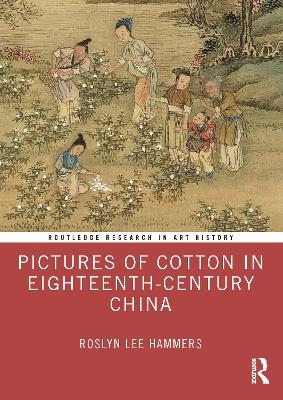
Pictures of Cotton in Eighteenth-Century China
Seiten
2025
Routledge (Verlag)
978-1-032-88801-9 (ISBN)
Routledge (Verlag)
978-1-032-88801-9 (ISBN)
This interdisciplinary volume takes an innovative approach to examining the history of cotton in China’s visual and textual traditions.
Pictures of Cotton in Eighteenth-Century China narrates cotton’s journey from a little understand material to a cherished commodity ennobled by associations with the classical heritage of China. In the 12th century, cotton, an imported crop, was plucked from the fields and entered the margins of agricultural treatises. The material was eventually “acknowledged” as cotton, an object distinct from silk, worthy of representation. By the late 16th century, representations of the plant and of the labor used to process it were incorporated into agricultural publications. During the 18th century, cotton imagery and discussions were situated in imperial encyclopaedias, further consolidating its classical legacy. Governor-general Fang Guancheng (1696/8-1768) deemed cotton a worthy subject for ambitious painting. In 1765, he designed the Pictures of Cotton, a series of sixteen paintings complete with commentary that delineated the processes of growing cotton and manufacturing fabric. He presented the Pictures of Cotton to the Qianlong emperor (r. 1735-1796) who inscribed his imperial verse on each scene. Knowledge about the fiber became a means to collaborate at the highest level of the court and bureaucracy. Fang replicated the series, complete with imperial verses into carved stone to enable replication. The Jiaqing emperor (r.1796-1821) likewise published the series as woodblock prints. Upon domestication, cotton advanced political legitimacy, becoming a commodity that attained canonical status. Cotton was represented in a scopic regime formulated by the Qing imperium, and in the process, the Imperially Inscribed Pictures of Cotton became the authoritative vision of cotton.
This study is ideal for those studying Chinese art, Chinese history, Asian Studies, and history of science and technology.’
Pictures of Cotton in Eighteenth-Century China narrates cotton’s journey from a little understand material to a cherished commodity ennobled by associations with the classical heritage of China. In the 12th century, cotton, an imported crop, was plucked from the fields and entered the margins of agricultural treatises. The material was eventually “acknowledged” as cotton, an object distinct from silk, worthy of representation. By the late 16th century, representations of the plant and of the labor used to process it were incorporated into agricultural publications. During the 18th century, cotton imagery and discussions were situated in imperial encyclopaedias, further consolidating its classical legacy. Governor-general Fang Guancheng (1696/8-1768) deemed cotton a worthy subject for ambitious painting. In 1765, he designed the Pictures of Cotton, a series of sixteen paintings complete with commentary that delineated the processes of growing cotton and manufacturing fabric. He presented the Pictures of Cotton to the Qianlong emperor (r. 1735-1796) who inscribed his imperial verse on each scene. Knowledge about the fiber became a means to collaborate at the highest level of the court and bureaucracy. Fang replicated the series, complete with imperial verses into carved stone to enable replication. The Jiaqing emperor (r.1796-1821) likewise published the series as woodblock prints. Upon domestication, cotton advanced political legitimacy, becoming a commodity that attained canonical status. Cotton was represented in a scopic regime formulated by the Qing imperium, and in the process, the Imperially Inscribed Pictures of Cotton became the authoritative vision of cotton.
This study is ideal for those studying Chinese art, Chinese history, Asian Studies, and history of science and technology.’
Roslyn Lee Hammers is Associate Professor at the University of Hong Kong.
Introduction: Regarding Agrarian Labor in Chinese Visual Culture and Literature
Chapter 1: Bringing Cotton into the Fold of Ming-dynasty Visual Culture
Chapter 2: The Qing Imperium and the Publication of Knowledge on Cotton
Chapter 3: Presenting the Pictures of Cotton
Chapter 4: Recasting the Qing Reign: Imagining Cotton in a Scopic Regime
Coda to the Imperially Inscribed Pictures of Cotton: Speculations on Visualizing Cotton
Appendix: Texts and Poems of the Yu Ti Mian Hua Tu (Imperially Inscribed Pictures of Cotton) and of the Qin Ding Shou Yi Guang Xun (Imperially Approved Magisterial Guidance on the "Bestowing of Clothes")
Bibliography
Index
| Erscheinungsdatum | 19.07.2025 |
|---|---|
| Reihe/Serie | Routledge Research in Art History |
| Zusatzinfo | 18 Halftones, color; 42 Halftones, black and white; 18 Illustrations, color; 42 Illustrations, black and white |
| Verlagsort | London |
| Sprache | englisch |
| Maße | 174 x 246 mm |
| Gewicht | 470 g |
| Themenwelt | Kunst / Musik / Theater ► Kunstgeschichte / Kunststile |
| Geisteswissenschaften ► Geschichte ► Regional- / Ländergeschichte | |
| Naturwissenschaften | |
| ISBN-10 | 1-032-88801-6 / 1032888016 |
| ISBN-13 | 978-1-032-88801-9 / 9781032888019 |
| Zustand | Neuware |
| Informationen gemäß Produktsicherheitsverordnung (GPSR) | |
| Haben Sie eine Frage zum Produkt? |
Mehr entdecken
aus dem Bereich


aus dem Bereich
die Geschichte meiner Urgroßmutter
Buch | Hardcover (2025)
C.H.Beck (Verlag)
CHF 32,15
Träume und Macht : eine Biografie
Buch | Hardcover (2025)
C.H.Beck (Verlag)
CHF 61,60


