Maximum Power and its Philosophical Roots (eBook)
XV, 146 Seiten
Springer Nature Switzerland (Verlag)
978-3-031-80622-3 (ISBN)
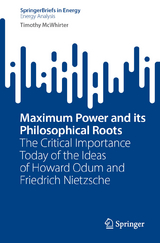
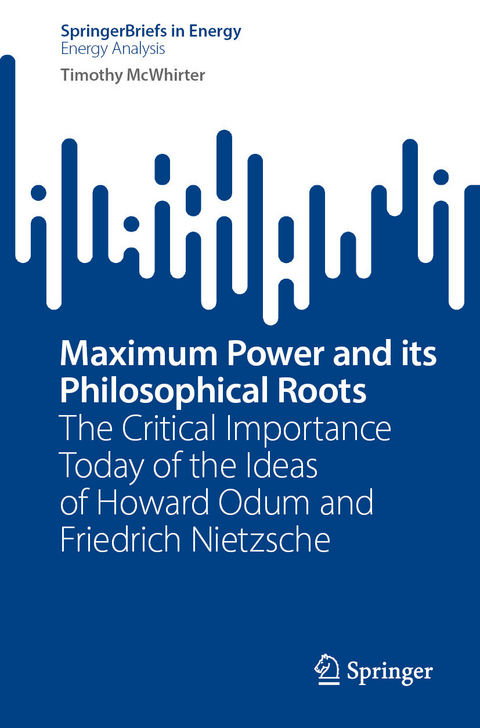
This Briefs volume focuses on the maximum power principle, which was created by the mathematician and physical chemist Alfred Lotka, and further developed and utilized most prominently by the systems ecologist H. T. Odum, who applied it to different physical, biological, ecological and economic systems. They both described this principle providing a thermodynamic framework for evolutionary theory. This principle has a philosophical heritage that has, until now, gone unrecognized. The 19th century philosopher Friedrich Nietzsche viewed his concept of the will to power as an empirical principle that describes how organic and inorganic systems develop in ways that grow in power. This book describes this interdisciplinary story: it discusses the development of both principles, reviews the empirical and theoretical support for them, critically examines their alleged limitations, and describes their philosophical implications, evidenced in a particularly provocative manner by Nietzsche's and Odum's critiques of moral and religious values.
| Erscheint lt. Verlag | 10.2.2025 |
|---|---|
| Reihe/Serie | Energy Analysis |
| Energy Analysis | SpringerBriefs in Energy |
| Zusatzinfo | XV, 146 p. 6 illus., 4 illus. in color. |
| Sprache | englisch |
| Themenwelt | Geisteswissenschaften |
| Naturwissenschaften ► Biologie | |
| Naturwissenschaften ► Physik / Astronomie ► Thermodynamik | |
| Schlagworte | Energy Metaphors • Energy Systems Language • H. T. Odum • Law of Evolution • Maximum Power Principle • Nietzsche's Metaethical Epistemology • Will to Power |
| ISBN-10 | 3-031-80622-0 / 3031806220 |
| ISBN-13 | 978-3-031-80622-3 / 9783031806223 |
| Informationen gemäß Produktsicherheitsverordnung (GPSR) | |
| Haben Sie eine Frage zum Produkt? |
 PDF (Wasserzeichen)
DRM: Digitales Wasserzeichen
Dieses eBook enthält ein digitales Wasserzeichen und ist damit für Sie personalisiert. Bei einer missbräuchlichen Weitergabe des eBooks an Dritte ist eine Rückverfolgung an die Quelle möglich.
Dateiformat: PDF (Portable Document Format)
Mit einem festen Seitenlayout eignet sich die PDF besonders für Fachbücher mit Spalten, Tabellen und Abbildungen. Eine PDF kann auf fast allen Geräten angezeigt werden, ist aber für kleine Displays (Smartphone, eReader) nur eingeschränkt geeignet.
Systemvoraussetzungen:
PC/Mac: Mit einem PC oder Mac können Sie dieses eBook lesen. Sie benötigen dafür einen PDF-Viewer - z.B. den Adobe Reader oder Adobe Digital Editions.
eReader: Dieses eBook kann mit (fast) allen eBook-Readern gelesen werden. Mit dem amazon-Kindle ist es aber nicht kompatibel.
Smartphone/Tablet: Egal ob Apple oder Android, dieses eBook können Sie lesen. Sie benötigen dafür einen PDF-Viewer - z.B. die kostenlose Adobe Digital Editions-App.
Buying eBooks from abroad
For tax law reasons we can sell eBooks just within Germany and Switzerland. Regrettably we cannot fulfill eBook-orders from other countries.
aus dem Bereich