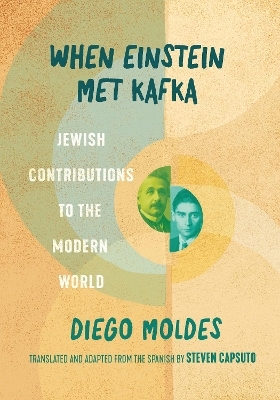
When Einstein Met Kafka
Mandel Vilar Press (Verlag)
978-1-942134-39-8 (ISBN)
While Jews account for 0.2 percent of the world’s population and no more than 2.5 percent of any country except Israel, they have made some of the greatest contributions to Western Culture in diverse fields that range from physics and philosophy to music and art. One register of these contributions is the Nobel Prizes: from their first recipients in 1901, 26 percent of awardees in the Nobel’s six fields — among them, physics, physiology/medicine, and economics — have been Jews. What accounts for the extraordinary breadth of these achievements? This is a question that Diego Moldes examines in When Einstein Met Kafka.
His answers include the history of Jewish culture itself, whether religious or secular, with its emphasis on literacy, learning, and especially inquiry and questioning. Until the European Enlightenment in the 18th century, Jews did not have full citizenship and civil rights — they were barred from universities, from government, and from entire professions. The Enlightenment opened the doors!
Despite the outbreaks of violent anti-Semitism — or what Diego Moldes calls Judeophobia — and continuing discrimination in all Western countries, Jews now had legal rights, and they persevered. In a near-encyclopedic fashion, he profiles just how thousands of individual Jews, by name, made original contributions to fields as diverse as medicine, artificial intelligence, philosophy, history, economics, business, world finance, computing, sports, film, architecture, and more! The book itself is an extraordinary achievement, the result of twenty years of intensive research, yet written in an immensely engaging style that has been translated and adapted for English readers from the Spanish by Steven Capsuto.
Diego Moldes is a Spanish writer, an essayist, novelist, poet, critic and historian of cinema and culture. He holds a PhD in Information Sciences (Complutense University, Madrid), a BA degree in Advertising and Public-Relations, an MA in Publishing and an MA in Foundation Management. In 2019, Galaxia Gutenberg published his book Cuando Einstein encontró a Kafka, Contribuciones de los Judíos al mundo moderno. His connection to Judaism led him to collaborate with Raíces: Revista judía de cultura (Roots: A Jewish Cultural Magazine). From 2015 to 2018, he served as the executive director of the Fundación Hispanojudía (the Hispanic-Jewish Foundation). In 2015, he became president and co-founder of ONG Asociación Fania (the Fania Association), a group which combats antisemitism and supports Jewish cultural endeavors. To date, Diego Moldes has published 14 books. Steven Capsuto translates from Spanish, Portuguese, Catalan, French, Galician and Ladino. His most recent published translation was Amazônia by Sebastiao Salgado (Taschen, 2022); since 2019 he has been the main Ladino-English translator for the ten-volume Posen Library of Jewish Culture (Yale). He is also the author of Alternate Channels: Queer Images on 20th-Century TV (Original edition Ballantine Books, 2000, revised 20th Anniversary edition, 2020).
When Einstein Met Kafka
Table of Contents
Part 1
1.
Anti-Semitism
Education and Judaism
World Map of Anti-Semitism
2.
Jewish Identity
Judeo-Christianity, Judeo-Christian, or Judaism and Christianity?
Part 2
1. Modern Geniuses of Humanity
Intelligence Quotient (IQ)
“Overeducation”
2. Science and Inventions
Mathematics
Six Degrees of Separation
Artificial Intelligence
Topology
Statistics
Invention of the Gasoline-Powered Car
Invention of Aspirin
UNICEF
Origins of the City, Origins of Cement
Invention of Glass
3. Literature and Culture
Hebrew and Jewish Modern Literature (Eighteenth to Twenty-First Centuries)
A Nation without a Territory (Extraterritoriality)
Modern Literature (Authors Born in the Nineteenth and Twentieth Centuries)
“Electric-Fan Writers”and “Sponge Writers”
Franz Kafka
Marcel Proust
Stefan Zweig
Some Modern Jewish Authors
Angel Wagenstein’s Remarkable Trilogy of Novels
Dutch Jewish Writers
Danilo Kiš
Literature of the Holocaust
France
Two Notable Cases: Canetti and Koestler
Other Examples
Italy
Hugo Bettauer and The City without Jews
Exilliteratur
North America
The Pawnbroker, Edward Lewis Wallant’s Great Novel
Playwrights of Jewish Origin
Two Spanish Examples: Aub and Cansinos Assens
Other Contemporary Cases
Clarice Lispector
Latin America
Interview with Gabi Gleichmann
Interview with Ezequiel Szafir
Israeli Literature in Hebrew
The Hare with Amber Eyes: The Story of the Ephrussis
Jewish, Part Jewish, or Non-Jewish?
Conversos in Castile in the Fifteenth, Sixteenth, and Seventeenth Centuries
4. Philosophy, History, and Thought
The Frankfurt School
Anthropology
Linguistics
Psychology and Psychiatry
Film Criticism and Essays
Hinduism and Sanskrit
A Spanish Cultural Example
Historians from Jewish Backgrounds
5. Business, Banking, and the World of Finance
Building American Capitalism
Examples from the Twentieth and Twenty-First Centuries
Nobel Prizes
Various Economic Examples
Real Estate
Shell
Mattel
Hasbro
Kraft
Danone (Dannon)
Nivea
Mercedes-Benz
Citroën
Philips
Heineken
Hartz Mountain
Dunkin’ Donuts
Life Insurance
Sara Lee Corporation
Louis Dreyfus Group
BlackRock
Tamares Group
Bernie Madoff
The FIAT Group
Glencore
Coca-Cola
Private Aviation
Consulting and Auditing: The Big Four
Jews Prominent in Germany’s Economy before the Holocaust (1825–1933)
Jews Prominent in the United Kingdom’s Economy
Jews Prominent in Canada’s Economy
Jews Prominent in Brazil’s Economy
Jews Prominent in Argentina’s Economy
Jews Prominent in Russia’s Economy
Jews Prominent in Asia’s Economy
Jews Prominent in Spain’s Economy
Jews Prominent in the International Diamond Trade
Jews Prominent in Marketing
Anti-Semitic Magnates
Summary
6. Computing and the Internet
Google
Beginnings
The Example of Israel: A Start-Up Nation
Computer Scientists and Computer Engineers
7. Fashion, Textile Industry, Cosmetics, and Retail
Retail
Bookstore Chains
8. Sports
Soccer
Basketball
European Basketball
Chess
Boxing
Paralympic Games
9. Cinema, Television, Music, and Entertainment
Jews and the Movies
Jewish Producers in Hollywood
Jewish Producers Who Won Oscars (or Had Best Picture Nominations)
Jewish Film Directors in Hollywood
Other Examples
British Cinema
Film Studios in the Twenty-First Century
The “Big Three” Entertainment Agencies: WME, CAA, and UTA
Other Parts of the World
Acting
Jewish Actresses
Actresses Who Converted to Judaism
A Mysterious Case: John M. Stahl
Cornel Wilde: Kornél Lajos Weisz
Jon Favreau
Some Examples in Modern Cinema
Film Scores
Hollywood Films about Anti-Semitism
Jewish Casablanca
Examples of Jewish-Themed European Cinema
Kapo (Kapò, 1959)
Romeo, Juliet and Darkness (Romeo, Julie a tma, 1959)
Passenger (Pasazerka, 1961–63)
The Trial (Le procès / Il processo / Der prozess, 1962)
Intimate Lighting (Intimní osvetlení, 1965)
The Shop on Main Street / The Shop on the High Street (Obchod na korze, 1965)
Father (Apa, 1966)
The Night Porter (Il portiere di notte, 1974)
Mr. Klein (Monsieur Klein / Chi è Mr. Klein?, 1976)
Au revoir les enfants (German title: Auf Wiedersehen, Kinder, 1986)
Life is Beautiful (La vita è bella, 1997)
The Pianist (2002)
Shoah (1985)
Entertainment Companies and Television
Saban Entertainment
Film Meets Internet, Through Jewish American Entrepreneurs
Other Show Business
Dance and Ballet: Ida Rubinstein, Maya Plisetskaya, and Alicia Markova
Ida Rubinstein
Maya Plisetskaya
Alicia Markova
Magic and Illusionists
Music and the Recording Industry
French Music Hall: Théâtre des Trois Baudets and Canetti
Rock and Pop Music
Classical Music
10. Comics
11. Art
Collecting
Art History
12. Modern Architecture
13. The Publishing Industry
14. Journalism
The Case of Naomi Klein
Photography
15. Media and Advertising
Advertising
The PRISA Group and El País
Italian Media
16. Justice and Politics
Justice
Politics
Labor Organizing in the United States
Feminism
Non-Governmental Organizations (NGOs)
Elected Officials
The Pentagon and CIA
An Unusual Case in Ukraine
The Obama White House
Socialism
Anarchism
The Greens
Communism
Intellectuals and Communism
Josef Stalin
17. Conclusions and Questions for Discussion
Part 3
Appendix, Postscript, Bibliography, and Videography
Appendix
Postscript
Bibliography and Videography
Selected Bibliography
Essays, History Books, Memoirs, Biographies
Jewish-Themed Literature: Fiction (Novels, Novellas, Short Stories) and Poetry
Graphic Novels and Comics
Selected Videography Consulted on DVD and Blu-Ray Discs
Main Websites Consulted
Acknowledgments
| Erscheinungsdatum | 12.09.2025 |
|---|---|
| Übersetzer | Steven Capsuto |
| Zusatzinfo | Illustrations |
| Verlagsort | CT |
| Sprache | englisch |
| Maße | 177 x 254 mm |
| Themenwelt | Literatur ► Biografien / Erfahrungsberichte |
| Geisteswissenschaften ► Geschichte ► Allgemeine Geschichte | |
| Geschichte ► Teilgebiete der Geschichte ► Kulturgeschichte | |
| ISBN-10 | 1-942134-39-8 / 1942134398 |
| ISBN-13 | 978-1-942134-39-8 / 9781942134398 |
| Zustand | Neuware |
| Informationen gemäß Produktsicherheitsverordnung (GPSR) | |
| Haben Sie eine Frage zum Produkt? |
aus dem Bereich