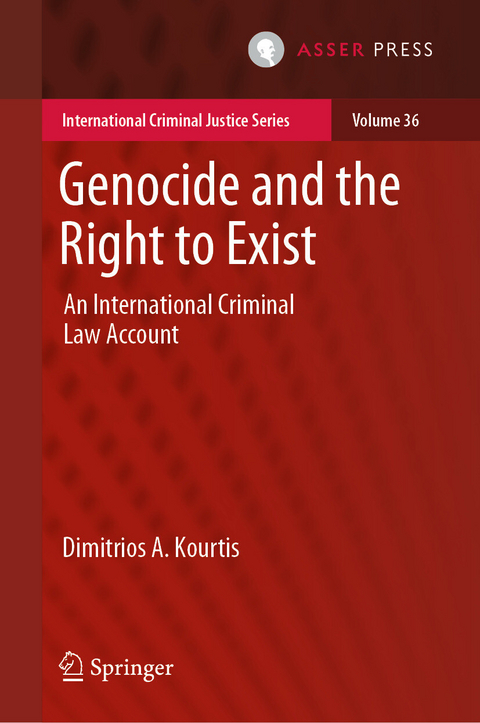
Genocide and the Right to Exist (eBook)
XXI, 674 Seiten
T.M.C. Asser Press (Verlag)
978-94-6265-659-8 (ISBN)
This book delves into the complexities of genocide as a legal concept, offering a fresh perspective by exploring the rights of groups to exist under international criminal law. It presents an in-depth analysis of group rights, challenging traditional interpretations within the context of the Genocide Convention. By focusing on the conceptual and practical implications of recognizing groups as rights-holders, this work introduces a nuanced understanding of collective rights and their enforcement.
What sets this approach apart is its thorough examination of both the theoretical foundations and the operational aspects of international law concerning genocide. The book provides a critical assessment of various legal theories, addressing how these can be reconciled with the dynamic nature of international human rights practices. It also highlights the potential for these theoretical frameworks to impact the protection of vulnerable groups on a global scale.
The scope of this work is broad yet detailed, encompassing an analysis that will be invaluable for legal practitioners, scholars, and policymakers. It systematically addresses the ambiguities and challenges in defining and prosecuting genocide, offering strategic insights into the enhancement of legal frameworks to prevent such atrocities. The book incorporates primary archival research that brings to light new evidence on the drafting of the Genocide Convention, including cases such as that of the Greek children, which have previously been underexplored.
The primary audience for the work includes academics and students in the fields of international law, international criminal law, criminal law, human rights, and genocide studies, as well as diplomats, policy-makers, legal professionals, historians, sociologists, anthropologists, philosophers specializing in genocide, and genocide scholars in general. The insights provided will be crucial for anyone committed to advancing the understanding and implementation of international law protecting group rights.
Dimitrios Kourtis holds a PhD and is a Post-doctoral Researcher and Teaching Fellow in the Department of International Studies at the Faculty of Law of the Aristotle University in Thessaloniki, Greece.
This book delves into the complexities of genocide as a legal concept, offering a fresh perspective by exploring the rights of groups to exist under international criminal law. It presents an in-depth analysis of group rights, challenging traditional interpretations within the context of the Genocide Convention. By focusing on the conceptual and practical implications of recognizing groups as rights-holders, this work introduces a nuanced understanding of collective rights and their enforcement.What sets this approach apart is its thorough examination of both the theoretical foundations and the operational aspects of international law concerning genocide. The book provides a critical assessment of various legal theories, addressing how these can be reconciled with the dynamic nature of international human rights practices. It also highlights the potential for these theoretical frameworks to impact the protection of vulnerable groups on a global scale.The scope of this work is broad yet detailed, encompassing an analysis that will be invaluable for legal practitioners, scholars, and policymakers. It systematically addresses the ambiguities and challenges in defining and prosecuting genocide, offering strategic insights into the enhancement of legal frameworks to prevent such atrocities. The book incorporates primary archival research that brings to light new evidence on the drafting of the Genocide Convention, including cases such as that of the Greek children, which have previously been underexplored.The primary audience for the work includes academics and students in the fields of international law, international criminal law, criminal law, human rights, and genocide studies, as well as diplomats, policy-makers, legal professionals, historians, sociologists, anthropologists, philosophers specializing in genocide, and genocide scholars in general. The insights provided will be crucial for anyone committed to advancing the understanding and implementation of international law protecting group rights.Dimitrios Kourtis holds a PhD and is a Post-doctoral Researcher and Teaching Fellow in the Department of International Studies at the Faculty of Law of the Aristotle University in Thessaloniki, Greece.
| Erscheint lt. Verlag | 5.2.2025 |
|---|---|
| Reihe/Serie | International Criminal Justice Series |
| Zusatzinfo | XXI, 674 p. 3 illus., 1 illus. in color. |
| Sprache | englisch |
| Themenwelt | Geisteswissenschaften ► Geschichte |
| Recht / Steuern ► EU / Internationales Recht | |
| Recht / Steuern ► Öffentliches Recht ► Völkerrecht | |
| Recht / Steuern ► Privatrecht / Bürgerliches Recht | |
| Recht / Steuern ► Strafrecht | |
| Sozialwissenschaften ► Politik / Verwaltung | |
| Schlagworte | Collective existence • Collective Rights • Genocide • Grouphood • Intent to destroy • National, ethnic, racial, religious groups • Prohibition of genocide • Protected groups • right to exist |
| ISBN-10 | 94-6265-659-2 / 9462656592 |
| ISBN-13 | 978-94-6265-659-8 / 9789462656598 |
| Informationen gemäß Produktsicherheitsverordnung (GPSR) | |
| Haben Sie eine Frage zum Produkt? |
 PDF (Wasserzeichen)
DRM: Digitales Wasserzeichen
Dieses eBook enthält ein digitales Wasserzeichen und ist damit für Sie personalisiert. Bei einer missbräuchlichen Weitergabe des eBooks an Dritte ist eine Rückverfolgung an die Quelle möglich.
Dateiformat: PDF (Portable Document Format)
Mit einem festen Seitenlayout eignet sich die PDF besonders für Fachbücher mit Spalten, Tabellen und Abbildungen. Eine PDF kann auf fast allen Geräten angezeigt werden, ist aber für kleine Displays (Smartphone, eReader) nur eingeschränkt geeignet.
Systemvoraussetzungen:
PC/Mac: Mit einem PC oder Mac können Sie dieses eBook lesen. Sie benötigen dafür einen PDF-Viewer - z.B. den Adobe Reader oder Adobe Digital Editions.
eReader: Dieses eBook kann mit (fast) allen eBook-Readern gelesen werden. Mit dem amazon-Kindle ist es aber nicht kompatibel.
Smartphone/Tablet: Egal ob Apple oder Android, dieses eBook können Sie lesen. Sie benötigen dafür einen PDF-Viewer - z.B. die kostenlose Adobe Digital Editions-App.
Buying eBooks from abroad
For tax law reasons we can sell eBooks just within Germany and Switzerland. Regrettably we cannot fulfill eBook-orders from other countries.
aus dem Bereich