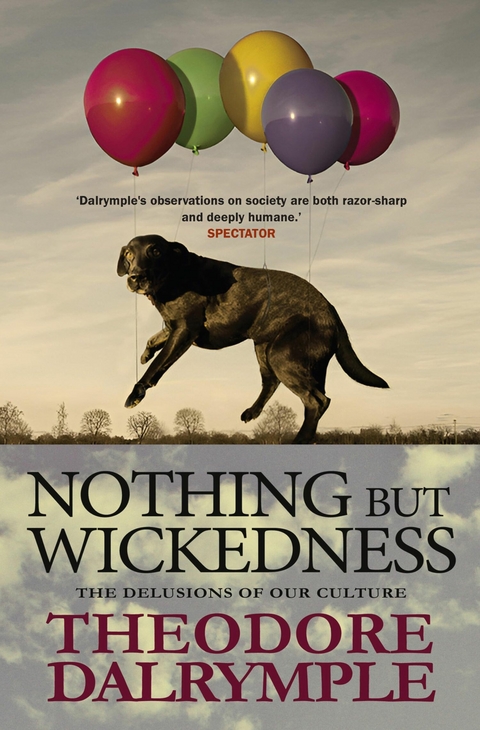
Nothing but Wickedness (eBook)
204 Seiten
Gibson Square (Verlag)
978-1-908096-97-5 (ISBN)
Theodore Dalrymple is a psychiatrist who acts as expert-witness in murder trials. After working as a doctor in Africa and the Gilbert Islands, he returned to Britain and has worked in prisons and hospitals in the East End of London, the Midlands, and Birmingham. He is a contributor to The Times, Telegraph, Wall Street Journal, Spectator, and the British Medical Journal. He is the author of several books, including the acclaimed Spoil Rotten, The Knife Went In, Litter, and the Pleasure of Thinking.
Nothing But Wickedness delves into society's subtle-and some not so subtle-transgressions that contribute to the decline of our culture. Theodore Dalrymple, drawing on his extensive experience as an inner-city GP and prison psychiatrist, examines the underlying factors that drive societal behaviours and self-deception. The book covers a range of thought-provoking topics, including what drives doctors to work for dictators, the benefits of idleness, understanding the mindset of Hitler, why doctors collect body parts, the true meaning of illness, and how war can paradoxically advance medicine. This wide-ranging exploration is a compelling read for the intelligent reader and the Theodore Dalrymple fan. Dalrymple's insights offer a unique perspective on the complexities of human behaviour and cultural decline. Whether you are intrigued by the benefits of idleness, fascinated by the darker side of human nature, or interested in historical and psychological analyses, Nothing But Wickedness promises to be an enlightening and engaging read ranging across many genres.
Nothing but wickedness
Dr Samuel Johnson (1709-1784) had many illnesses, and even more ascribed to him by writers, but he had a strong constitution and lived to what was, for the time, an old age. He was interested in physic and was willing to experiment on himself. On his deathbed, frustrated by the inability of his doctors to relieve the gross oedema of his legs, he cut deeply into his own flesh.
Johnson, whom Voltaire (wrongly) called a superstitious dog, believed that science would help to relieve mankind of much misery, but not of misery as such. Living at a time when poverty meant not an income lower than 60% of the median income but having little to eat and rags to wear, it was perhaps prescient of him to realise that, notwithstanding the horrors of poverty that he never underestimated, material progress would not mean full and final happiness.
A religious man, or perhaps (better) a man striving to keep his religious belief intact, one of his preoccupations was the problem of how an infinitely wise, powerful, knowing, and benevolent God could permit such suffering in the world. Among the great causes of suffering, of course, were disease and illness. When Johnson was writing his great Rambler, Idler, and Adventurer essays, half of all children in London died before their fifth birthday, and the city was so unhealthy that its population grew only because of migration from the countryside. The search for good health is not a cause of mass migration.
In one of his lay sermons, Johnson tackled the question of how much suffering was attributable to God’s will. He wrote:
In making an estimate, therefore, of the miseries that arise from the disorders of the body, we must consider how many diseases proceed from our own laziness, intemperance, or negligence; how many the vices or follies of our ancestors have transmitted to us; and beware of imputing to God, the consequences of luxury, riot, and debauchery. There are, indeed, distempers which no caution can secure us from, and which appear to be more immediately the strokes of heaven; but these are not of the most painful or lingering kind; they are for the most part acute and violent, and quickly terminate, either in recovery or death; and it is always to be remembered, that nothing but wickedness makes death an evil.
The last sentence makes sense, of course, only if there is a future state of being whose felicities are handed out according to our desert in this life; and perhaps pedantically inclined philosophers might say that otherwise it is not death itself that is an evil, but only the truncation of existence that might have been more prolonged and is foregone by the intervention of death.
Be that as it may, I confess that whenever I read the first sentence of the part of the sermon that I have quoted, I think of the mass public drunkenness that foolish or perhaps corrupt governments have assiduously encouraged, promoted, and benefited from. What better illustration of Johnson’s point could there be than that, at the last count known to me, 70% of attendances at casualty departments between midnight and 5 am are attributable in one way or another to drunkenness?
All in the mind?
There is no pleasure greater than to denounce the wickedness of the times, and since the times are always wicked the pleasure is inexhaustible.
The Reverend Jeremy Collier MA (1650-1726) was a great denouncer of the wickedness of his times. He was famous for it; in fact, it was his metier. He did not think the Glorious Revolution was glorious and refused to swear allegiance to the new monarchs, William and Mary, and he was particularly against the degeneracy and vulgarity of Restoration comedy, which he denounced in his Short View of the Immorality and Profaneness of the English Stage, published in 1698. He was answered in kind by Vanbrugh and Congreve, whom he especially attacked, and he wrote a riposte to their riposte. It was all good clean fun.
He also wrote a series of moral essays, many in the form of a dialogue, some of medical interest. For example, his ‘A Moral Essay of Pain’ takes up the question of the nature and utility of pain in a world ruled by divine providence. He defines pain as ‘an unacceptable Notice arising from some Disorder in the Body.’ He goes on:
When the Continuity of the Organ is disjoyn’d, the Nerves discomposed, and the Muscles forced into a foreign Situation; when there’s a stop of the Spirits, when the Parts don’t keep their Ranks, but are beaten out of the Figure which Nature has drawn them up in; then the Mind immediately receives a grating Information of what has happen’d; Which Intelligence is more or less troublesome in Proportion to the Disadvantages of the Accident.
As any good moralist must, he points out that much pain is the fault of the sufferers themselves, a kind of punishment of their own conduct and a good lesson to them:
For instance, a Man of Choler and Conceit takes fire at an insignificant Affront, rushes into a Quarrel, has his Head broke, and it may be his limbs raked, into the Bargain; now when a Wound is thus impertinently made, ought it not to put the patient to some Trouble? He that’s thus prodigal of his Person, and makes his Limbs serve in an ill Cause, ought to meet with a Mortification; The Punishment is but a just return for the Pride, and the Smart, it may be, the best Cure for the Folly.’
Where indeed would our casualty departments be, what work would they have to do, were it not for those who are ‘thus prodigal of their Person’?
Collier is not so fanatic as to fail to recognise that pain is sometimes undeserved, that it afflicts the righteous as well as the unrighteous; but he is particularly exercised by the fact that a person’s psychological state affects the degree of pain that they feel, from which he concludes that pain, notwithstanding his initial definition of it, is not really physical at all. He refers to the fact that the barbarian Gauls, fighting the Romans, hardly felt their wounds but were abject cowards in the face of disease; whereas with ‘the Grecians’ it was the other way round. He gives many other examples, from the Bible and classical literature.
So pain for Collier is both physical and psychological. In a surprising way, therefore, he is a forerunner of Melzack and Wall’s ‘gate’ theory of pain: that nerves that don’t transmit pain can interfere with signals from pain nerves and inhibit the perception of pain.
His dialogue ‘Of Drunkenness, between the Toper Oenophilus and the Sober Eucratius’ is also of surprisingly contemporary relevance. When Oenophilus points out that people often drown their sorrows in drink, Eucratius replies: ‘To throw one World after another, is a Dismal Relief against Poverty.’
Inscribe it in Whitehall, say I.
The riot of our mind
Every month for nearly six years, Johnson’s biographer James Boswell (1740-1795) wrote an essay for the London Magazine under the name of The Hypochondriack. By hypochondriack, Boswell meant not the man who is consumed by fear of illnesses he does not have but the one who suffers from melancholy, spleen, or ‘the vapours’.
If Boswell were writing his essays today, I suppose it would be as The Depressive, and he would long ago have been put on antidepressants. In issue 39, he describes the hypochondriack’s symptoms:
His opinion of himself is low and desponding. His temporary dejection makes his faculties seem quite feeble. His fancy roves over the variety of characters whom he knows in the world … and they seem all better than his own. He regrets his ever having attempted distinction and excellence in any way, because the effect of his former exertions now serves only to make his insignificance more vexing to him. Nor has he any prospect of more agreeable days when he looks forward. There is a cloud as far as he can perceive, and he supposes it will be charged with thicker vapour, the longer it continues. He is distracted between indolence and shame… He acts like a slave, not animated by inclination, but goaded by fear.
He hoped to ward off his own tendency to this condition, or these conditions, by his literary exertions.
Inauspiciously, perhaps, his first essay in the series was dated November, and he quotes a French novel that starts with the line (one wants to read on), ‘In the gloomy month of November, when the people of England begin to hang and drown themselves…’
Boswell proposes two remedies to the hypochondriac: therapy, and or psychopharmacology.
The therapy is religious belief:
By religion, the Hypochondriack will have his mind fixed upon one invariable object of veneration, will have his troubled thoughts calmed by the consideration that he is here in a state of trial, that to contribute his part in carrying out the plan of providence in this state of being is his duty, and that his sufferings however severe will be found beneficial to him in the other world.
The psychopharmacological remedy Boswell proposes is drink:
To be sure we know that an excess in wine which alone can move a thick melancholy, will probably make us worse when its violent operation has ceased, so that it is in general better to bear the mental malady with firmness. Yet I am not so sure but when the black distress has been of long continuance, it may be allowable to try by way of a desperate remedy, as poisons are sometimes given...
| Erscheint lt. Verlag | 6.3.2025 |
|---|---|
| Verlagsort | London |
| Sprache | englisch |
| Themenwelt | Geisteswissenschaften ► Psychologie |
| Sozialwissenschaften ► Politik / Verwaltung | |
| Schlagworte | body parts • cultural decline • Curiosity • Dalrymple • deceptions behavior • decline of culture • Dictators • History • Hitler • Human • Humor • idleness • Illness • Literature • Medicine • Psychology • Repression • Society • Transgressions • war • Wit |
| ISBN-10 | 1-908096-97-7 / 1908096977 |
| ISBN-13 | 978-1-908096-97-5 / 9781908096975 |
| Informationen gemäß Produktsicherheitsverordnung (GPSR) | |
| Haben Sie eine Frage zum Produkt? |
 EPUB (Adobe DRM)
Kopierschutz: Adobe-DRM
Adobe-DRM ist ein Kopierschutz, der das eBook vor Mißbrauch schützen soll. Dabei wird das eBook bereits beim Download auf Ihre persönliche Adobe-ID autorisiert. Lesen können Sie das eBook dann nur auf den Geräten, welche ebenfalls auf Ihre Adobe-ID registriert sind.
Details zum Adobe-DRM
Dateiformat: EPUB (Electronic Publication)
EPUB ist ein offener Standard für eBooks und eignet sich besonders zur Darstellung von Belletristik und Sachbüchern. Der Fließtext wird dynamisch an die Display- und Schriftgröße angepasst. Auch für mobile Lesegeräte ist EPUB daher gut geeignet.
Systemvoraussetzungen:
PC/Mac: Mit einem PC oder Mac können Sie dieses eBook lesen. Sie benötigen eine
eReader: Dieses eBook kann mit (fast) allen eBook-Readern gelesen werden. Mit dem amazon-Kindle ist es aber nicht kompatibel.
Smartphone/Tablet: Egal ob Apple oder Android, dieses eBook können Sie lesen. Sie benötigen eine
Geräteliste und zusätzliche Hinweise
Buying eBooks from abroad
For tax law reasons we can sell eBooks just within Germany and Switzerland. Regrettably we cannot fulfill eBook-orders from other countries.
aus dem Bereich