


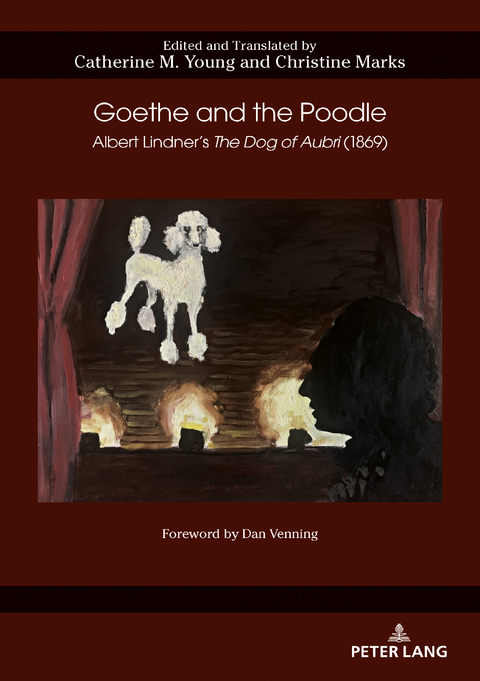
Goethe and the Poodle
Albert Lindner’s «The Dog of Aubri» (1869)
Seiten
2025
|
New edition
Peter Lang International Academic Publishers (Verlag)
978-1-80374-371-4 (ISBN)
Peter Lang International Academic Publishers (Verlag)
978-1-80374-371-4 (ISBN)
This collaborative project presents the first annotated English translation of German scholar Albert Lindner’s 1869 metatheatrical play, Der Hund des Aubri. It includes a foreword, an introductory essay with 18 images, and a translators’ dialogue.
“This superbly compiled and provocative edition makes available for the first time in English translation Albert Lindner’s metatheatrical play on the canine conflict that disrupted Goethe’s Weimar Classicism with melodramatic sensation to herald modernism. The critical apparatus offers a rich historiographical frame for reading diegetic animals in performance, while images of primary documents help vivify the context. Thus framed and honed with two staged readings, the German- and English-language play texts raise intriguing questions about des Pudels Kern, the absent/present poodle’s core meaning. Faustian allusions evoke disturbing dynamics of white patriarchy amid complex intersections of political and theatrical autocracies that resound to the present day.”
– Professor Kim Marra, University of Iowa
“In Goethe and the Poodle, you get not only an extraordinary play but, also, extraordinary history. Young and Marks make Lindner's nineteenth-century play accessible, bringing out its humor and its theatricality. In the introduction and footnotes, they use the play to teach the reader about the sweep of nineteenth-century German theater, from Goethe and French melodrama through to unified Germany. The book is eminently teachable, in German as well as English, and very entertaining.”
– Professor Matt Cornish, Ohio University
Goethe and the Poodle is the first English translation of scholar Albert Lindner's 1869 play Der Hund des Aubri, which premiered at Berlin's Wallner Theater during the German Wars of Unification. Inspired by actual events, Lindner's eccentric play stages the conspiracy to bring a popular melodrama featuring a trained poodle to the Weimar Court theater in 1817, Johann Wolfgang von Goethe's resistance to the performance, and his subsequent departure after leading the theater for 26 years. Thorough annotations explain the play's cultural and geographic references, and the introductory essay analyzes aesthetic debates surrounding Weimar Classicism, popular taste, and animal performance. Archival images including playbills, portraits, and the 1812 Weimar Theater Laws supplement the volume's contributions to theater history.
“This superbly compiled and provocative edition makes available for the first time in English translation Albert Lindner’s metatheatrical play on the canine conflict that disrupted Goethe’s Weimar Classicism with melodramatic sensation to herald modernism. The critical apparatus offers a rich historiographical frame for reading diegetic animals in performance, while images of primary documents help vivify the context. Thus framed and honed with two staged readings, the German- and English-language play texts raise intriguing questions about des Pudels Kern, the absent/present poodle’s core meaning. Faustian allusions evoke disturbing dynamics of white patriarchy amid complex intersections of political and theatrical autocracies that resound to the present day.”
– Professor Kim Marra, University of Iowa
“In Goethe and the Poodle, you get not only an extraordinary play but, also, extraordinary history. Young and Marks make Lindner's nineteenth-century play accessible, bringing out its humor and its theatricality. In the introduction and footnotes, they use the play to teach the reader about the sweep of nineteenth-century German theater, from Goethe and French melodrama through to unified Germany. The book is eminently teachable, in German as well as English, and very entertaining.”
– Professor Matt Cornish, Ohio University
Goethe and the Poodle is the first English translation of scholar Albert Lindner's 1869 play Der Hund des Aubri, which premiered at Berlin's Wallner Theater during the German Wars of Unification. Inspired by actual events, Lindner's eccentric play stages the conspiracy to bring a popular melodrama featuring a trained poodle to the Weimar Court theater in 1817, Johann Wolfgang von Goethe's resistance to the performance, and his subsequent departure after leading the theater for 26 years. Thorough annotations explain the play's cultural and geographic references, and the introductory essay analyzes aesthetic debates surrounding Weimar Classicism, popular taste, and animal performance. Archival images including playbills, portraits, and the 1812 Weimar Theater Laws supplement the volume's contributions to theater history.
Catherine M. Young is a theater and performance historian living in New York City. She researches popular performance including circus, vaudeville, and musicals. Christine Marks is Professor of English and Co-Program Director of the Liberal Arts: Health Humanities program at LaGuardia Community College, City University of New York.
Contents: Goethe, Diegetic Dogs, and Albert Lindner’s The Dog of Aubri by Catherine M. Young – Der Hund des Aubri. Ein Zeit-Bild in 3 Acten von Dr. Albert Lindner (1869) – The Dog of Aubri: A Portrait of an Era in 3 Acts by Albert Lindner Edited and Translated by Catherine M. Young and Christine Marks – Translators’ Dialogue – Notes on Contributors – Index.
| Erscheinungsdatum | 07.02.2025 |
|---|---|
| Reihe/Serie | German Studies in America ; 81 |
| Mitarbeit |
Herausgeber (Serie): Gail Hart, Celia Applegate, Susan Gustafson, Kai Evers, Peter Meilaender |
| Zusatzinfo | 21 Illustrations |
| Verlagsort | Oxford |
| Sprache | englisch |
| Maße | 152 x 229 mm |
| Gewicht | 263 g |
| Themenwelt | Literatur ► Lyrik / Dramatik ► Dramatik / Theater |
| Kunst / Musik / Theater | |
| Schulbuch / Wörterbuch ► Wörterbuch / Fremdsprachen | |
| Geisteswissenschaften ► Sprach- / Literaturwissenschaft ► Germanistik | |
| Geisteswissenschaften ► Sprach- / Literaturwissenschaft ► Literaturwissenschaft | |
| ISBN-10 | 1-80374-371-9 / 1803743719 |
| ISBN-13 | 978-1-80374-371-4 / 9781803743714 |
| Zustand | Neuware |
| Informationen gemäß Produktsicherheitsverordnung (GPSR) | |
| Haben Sie eine Frage zum Produkt? |
Mehr entdecken
aus dem Bereich



aus dem Bereich


