


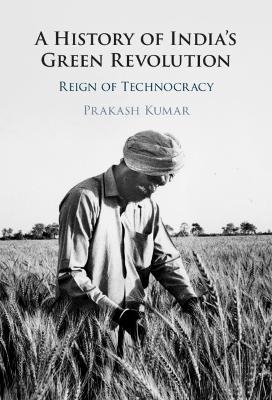
A History of India's Green Revolution
Reign of Technocracy
Seiten
2025
Cambridge University Press (Verlag)
978-1-009-64658-1 (ISBN)
Cambridge University Press (Verlag)
978-1-009-64658-1 (ISBN)
India's 'green revolution' embraced more productive agricultural practices and high yielding variety seeds, bringing the country out of food scarcity. Although lauded as a success of the Cold War fight against hunger, Prakash Kumar argues this was part of a much broader, contested history of agrarian modernization in India.
In the mid-1960s, India's 'green revolution' saw the embrace of more productive agricultural practices and high yielding variety seeds, bringing the country out of food scarcity. Although lauded as a success of the Cold War fight against hunger, the green revolution has also faced criticisms for causing ecological degradation and socio-economic inequality. This book contextualizes the 'green revolution' to show the contingencies and pitfalls of agrarian transformation. Prakash Kumar unpacks its contested history, tracing agricultural modernization in India from colonial-era crop development, to land and tenure reforms, community development, and the expansion of arable lands. He also examines the involvement of the colonial state, post-colonial elites, and American modernizers. Over time, all of these efforts came under the spell of technocracy, an unyielding belief in the power of technology to solve social and economic underdevelopment which, Kumar argues, best explains what caused the green revolution.
In the mid-1960s, India's 'green revolution' saw the embrace of more productive agricultural practices and high yielding variety seeds, bringing the country out of food scarcity. Although lauded as a success of the Cold War fight against hunger, the green revolution has also faced criticisms for causing ecological degradation and socio-economic inequality. This book contextualizes the 'green revolution' to show the contingencies and pitfalls of agrarian transformation. Prakash Kumar unpacks its contested history, tracing agricultural modernization in India from colonial-era crop development, to land and tenure reforms, community development, and the expansion of arable lands. He also examines the involvement of the colonial state, post-colonial elites, and American modernizers. Over time, all of these efforts came under the spell of technocracy, an unyielding belief in the power of technology to solve social and economic underdevelopment which, Kumar argues, best explains what caused the green revolution.
Prakash Kumar is Associate Professor of History at Pennsylvania State University. He is the author of Indigo Plantations and Science in Colonial India.
Introduction; 1. Colonial technocracy; 2. Development through people's participation; 3. Making Tarai the granary of the province; 4. A decolonizing perspective and technocracy in Uttar Pradesh; 5. Realization of modernization dreams?; Conclusion; Bibliography; Index.
| Erscheinungsdatum | 14.08.2025 |
|---|---|
| Zusatzinfo | Worked examples or Exercises |
| Verlagsort | Cambridge |
| Sprache | englisch |
| Themenwelt | Geisteswissenschaften ► Geschichte ► Regional- / Ländergeschichte |
| ISBN-10 | 1-009-64658-3 / 1009646583 |
| ISBN-13 | 978-1-009-64658-1 / 9781009646581 |
| Zustand | Neuware |
| Informationen gemäß Produktsicherheitsverordnung (GPSR) | |
| Haben Sie eine Frage zum Produkt? |
Mehr entdecken
aus dem Bereich



aus dem Bereich
die Geschichte meiner Urgroßmutter
Buch | Hardcover (2025)
C.H.Beck (Verlag)
CHF 32,15


