


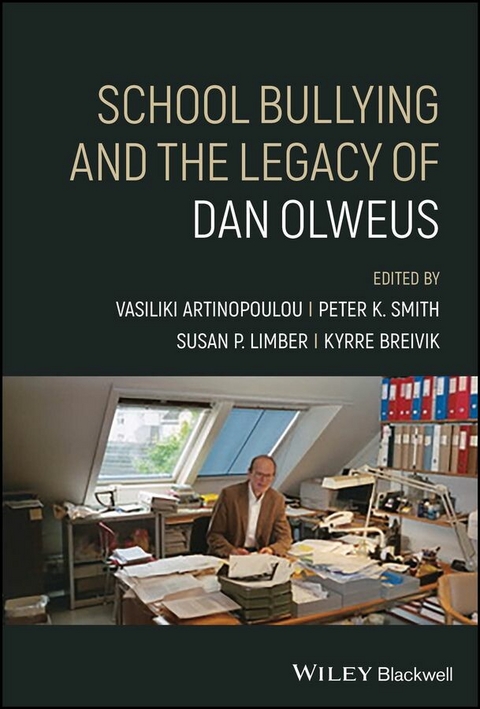
School Bullying and The Legacy of Dan Olweus (eBook)
532 Seiten
Wiley-Blackwell (Verlag)
978-1-394-17354-9 (ISBN)

The intellectual and personal history of the late Dan Olweus, a pioneer in the field of bullying management and prevention
School Bullying and the Legacy of Dan Olweus honours the work and legacy of Dan Olweus, a man generally seen as the 'founding father' in the field of bullying management and prevention who initiated a shift in how society, educators, parents and professionals handle and keep track of the hostility that some children display.
This book explores how Olweus developed the first widely used questionnaire to survey the issue of bullying and victimisation (the Olweus Bullying Questionnaire, or OBQ), was instrumental in designing the first intervention campaign against school bullying in Norway in the 1980s and developed a multi-layered program of intervention, the Olweus Bullying Prevention Program (OBPP), which is used in many countries around the world.
This book also provides constructive criticisms of his work, as well as ways to build on his legacy to reduce the impact of bullying on children and young people.
Delivering a summative view of his contribution to this research area, School Bullying and the Legacy of Dan Olweus discusses topics including:
- Olweus' research and practical achievements over three main stages: first in Sweden, then in Norway and then in later years
- Uses, strengths and limitations of the OBQ and OBPP, the views of Olweus on cyberbullying and his influence in Japan and China
- The definition of bullying, bias-based bullying and research challenges around the assessment of interventions
- The view of the school as a complex adaptive system and the contribution of civil society and of laws and policies against bullying
Providing an expansive intellectual and personal history of a leader in the field, School Bullying and the Legacy of Dan Olweus is an essential read for all parents, educators, administrators, researchers and professionals seeking to understand and prevent bullying in schools around the world.
VASILIKI ARTINOPOULOU is Professor of Criminology at Panteion University of Social and Political Sciences in Athens, Greece, where she previously served as Vice Rector. She currently leads the Greek Prime Minister's Expert Committee on Youth Violence and is a member of the UN Subcommittee for the Prevention of Torture. Her work centers on justice, human rights, and crime prevention in Europe and beyond.
PETER K. SMITH is Research Fellow at University of Greenwich, UK. He has led extensive research on bullying in schools, including a COST Action on Cyberbullying. Smith has published widely on the topic and co-edited The Wiley Blackwell Handbook of Bullying: A Comprehensive and International Review of Research and Intervention, a landmark reference in the field of bullying research.
SUSAN P. LIMBER is Dan Olweus Professor at Clemson University, where she also is Associate Director of the Institute on Family & Neighborhood Life. A developmental psychologist and expert in legal issues related to bullying, Limber has consulted for the U.S. Department of Health and Human Services and co-authored key works such as Cyberbullying: Bullying in the Digital Age.
KYRRE BREIVIK is Senior Researcher at the Regional Centre for Child and Youth (RKBU) at NORCE Norwegian Research Centre. He has published extensively in leading journals such as Frontiers in Psychology, Journal of Child Psychology and Psychiatry, and Journal of School Psychology. Breivik's work focuses on developmental issues, bullying, and interventions for improving well-being among children and adolescents.
The intellectual and personal history of the late Dan Olweus, a pioneer in the field of bullying management and prevention School Bullying and the Legacy of Dan Olweus honours the work and legacy of Dan Olweus, a man generally seen as the founding father in the field of bullying management and prevention who initiated a shift in how society, educators, parents and professionals handle and keep track of the hostility that some children display. This book explores how Olweus developed the first widely used questionnaire to survey the issue of bullying and victimisation (the Olweus Bullying Questionnaire, or OBQ), was instrumental in designing the first intervention campaign against school bullying in Norway in the 1980s and developed a multi-layered program of intervention, the Olweus Bullying Prevention Program (OBPP), which is used in many countries around the world. This book also provides constructive criticisms of his work, as well as ways to build on his legacy to reduce the impact of bullying on children and young people. Delivering a summative view of his contribution to this research area, School Bullying and the Legacy of Dan Olweus discusses topics including: Olweus' research and practical achievements over three main stages: first in Sweden, then in Norway and then in later years Uses, strengths and limitations of the OBQ and OBPP, the views of Olweus on cyberbullying and his influence in Japan and China The definition of bullying, bias-based bullying and research challenges around the assessment of interventions The view of the school as a complex adaptive system and the contribution of civil society and of laws and policies against bullying Providing an expansive intellectual and personal history of a leader in the field, School Bullying and the Legacy of Dan Olweus is an essential read for all parents, educators, administrators, researchers and professionals seeking to understand and prevent bullying in schools around the world.
CHAPTER ONE
Our Father Dan
Cecilia Olweus and Johanna Olweus
The Early Years and Crafting of a Musician
Dan Åke was born on April 18, 1931, in idyllic, beautiful Kalmar, Småland, in southern Sweden. At that time, Kalmar was inhabited by about 20,000 people. Dad was the second child in line. He had an older brother, Hans, who went by the nickname Hasse. Hasse was just two years older, and the two stuck together. As a child, Dan admired his big brother, and when there was a decision to be made, he always looked up at his big brother and asked, “What do you think, Hasse?” The brothers were not as innocent as they seemed. There were stories about their mother's hidden storage of 12 kinds of Christmas cookies that mysteriously emptied well before the holiday. If they did something wrong, they did it together (Figure 1.1).
His mother wrote in neat handwriting that Dan was very trusting from an early age, but “quite stubborn—yet easily persuaded.” The latter changed later, at least we daughters thought so.
Figure 1.1 Dan, approximately two years old, together with his two‐years‐older brother Hasse (Hans) at the photographer´s studio. With permission of Johanna Olweus.
The summers were infinitely long and happy at the family's summer house on the island Öland, just outside Kalmar. Adults and children alike played croquet and tennis, swam, and cycled with friends. Dad was an expert at escaping tedious garden work, such as weeding in the strawberry field, although he was very fond of strawberries and cream. Whenever we, his daughters, asked him to tell stories from his childhood, he was happy to tell us this and much more. Patiently, he recounted the same tales time and again, and we never grew weary of listening.
His father, Daniel, a lawyer blessed with a great sense of humor, was always amazed at his sons' outstanding academic achievements. “I was never that accomplished” was his standard remark. His mother, Hilly, was a housewife and a talented tennis player, earning multiple Småland tennis championships over the years. To the astonishment of Dan and Hasse, after nearly a decade, the brothers were graced with the arrival of three little sisters. First came Bettan, followed by Eva, and finally, Maria, who was 13 years younger than our father.
Dan became interested in music early on. Both of his parents were musical, and the family had a grand piano in its huge apartment in Kalmar. At the age of 11, Dan got his first instrument, a French horn. The horn was, however, quickly replaced with a cornet, which he played in the school's music orchestra. But soon enough, the brothers developed an interest in playing something else than marches, for jazz had also made its way to Kalmar.
Dan on trumpet and Hasse on trombone were joined by Dan's friend Harald Gamme on tenor saxophone. Dan's nickname at the time was Lillis—“the little guy”—due to his short stature. Harald, or Halle as he was called, was Dan's oldest and dearest friend, and the two remained close throughout their lives. Halle would later become a journalist at Kalmar's premier newspaper, Barometern, and authored the book Jazz in Kalmar.
Here are some excerpts from Halle's eulogy about Dan:
We met at Kalmar Higher General High School (Kalmar högre allmänna lärovärk) in the fall of 1942. We immediately became friends due to our mutual interest in music. For the first time, the school was going to organize a Christmas party for all classes in the gymnasium. Lillis and I, along with three other friends, were to play the then‐popular tune “Lili Marlene”, which begins with a fanfare. Lillis put the trumpet to his mouth, unfortunately started on the wrong note and had to interrupt. He sat down, but quickly got up again and did it right this time, to thunderous applause.
Lillis was already then active in many areas, a lively boy with an interest in soccer and athletics, but music was his passion. Because of his short stature, he often had to raise his voice to be noticed. But during the summer of 1946, he grew at rocket speed and reached adult length in two months.
In school, he was phenomenal at talking his way out of situations when he did not know the answer to a teacher's question. Somehow, he always managed to switch the conversation to a topic that he knew well.
In 1945, I had a summer job and had saved up enough money for a used tenor sax. Lillis and his brother had trumpet, trombone, and clarinet (also played by Dan). Finally, what we had talked about during every school recess was about to happen. A jazz orchestra was to be formed and thus King Kellers Orchestra came into existence. We bought pre‐made arrangements and commenced our rehearsals.
By the late spring of 1946, we found ourselves ready to make our debut on the dance floors and joined the Swedish Musician's Association in search of gigs. However, when we inquired about the process, the response we received was: “You'll have to handle that yourselves”. Easier said than done. We placed an advertisement in the local newspaper, Barometern, which proclaimed: “King Kellers popular six‐man orchestra available for engagements. Performs both Modern and Old dance music.” We were up and running!
In 1947, all orchestra members were students at Kalmar Higher General High School. At that time, school guidelines stated that students could only attend public entertainment if accompanied by their parents. Sure enough, in the auditorium after morning prayer before the first lesson, Rector Göransson took the podium: “It has come to my attention that students at this school perform dance music at public events. This is strictly prohibited and must of course not occur in the future”. Suddenly we were on thin ice. Already the following Saturday we had a contract for a gig in Kalmar Folkets Park.
“Folkets Park” (the People's Park) existed all over Sweden and in those days was the party place for all young adults. Every Saturday between 700 and 1,200 people gathered to dance and drink in Kalmar Folkets Park, and not infrequently, there was a fight or two.
So what did the 16‐year‐old boys do? Halle continues:
Shaken, we called Edvin Pettersson, the manager of Folkets Park, who also happened to be the train master, to complain about our distress. The honorable man promised to take care of the matter, we should not worry. Even today, I can envision Pettersson with confident steps, dressed in a black overcoat and hat passing the school yard on his way to rector's office to set rector straight. It took 15 minutes. From that day onward, we played without any interference from the rector or the college.
The boys practiced rigorously, and their coolness factor increased in tandem. Now it was all about bebop, characterized by its intricate rhythmic changes and virtuosic improvisations, not always appreciated by the dance‐loving locals. Dad would chuckle as he remembered calls from the audience: “Play a waltz, guys!”
King Kellers were now a group of stylish teenagers in white jackets, with bandleader and older brother Hans clad in black. However, after the summer of 1947, Hans embarked on his law studies in Lund. It was then that 16‐year‐old Dan stepped up as the new bandleader, assuming the responsibility of composing all the orchestral arrangements, testing all chords on the piano (Figure 1.2). He also took over the role as chronicler, documenting the orchestra's adventures with the characteristic handwriting that would accompany him throughout his life. A beautiful and personal handwriting, however challenging for others to decipher.
In the fall of 1948, King Kellers was ready to sign up for the nationwide jazz band competition, organized by the magazine Orkester‐journalen and the esteemed dance palace Nationalen, also known as Nalen, in Stockholm. At that time, the orchestra had grown to seven members.
Halle recalls:
The competition consisted of five preliminary rounds, each featuring five orchestras competing with two musical numbers each. The winner of each round received a medal and moved on to the final held at the Concert House. Our diligence during the autumn rehearsals was not in vain. We won our round and advanced to the finals largely thanks to the then 17‐year‐old Lillis's ultra‐modern trumpet playing. He was very talented. He had already adopted Dizzy Gillespie's aggressiveness and phrasing and, naturally, received the round's soloist prize. The professionals in Stockholm were deeply impressed and much to our delight, we secured a second‐place finish in the finals. We had placed Kalmar on the Swedish jazz map.
Figure 1.2 Dan “Lillis” took over as band leader for King Kellers, 16 years old. His best friend throughout life, Halle (Harald Gamme), far right. With permission of Johanna Olweus.
On Spotify, we can hear how King Kellers sounded in the fall of 1948. Dan's grandchildren posted one of the two numbers from the competition: “Our Delight.” The arrangement is by Dan, and the third and final solo is his trumpet solo. In the fall of 1949, there was a radio recording in Swedish Radio.
In between playing, there was also time for some studies. Dan did very well during the first year and a half at the...
| Erscheint lt. Verlag | 31.1.2025 |
|---|---|
| Sprache | englisch |
| Themenwelt | Geisteswissenschaften ► Psychologie ► Entwicklungspsychologie |
| Schlagworte | bias based bullying • bullying laws • bullying research • bullying society • china bullying • Cyberbullying • intervention school bullying • japan bullying • OBPP • OBQ • Olweus Bullying Prevention Program • Olweus Bullying Questionnaire |
| ISBN-10 | 1-394-17354-7 / 1394173547 |
| ISBN-13 | 978-1-394-17354-9 / 9781394173549 |
| Informationen gemäß Produktsicherheitsverordnung (GPSR) | |
| Haben Sie eine Frage zum Produkt? |
 EPUB (Adobe DRM)
Kopierschutz: Adobe-DRM
Adobe-DRM ist ein Kopierschutz, der das eBook vor Mißbrauch schützen soll. Dabei wird das eBook bereits beim Download auf Ihre persönliche Adobe-ID autorisiert. Lesen können Sie das eBook dann nur auf den Geräten, welche ebenfalls auf Ihre Adobe-ID registriert sind.
Details zum Adobe-DRM
Dateiformat: EPUB (Electronic Publication)
EPUB ist ein offener Standard für eBooks und eignet sich besonders zur Darstellung von Belletristik und Sachbüchern. Der Fließtext wird dynamisch an die Display- und Schriftgröße angepasst. Auch für mobile Lesegeräte ist EPUB daher gut geeignet.
Systemvoraussetzungen:
PC/Mac: Mit einem PC oder Mac können Sie dieses eBook lesen. Sie benötigen eine
eReader: Dieses eBook kann mit (fast) allen eBook-Readern gelesen werden. Mit dem amazon-Kindle ist es aber nicht kompatibel.
Smartphone/Tablet: Egal ob Apple oder Android, dieses eBook können Sie lesen. Sie benötigen eine
Geräteliste und zusätzliche Hinweise
Buying eBooks from abroad
For tax law reasons we can sell eBooks just within Germany and Switzerland. Regrettably we cannot fulfill eBook-orders from other countries.
aus dem Bereich


