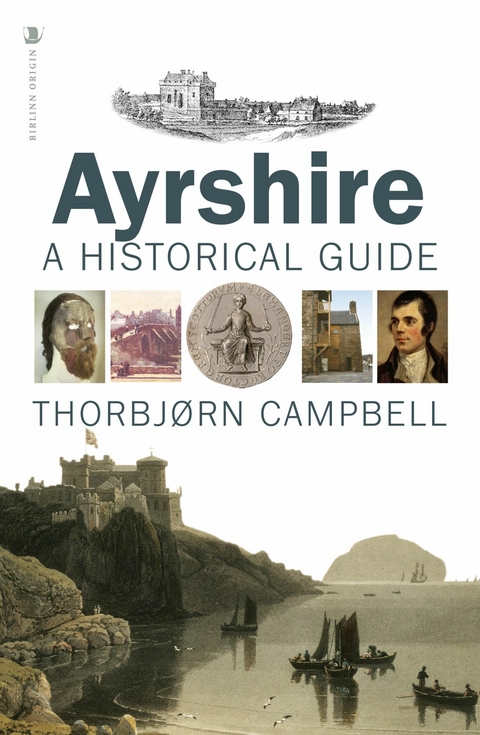
Ayrshire (eBook)
304 Seiten
Origin (Verlag)
978-1-78885-766-6 (ISBN)
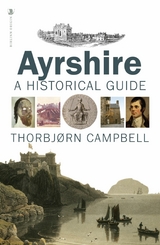
Thorbjorn Campbell (aka K.T.S. Campbell) was born and bred in Ayrshire. Educated at Ayr Academy, Glasgow University (where he studied Greek, English and aesthetic philosophy) and at Jordanhill Teacher Training College, he then worked as a civil servant and a school teacher and is now retired.
Thorbjorn Campbell (aka K.T.S. Campbell) was born and bred in Ayrshire. Educated at Ayr Academy, Glasgow University (where he studied Greek, English and aesthetic philosophy) and at Jordanhill Teacher Training College, he then worked as a civil servant and a school teacher and is now retired.
FOREWORD
My father was a local government official in Ayrshire and his job, winter and summer, took him far and wide over the highways and byways of the old county. For thirty-seven years he was never happier than when cruising along some leafy unfrequented road in Carrick or entering the portals of some great industrial undertaking in Cuninghame. He was not a desk man, and in later years when he was promoted and relatively office-bound, his sunny nature suffered something of an eclipse. Many were the stories he brought home to us, and I would occasionally suggest that he should write a book entitled Old Ayrshire by One Who Knows. He would decline the challenge, saying, in his mild way, that he had a fancy to end his days out of jail. The book remained unwritten. Here is one of the more printable tales.
During the Second World War, when Hermann Göring’s Luftwaffe were doing their best to eradicate British war industries, they attacked the vast explosives and chemical factory at Ardeer near Stevenston. The explosions were seen and heard all over Ayrshire, and there were many casualties. The morning after the raid my father happened to be calling on a Co-op, predecessor of supermarkets, in Kilwinning. There was a queue, of course, and two typical Ayrshire ‘bodies’, curlers under head-scarves, carpet slippers, shopping-bags carried near the ground, were in the line having an animated conversation, just in front of my father and a rather stiff-looking English lady, who obviously had a low opinion of these Ayrshire natives.
‘Did ye hear it last night?’ said Bodie A.
‘Aye,’ said Bodie B. ‘It was that bad, the pig fell oot the bed!’
The English lady’s eyes bulged in mingled triumph and horror at the image. But ‘pig’ was and is Ayrshire (and other) dialect for a stoneware hot-water bottle ...
It is still possible – just – to walk out along the old Ayr harbour breakwater and turn to face inland from the lighthouse, surveying the whole sweep of the Ayr Bay coastline from the Heads of Ayr in the south to the Cumbraes in the north. Then, turning again, you may gaze out over the firth, from Ailsa Craig massively rising out of the sea, and the impressive mountainscape of Arran, to the northern narrows of the estuary, the Holy Loch, the Loch Lomond Hills and the Paps of Jura. It is a spectacular setting that can be enhanced by taking the road to the top of Carwinshoch Hill, the Brown Carrick, which commands a view from the north coast of Ireland and the distant Campbeltown on the Mull of Kintyre to Schiehallion in Perthshire. But for all its romantic beauty, this segment of Britain is nowadays such a mundane and unremarkable backwater that it may come almost as a shock to realise that Ayrshire too has a history, that exciting and alarming events have occurred within its borders, and even that it has not always been a single unit – as Ayrshire – nor always a part of Scotland. Between the northern and southernmost points of Ayrshire – Wemyss Bay to the Galloway Burn – lies a great deal of history.
This history begins far back in the mists of time, long before the integration and realization of Ayrshire itself. Part I of this book tries to give an account of how Ayrshire came about – not just of what happened there once it was in existence. In order to understand the components of what became Ayrshire you have to take into account Strathclyde and Galloway and their long prehistory in the form of Brythonic tribes that may have been in the Ayrshire region since Neolithic times and even before then.
Even in the very deep past, ten or eleven thousand years ago, when the first Mesolithic pioneers crept in their tens or twenties through the silent forests of post-glacial Scotland or came upon the shimmering expanse of Loch Doon, their strategies to make use of the gifts of nature can be recognised – in their industrial chipping of ‘microliths’ still to be found in quantities on that loch’s shores, or in their huge shell-mounds at the edge of the sea, one of which was removed only a century ago near the Castle Hill at Ardrossan. These signs are reproduced all over Britain, showing that human beings were for the first time invading the inhospitable lands of the north and wresting them to their own use. Later, the first glimmerings of state and religious organisation are to be seen in the great row of hill-top cairns that stretches down to the sea from Knockdolian, unmistakably delineating a sacral and royal precinct even if we do not know the names of the people or the kingdom. That little patch of human settlement in the Glen App region endured and still endures – now as an integrated part of Ayrshire.
These apparently forgotten people developed a fully Megalithic culture, perhaps more clearly in places like Arran (on the plain of Machrie) or Orkney, but in Ayrshire well attested by henges, standing stones and cup-and-ring marked rocks. The relics seem anonymous and unresponsive to us, yet present-day place-names, Finnarts Hill, Ayr, Girvan, Loudoun, echoing the names of ancient Celtic deities, may through them preserve a trace of the original Neolithic sense of local divinity and kingly power. Such traces are as worthy of preservation in Ayrshire as in any other part of Britain.
The ‘prehistory’ of Ayrshire winds through some rather tortuous and gloomy cleughs before arriving at the plain vista of 1371 – the approximate date of integration under Robert II. Yet I have thought it worthwhile in Chapter 2 of Part I to take the reader through some of the linguistic evidence for the pre-1000 period, to display the great melting pot of Cymric, Anglian, Gaelic and Norse influences that can be traced in Ayrshire place-names even today. I have speculated on David I’s dismemberment of Strathclyde and his sharing out of the fragments among his Norman colleagues, and I have shown the practical effects of this reorganisation. I have tried to unravel the dynastic rivalries and alliances that in the end led William the Lion to set up his royal castle at Ayr in 1197 and some years later to establish a sheriffdom there with putative powers extending ‘on paper’ from Cuninghame to Carrick. I have also given, in the Gazetteer, a very brief description of the development of the three principal burghs of northern Ayrshire; Ayr, Irvine and Prestwick – and I should like to give notice here that I have not tried to emulate let alone surpass the meticulous and all-embracing studies of Strawhorn and Dodd, to which I refer all seekers after more information.
I have grappled in a very short compass with the gigantic mess of hesitation, accident, frenzy and misunderstanding that led the Earl of Carrick to renounce his allegiance to the King of England, to make his earldom a base for an adventure which by any standards must have been regarded as crazy, and to come to the throne of a new-minted realm – and by the way to make a Gordian knot of inheritance that, two generations later, by the interposition of a royal house not his own, casually created the integral shire of Ayr. All this with more than one glance over my shoulder at the presiding genius of Bruce history, Professor Barrow.
Newly-made Ayrshire in the fifteenth and sixteenth centuries must have resembled Somalia or Afghanistan in our own day, torn apart by warlords. Montgomeries, Cuninghames, Campbells, Kennedys, Wallaces – all plunged with enthusiasm into fierce rivalry for land and power. The removal or reduction of the threat of English annexation released these chieftains to a seemingly never-ending internecine civil war between families and factions. But once the Reformation had taken hold of Scotland, and the land-hunger in Ayrshire had been to some degree assuaged by the plundering and spoliation of the abbeys of Crossraguel and Kilwinning, the internal enmities began to subside. The people as well as the magnates came together to respond to the challenge of a vaguer, more abstract bogey – one, therefore, that could not be defeated so readily as a flesh-and-blood neighbour: the Church of Rome, and locally, episcopacy, the hated ‘rule of bishops’. Ayrshire magnates like the Earls of Cassillis, Eglinton and Loudoun, representing previously irreconcilable interests, rode together against Edinburgh in 1648 to establish a Presbyterian dictatorship, a Rule of Saints. Ayrshire people and rulers controlled Scotland and, for a brief moment, Scots were the Chosen People. But an exclusivist logic had its inevitable effect upon the Covenanters, and they dwindled to a ‘suffering remnant’ hiding in the hills above Muirkirk and New Cumnock, perpetually divided even against themselves. Siste viator.
In the task of compiling this brief record of Ayrshire’s history I have had the welcome assistance of many hands, and these must be acknowledged. Dr Richard Oram has been kind enough to read the whole text several times in the course of its development, to make many helpful suggestions and to save me from more than one egregious error. Without the assistance of the Royal Commission on the Ancient and Historical Monuments of Scotland (RCAHMS) I should have been lost – or perhaps even more forwandered. I must thank in particular Mr Iain Fraser, who assisted me vitally in coping with the intricacies of the great database ‘Canmore’. The staff at the new Museum of Scotland in Edinburgh and its library have been most helpful in the latter stages of preparation; Mr Andrew Martin and Dr Alison Sheridan have grappled nobly with my anxious queries. In the Dick Institute in Kilmarnock I have been assisted very materially by Mr...
| Erscheint lt. Verlag | 15.5.2025 |
|---|---|
| Reihe/Serie | Birlinn Historical Guides |
| Zusatzinfo | 8pp b/w plates; maps |
| Verlagsort | London |
| Sprache | englisch |
| Themenwelt | Geisteswissenschaften ► Geschichte ► Regional- / Ländergeschichte |
| Geschichte ► Teilgebiete der Geschichte ► Kulturgeschichte | |
| Schlagworte | Ayr • Ayrshire • Ayrshire history • Birlinn Historical Guides • historical guide • History of Ayrshire • In Depth History • Local History • Local Scottish History • Scottish History • Scottish local history |
| ISBN-10 | 1-78885-766-6 / 1788857666 |
| ISBN-13 | 978-1-78885-766-6 / 9781788857666 |
| Informationen gemäß Produktsicherheitsverordnung (GPSR) | |
| Haben Sie eine Frage zum Produkt? |
 EPUB (Wasserzeichen)
DRM: Digitales Wasserzeichen
Dieses eBook enthält ein digitales Wasserzeichen und ist damit für Sie personalisiert. Bei einer missbräuchlichen Weitergabe des eBooks an Dritte ist eine Rückverfolgung an die Quelle möglich.
Dateiformat: EPUB (Electronic Publication)
EPUB ist ein offener Standard für eBooks und eignet sich besonders zur Darstellung von Belletristik und Sachbüchern. Der Fließtext wird dynamisch an die Display- und Schriftgröße angepasst. Auch für mobile Lesegeräte ist EPUB daher gut geeignet.
Systemvoraussetzungen:
PC/Mac: Mit einem PC oder Mac können Sie dieses eBook lesen. Sie benötigen dafür die kostenlose Software Adobe Digital Editions.
eReader: Dieses eBook kann mit (fast) allen eBook-Readern gelesen werden. Mit dem amazon-Kindle ist es aber nicht kompatibel.
Smartphone/Tablet: Egal ob Apple oder Android, dieses eBook können Sie lesen. Sie benötigen dafür eine kostenlose App.
Geräteliste und zusätzliche Hinweise
Buying eBooks from abroad
For tax law reasons we can sell eBooks just within Germany and Switzerland. Regrettably we cannot fulfill eBook-orders from other countries.
aus dem Bereich