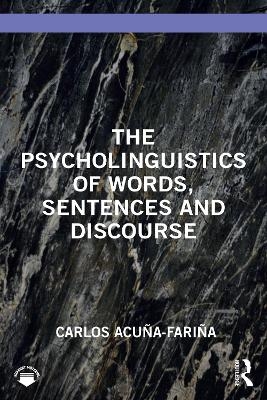
The Psycholinguistics of Words, Sentences and Discourse
Routledge (Verlag)
978-1-032-95848-4 (ISBN)
The Psycholinguistics of Words, Sentences and Discourse introduces the way words, sentences and discourse live in the mind. Actual language use is about putting together words into syntactic frames that make sense in a specific context. This book provides an overview of the many mental processes involved in that, explaining how the mind conjures up specific words and syntactic structures in a particular situation of discourse.
The book:
Offers an overview of historic research milestones as well as more recent developments and research in psycholinguistics
Introduces how words, sentences and discourse are processed in the mind
Answers questions such as what is needed to develop a linguistic capacity, and how current technology can help us enter the linguistic mind with a chapter on AI and language
Includes definitions of key linguistic terms, chapter outlines, discussion questions, suggestions for further reading and summaries of key points
This entertaining and informed introduction to the psychological reality of the human language faculty will be of interest to students and researchers in psycholinguistics, experimental psychology and artificial intelligence.
Carlos Acuña-Fariña, a linguist and a psycholinguist, is Professor of English Philology at the University of Santiago de Compostela, Galicia, Spain. His psycholinguistic research has used the methodologies of self-paced reading, eye-tracking and event-related potentials (ERPs). He is the author of Syntactic Processing: An Overview (2024).
Acknowledgments
1. Introduction
1.1. Going to the moon or translating
1.2. Clearing up three misunderstandings
1.3. What and how
Review questions
Further questions
2. Processing words
2.1. Introduction; what's in a word?
2.2. It is big and it moves fast, soooo fast...
23. Accessing the lexicon: three problems
2.4. Dealing with co-articulation
2.5. Activation is not selection
2.6. The words that meant too much
2.7. Selection criteria in access
2.8. The production of small words
2.9. Summarizing
Review questions
Further questions
3. Processing sentences
3.1. Introduction: What is a grammar good for?
3.2. The origin of sentence processing research
3.3. The origin of modern sentence processing research
3.4. The famous case of relative clauses after complex NPs
3.4.1. Introduction: the Garden Path Model
3.4.2. The Tuning model: the role of frequency in syntactic disambiguation
3.4.3. Construal: because not all constituents are created equal
3.4.4. The role of segmentation and prosody
3.4.5. The role of lexical and sentential meaning and context: Satisfying multiple constraints
3.4.6. The Unrestricted Race Model
3.5. The processing of agreement
3.5.1. Introduction
3.5.2. The phenomenon of attraction in production
3.5.3. Agreement in comprehension
3.6. The 'empty categories'
3.6.1. Introduction
3.6.2. PRO and the grammar of control
3.6.3. The Active Filler Strategy: traces
3.6.4. Word order as a guide
3.6.5. Summing up gaps (and, really, everything else …)
3.7. Heuristics and good-enough, goal-directed, predictive processing
Review questions
Further questions
4. Processing discourse
4.1. Discourse
4.2. The human inferential capacity
4.3. The memory of discourse
4.4. Referential coherence
4.5. Relational coherence (I)
4.6. Relational coherence (II)
4.7. Schemas and memory: computational economics that come at a price
Review questions
Further questions
5. Epilogue: artificial intelligence and language
5.1. Introduction
5.2. Artificial intelligence and human language
5.3. Artificial intelligence and 'sophisticated' syntax
Review questions
Further questions
Index
| Erscheinungsdatum | 24.07.2025 |
|---|---|
| Zusatzinfo | 2 Tables, black and white; 10 Line drawings, black and white; 12 Halftones, black and white; 22 Illustrations, black and white |
| Verlagsort | London |
| Sprache | englisch |
| Maße | 156 x 234 mm |
| Gewicht | 410 g |
| Themenwelt | Geisteswissenschaften ► Psychologie ► Allgemeine Psychologie |
| Geisteswissenschaften ► Psychologie ► Verhaltenstherapie | |
| Geisteswissenschaften ► Sprach- / Literaturwissenschaft ► Sprachwissenschaft | |
| ISBN-10 | 1-032-95848-0 / 1032958480 |
| ISBN-13 | 978-1-032-95848-4 / 9781032958484 |
| Zustand | Neuware |
| Informationen gemäß Produktsicherheitsverordnung (GPSR) | |
| Haben Sie eine Frage zum Produkt? |
aus dem Bereich