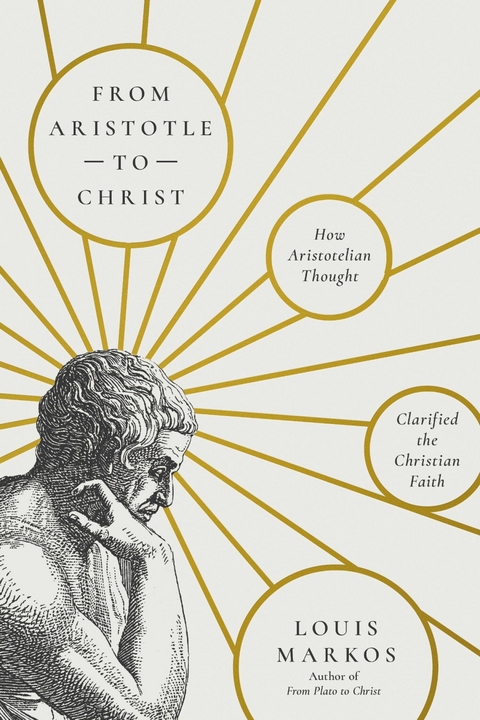
From Aristotle to Christ (eBook)
288 Seiten
IVP Academic (Verlag)
978-1-5140-1133-1 (ISBN)
Louis Markos (PhD, University of Michigan) is professor in English and scholar in residence at Houston Christian University, where he holds the Robert H. Ray Chair in Humanities. His 27 books include The Myth Made Fact; From Plato to Christ; From Achilles to Christ; Ancient Voices: An Insider's Look at Classical Greece; Heaven and Hell; Apologetics for the 21st Century; Atheism on Trial; and Passing the Torch: An Apology for Classical Christian Education. He has published over 300 essays and given over 300 public lectures. He is committed to the concept of the professor as public educator. He has two grown children and lives in Houston, Texas.
Discover how Aristotelian thought has shaped Christianity through history and remains relevant for Christians todayWhen Christians of any age, country, or denomination debate the nature of the good life, the soul, free will, or design, Aristotle lies behind their logic as well as their rhetoric. Although Aristotle did not have access to the Bible's special revelation, he made full use of general revelation to arrive at deep truths about the nature of God, human identity, and the universe. In the Catholic Middle Ages the spiritual vision that undergirded Dante's Divine Comedy was strongly indebted to Aristotle's cosmology, and in the Protestant Reformation and Enlightenment the social vision of a well-run state was equally indebted to his political science. In a follow up to his well-loved book From Plato to Christ, renowned scholar Louis Markos takes us on a vigorous and celebratory journey through the work of Plato's greatest student, demonstrating Aristotle's often unacknowledged influence on the Christian faith. In Markos's hands, Aristotle is far from an irrelevant ancient philosopher but is instead an important conversation partner for some of history's greatest Christian thinkers and a thoughtful guide to today's most challenging questions. With this book, you'll:- Consider the influence of Aristotle's thought on the Christian faith,- Carefully analyze several of Aristotle's best-known texts,- Trace Aristotle's influence upon many key theologians in Christian history, and- Understand Aristotle's continuing importance for Christians today. This book is a perfect addition to any classroom that seeks to understand how classical thought intersects with Christianity, both past and present. Grab your copy today and explore the relationship between Aristotelian philosophy and Christianity.
Louis Markos (PhD, University of Michigan) is professor in English and scholar in residence at Houston Christian University, where he holds the Robert H. Ray Chair in Humanities. His 27 books include The Myth Made Fact; From Plato to Christ; From Achilles to Christ; Ancient Voices: An Insider's Look at Classical Greece; Heaven and Hell; Apologetics for the 21st Century; Atheism on Trial; and Passing the Torch: An Apology for Classical Christian Education. He has published over 300 essays and given over 300 public lectures. He is committed to the concept of the professor as public educator. He has two grown children and lives in Houston, Texas.
Preface
A PLATONIST LEARNS TO LOVE ARISTOTLE
“EVERY MAN IS BORN AN ARISTOTELIAN, or a Platonist. I do not think it possible that any one born an Aristotelian can become a Platonist; and I am sure no born Platonist can ever change into an Aristotelian.”
So pronounced from on high the great Romantic poet-critic-philosopher Samuel Taylor Coleridge in his table talk for July 2, 1830. “They are the two classes of men,” he goes on to explain, “beside which it is next to impossible to conceive a third. The one [the Aristotelian] considers reason a quality, or attribute; the other [the Platonist] considers it a power. I believe that Aristotle never could get to understand what Plato meant by an idea.”1
In many ways, Coleridge is correct. Aristotle rejected Plato’s central doctrine of the Forms (or Ideas). He could not, as we will see in the chapters below, accept the existence of purely abstract universal forms/ideas that were not connected to something particular and concrete. And yet, Aristotle did believe in real universal forms that gave shape, function, and purpose to the particulars of our world. Coleridge is right again that Aristotle treated reason as a quality or attribute of the soul rather than a power; yet here too, Aristotle recognized a higher, transcendent, immaterial source for reason.
Like Coleridge, I am a born-and-bred, dyed-in-the-wool Platonist. I published a book a few years back, From Plato to Christ, that celebrated Plato’s thought and its (mostly positive) influence on Christianity. For several years, I thought, channeling the spirit of Coleridge, that I could not possibly write the necessary sequel to that book, because no true lover of Plato could write an equally celebratory book about Aristotle and the (mostly positive) influence he had on Christianity. That you are holding this book in your hand is proof that I was able to overcome my hesitancy.
That is not to say I have been converted to Aristotelianism. I remain a proud and fervent Platonist. Nevertheless, my yearlong deep dive into Aristotle has convinced me not only of the equally overwhelming genius of Plato’s greatest student but of the essential contributions he made to Western and Christian philosophy and theology, ethics and political science, psychology and sociology, cosmology and aesthetics. Aristotle’s legacy is a flawed one, and it did not begin to exert direct influence on Christianity until the dawn of the Middle Ages, but it did help to clarify, more for good than for ill, much of what is central to Christendom and to Western civilization.
As with my previous book, I hope that this one will appeal to Christian and non-Christian readers alike. To the latter group, whether you are nonreligious, a member of another religion, or a seeker, I ask that you extend me grace as I seek to assess Aristotle’s impact on the West, particularly as it was filtered through the church. To the former group, especially those who share my evangelical faith, I ask that you extend grace to the medieval and Renaissance Christians—Catholic and Protestant—who were willing to learn at the feet of Aristotle and to be guided in their thoughts and actions by his insights.
Indeed, I think it best at the outset to warn my fellow evangelicals that Aristotle’s legacy has been greater among Catholics than Protestants. It was during the Catholic Middle Ages, after all, that Aristotle reigned supreme, exerting a strong influence on Thomas Aquinas and Dante and establishing philosophical methods that undergirded the work of the Scholastics (or Schoolmen).
Sadly, it was precisely Aristotle’s connection to Aquinas and the Scholastics that earned him—unfairly—the scorn of both Martin Luther and John Calvin. In the section on the Lord’s Supper in his Babylonian Captivity of the Church, Luther traces the Catholic doctrine of transubstantiation, with which he disagrees, to a revival of Aristotle and the works of Aquinas. He goes so far as to call Aristotle a beast and accuses the church of showing a blind subservience to Aristotle and the Catholic Scholastics who held him in such a high regard. He even, in a moment of exasperation, exclaims that the “Holy Spirit is greater than Aristotle.”2
As for Calvin, though he quotes Augustine copiously in his Institutes of the Christian Religion, he almost totally ignores Aquinas—as he does the pagan philosopher to whom Aquinas appealed so frequently. In a rare moment, Calvin mentions Plato’s greatest pupil only to directly condemn “the frigid doctrine of Aristotle.” Later, he extends his condemnation to “the Schoolmen, who have in a manner drawn a veil over Christ . . . besides impairing, and almost annihilating, faith by their obscure definition.”3 With Calvin and Luther sharing such a low view of Aristotle, it is no wonder that early Protestant thinkers in general distanced themselves from Aristotle.
Still, I hope that this sad quirk of history will not prevent evangelical readers from learning from Aristotle. Calvin and Luther, whether they realized it or not, stood firmly in the long tradition of Aristotelian logical, ethical, and political thought. Both Reformers, along with those who followed in their wake, used their hermeneutical skills to understand the Bible in its proper historical context—and that context included the strong and ubiquitous legacy of Aristotle.
According to Galatians 4:4, God the Father sent Christ into the world in the “fulness of time.” I believe that fullness includes the law and order Rome brought to the Mediterranean, which allowed the gospel to spread quickly across the empire; I also believe it includes the philosophy of Greece that laid a foundation for the kind of thought needed to articulate fully the revelation of Christ and the Bible. I am convinced that the Bible is the Word of God; I am equally convinced that it is not, nor was it meant to be, a self-contained encyclopedia of all that is good, true, and beautiful.
Just as Moses, who was trained in the pagan wisdom of the Egyptians (Acts 7:22), willingly received management advice from his pagan father-in-law (Ex 18), so Christian apologists from Boethius in the sixth century to Anselm in the eleventh to C. S. Lewis in the twentieth have effectively used Aristotle’s terminology and methodology to defend the faith and work out its full implications. Just as the biblical writers borrowed and transformed literary genres that seem to have their roots in the cultures of the ancient Near East (proverbs, lamentation) and Greece (epistles, biography), so theologians from Augustine to Aquinas, Calvin to Richard Hooker have borrowed—and repurposed—Aristotle’s syllogisms, categories, and distinctions to ground their systematic treatises.
In the Catholic Middle Ages, the spiritual vision of man’s place in the universe that undergirds Dante’s Comedy was strongly indebted to Aristotle’s cosmology; in the Protestant Reformation and Enlightenment, the social vision of man’s place in a well-run state was equally indebted to his political science.4 When Christians of any age, country, or denomination debate the nature of the good life, the soul, free will, or design, Aristotle lurks behind their logic as well as their rhetoric.
In From Plato to Christ, I devoted the first half of the book to Plato’s thought and the second to the bearing of that thought on Christianity. Such an approach will not do for the man who invented the system we still use today for breaking down and classifying knowledge into discrete packages—what college students call majors, and their professors call disciplines. One cannot lump together the multifaceted thought of a man who himself distinguished between theoretical thinking, which guides our beliefs; practical thinking, which guides our conduct; and productive thinking, which results in the making of beautiful and useful things.
Accordingly, in this book I will divide Aristotle’s thought into five broad categories: logic and science, metaphysics and cosmology, psychology and ethics, social and political science, rhetoric and aesthetics. In each of these sections, I will move back and forth between Aristotle’s works and the Christian thinkers he influenced. Though I will critique some aspects of Aristotelianism that I believe led Christianity down some wrong paths, my orientation will be appreciative and joyful, not critical and judgmental.
I will not drag Aristotle to the bar and make him apologize for holding beliefs contrary to the zeitgeist of the twenty-first century. To the contrary, I will place myself and my age under his wise tutelage and will endeavor to learn from the thinkers who learned from Aristotle. That modern science has disproven the shape of Dante’s universe does not take away from the goodness and truth that continue to flow from the Comedy. The cosmology that Dante inherited from Aristotle retains its full beauty and is still capable of provoking awe, wonder, and gratitude in our most jaded of centuries.
Aristotle’s Poetics and Nicomachean Ethics are as true today as they were when they were written; if his Politics seems a tad quaint in its refusal to imagine a state much larger than Athens, then at least he erred in the direction of the small, the intimate, and the human. In any case, his treatment of man as a political animal and his analysis of how the good life of the individual should reflect the good life of the citizen has not lost any of its relevance. Our age desperately needs to be reschooled by...
| Erscheint lt. Verlag | 23.9.2025 |
|---|---|
| Verlagsort | Lisle |
| Sprache | englisch |
| Themenwelt | Geisteswissenschaften ► Philosophie ► Philosophie Altertum / Antike |
| Geisteswissenschaften ► Religion / Theologie | |
| Schlagworte | Behavior • Bible • Biblical • Classical • COSMIC • Emotions • English • fear • Form • God • History • homeschool • Imitation • Jesus • Literature • matter • Neighbor • Philosophy • pity • Politics • Professor • Religion • rhetoric • Scripture • Student • Theologian • Theology • Universe • virtue |
| ISBN-10 | 1-5140-1133-6 / 1514011336 |
| ISBN-13 | 978-1-5140-1133-1 / 9781514011331 |
| Informationen gemäß Produktsicherheitsverordnung (GPSR) | |
| Haben Sie eine Frage zum Produkt? |
 EPUB (Wasserzeichen)
DRM: Digitales Wasserzeichen
Dieses eBook enthält ein digitales Wasserzeichen und ist damit für Sie personalisiert. Bei einer missbräuchlichen Weitergabe des eBooks an Dritte ist eine Rückverfolgung an die Quelle möglich.
Dateiformat: EPUB (Electronic Publication)
EPUB ist ein offener Standard für eBooks und eignet sich besonders zur Darstellung von Belletristik und Sachbüchern. Der Fließtext wird dynamisch an die Display- und Schriftgröße angepasst. Auch für mobile Lesegeräte ist EPUB daher gut geeignet.
Systemvoraussetzungen:
PC/Mac: Mit einem PC oder Mac können Sie dieses eBook lesen. Sie benötigen dafür die kostenlose Software Adobe Digital Editions.
eReader: Dieses eBook kann mit (fast) allen eBook-Readern gelesen werden. Mit dem amazon-Kindle ist es aber nicht kompatibel.
Smartphone/Tablet: Egal ob Apple oder Android, dieses eBook können Sie lesen. Sie benötigen dafür eine kostenlose App.
Geräteliste und zusätzliche Hinweise
Buying eBooks from abroad
For tax law reasons we can sell eBooks just within Germany and Switzerland. Regrettably we cannot fulfill eBook-orders from other countries.
aus dem Bereich