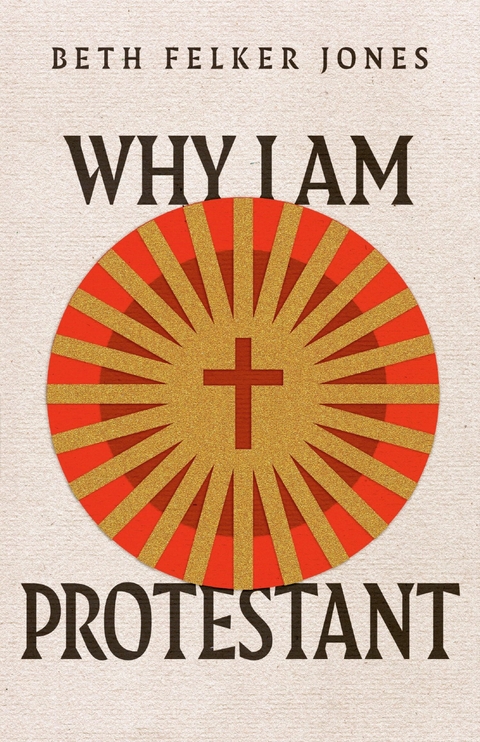
Why I Am Protestant (eBook)
160 Seiten
IVP Academic (Verlag)
978-1-5140-0301-5 (ISBN)
Beth Felker Jones (PhD, Duke University) is associate professor of theology at Wheaton College and former assistant professor of Bible and Religion at Huntington University. She is the author of The Marks of His Wounds: Gender Politics and Bodily Resurrection and Practicing Christian Doctrine: An Introduction to Thinking and Living Theologically.Jones is a columnist for the Christian Century and has written articles for publications such as Duke Divinity School's Faith and Leadership and Christianity Today's Her.meneutics blog. She lives in Wheaton, Illinois, with her husband Brian, a United Methodist pastor, and their four children.
Beth Felker Jones (PhD, Duke University) teaches theology at Northern Seminary and loves to write for the church and the academy. She lives in the Chicagoland area with her husband Brian, four kids, two dogs, and Dwight, her theology cat.
ONE
WHY I AM A CHRISTIAN
CHRISTIAN FAITH IS MY LIFE, my center, my everything. Jesus Christ is the one who animates my days, who gives me purpose and pulls me through, and who has shaped me, in big and small ways, for as long as I can remember. This is true professionally. My work is to teach and write about Christian theology, but it’s also true in every aspect of my life.
This makes the task of writing about why I am a Christian feel quite weighty. The personal stakes are high. What if I can’t articulate my answer well enough? (I won’t; there’s no “enough” to describe Jesus.) What if what I write is unpersuasive? (It cannot be, for it is the Spirit who persuades.) What if I don’t have anything new to say? (I won’t; I’m speaking of a faith with a long history and of a God who does not change.)
The parentheticals are my courage to keep writing. I don’t expect to offer an account of my faith that somehow surpasses other accounts. While I have personal things to say, I won’t have anything radically new to say, because who Jesus is and what he has done are not new. I write, then, vulnerably, to place my story in the context of my larger narrative in this book. I write to help you, my reader, understand why I am Protestant.
This chapter locates Protestant faith in its context: the context of the Christian faith as a whole. Protestant faith is first and foremost Christian faith, and the Protestant distinctives I’ll spend much of this book talking about matter far less than does that shared faith. The shared faith of Christians across traditions—including Eastern Orthodox, Roman Catholic, and Protestant—is far and away more significant than the matters separating those traditions. I remain convinced that Christians across traditions share the deposit of faith, which fits the rule of Vincent of Lerins; we believe that which Christians “everywhere, always, and all” (ubique, semper et ab omnibus) have embraced.1 If I can’t make that clear here, at the outset, I don’t want to write the rest of this book, because I’ll be talking about secondary matters split off from what comes first. In this chapter, I speak of why I am Christian in three ways. First, I’ll talk about my own story, then I’ll step back to talk about the big picture of Christian faith, and finally, I’ll ask us to think about what it means that God is the good God of good news.
A LIFE
I could start by saying I-grew-up-in-a-Christian-home (uttered quickly, almost all-one-word). Many Christians who, like me, don’t have dramatic conversion stories use this formula to begin to narrate the work of God in their lives. In many Protestant circles, “I-grew-up-in-a-Christian-home” tends to be voiced as an apology, with sheepishness, as though the work of God were less than when it happens through childhood and home and being raised in the church.
Grace, though, works in domesticity and in community. Grace works in parents who nudge their kids out of bed every Sunday, despite the “I don’t wanna go” and the “Church is boring.” It works in mothers who teach the Lord’s Prayer by bedsides and fathers who model giving and integrity. It works in local churches through Sunday school classes and youth groups and sermons and Bible studies. God does not eschew the domestic or the local. God does not disdain the quiet or the small.
God came to us to grow-up-in-a-Jewish-home, and that same God is happy to work in gentle and slow stories in other homes where God is honored. God also works in explosive and public ways. I love the dramatic conversion stories some of my friends can tell. But I am not a Christian because of my quiet story, and those friends aren’t Christians because they met God in fireworks. We are Christians because of God. We are Christians because of who God is and what God is doing in our lives, in the church, and in all creation.
My personal narrative, if recounted as a timeline of life events, is a common one. In my Christian home and my local church, I was always looking for and meeting Jesus. I always wanted God. I sang my heart out with the taped praise songs we kept in our car. I made big plans for Bible reading, which I sometimes kept, and I prayed earnestly, if sporadically, on retreats and at bedtimes. I resisted the kind of “getting saved” that involves responding to an altar call, partly because my parents had communicated their own distrust of accounts of God’s work that would disdain the small and slow and domestic, and partly because it felt disingenuous to make a decision for Jesus when I’d been wanting him for as long as I could recall.
Still, multiple times in multiple years at church camp I raised my hand when it was time to make that decision, checking off the box just in case I needed to do so to formalize Jesus’ presence in my life but also confirming and reaffirming my relationship with him. I’ve learned about Jesus by loving him, by teaching about him—from first efforts as a kindergarten Sunday school teacher and church camp counselor to my present job as a professor of theology—and in the experience of being sustained by him, through the power of the Spirit, through the good and the bad of an ordinary life.
I’ve known God as I’ve been fed at the Lord’s table, both when my hunger was met by weekly Communion and, during the Covid pandemic, through a long year of fasting. I’ve known God in weeping over injustice and in discovering God’s heart for justice and righteousness. I’ve known God in the mainline, Methodist church where I was baptized, in the kind of churches that claim nondenominationalism with praise bands and raised hands, in churches with haunting liturgies born in the English Reformation, and in churches in Kenya and Ethiopia where the singing lasts for hours and the many-tongued prayers go on even longer.
All that teaching about Jesus led to a sense that God was calling me, and I went to seminary, where the fuller riches of Christian doctrine and Christian tradition unfolded for me in new ways. I was in love with the same God of my Christian home, whom I was now discovering as the God of Augustine and Aquinas and Julian and Luther, the God of Africa and Asia and my own Midwestern United States, the God of the ancient church and of the Middle Ages, of the Reformation and of the present. I’ve known God intimately, palpably, as mystic fire, and I’ve known God when I haven’t felt an inkling of the divine presence for years on end.
But the God who was with me from the beginning was constant. My story isn’t dramatic, but God’s work is. God has transferred me from the dominion of sin and death into the kingdom of holiness and life. God has cleansed my sin and made me new creation, bringing me into right relationship with the Creator. God has knit me together with the body of Christ and given me good work to do as a part of the body. God is changing my life so that I am becoming, with time, more and more like Jesus. I know that’s an audacious sentence. God is audacious.
There are no public miracles to show here, but there are countless quiet ones, and that work of God matters to my family and my students. It matters to me. In God’s providence, it matters to all creation and to the kingdom that is without end. God is the drama of my story. It’s about what God has done, the same thing God has done in countless Christian lives and local churches through the centuries, justifying and sanctifying God’s people for life in right relationship to God, each other, and all of creation.
THE BEAUTY OF THE SHARED CHRISTIAN FAITH
I am a Christian because of who God is, and Christian faith acknowledges a God who is more beautiful and more compelling than any human mind could have conceived. We can know this God because of God’s goodness in revealing truth about the divine character and nature. The core teachings of the Christian faith are about who God is; and who God is, is why I am a Christian. There are different ways to describe those core teachings; here I’ll briefly speak of two. God is the God recognized in the reading of Scripture solidified in the early ecumenical councils, especially Nicaea and Chalcedon. And God is the God of the gospel, the good news for all people announced to the shepherds in Bethlehem and continuing to be announced by Christians today.
The “early ecumenical councils” may sound like a stodgy phrase for the beauty of God, but it points us to the history and the unity of Christian faith. Protestant, Roman Catholic, and Eastern Orthodox Christians all recognize the teaching of these councils.2 They are “early” because they predate some of the rifts that would give us those groups we now call Protestant, Roman Catholic, and Eastern Orthodox, and they are “ecumenical” because they belong to and are shared by the whole church of God. When we speak, then, of these councils, we are speaking of a great treasure, a deposit of faith that shapes Christians beyond any lines that divide us. We live in a time when many claim that there is nothing that unites Christians across those lines, but scores of worshipers who know God—God as the God of the early ecumenical councils, God as the God revealed in Scripture, the triune God—testify otherwise.
Above I referred to the teaching of these councils as “the reading of Scripture” solidified...
| Erscheint lt. Verlag | 30.9.2025 |
|---|---|
| Reihe/Serie | Ecumenical Dialogue Series |
| Verlagsort | Lisle |
| Sprache | englisch |
| Themenwelt | Geisteswissenschaften ► Religion / Theologie ► Christentum |
| Schlagworte | Beliefs • Bible • Biblical • Christian • Church • Comparison • Confessional • Conversation • Definition • Denomination • Dialogue • Doctrine • Ecumenical • fundamental • History • Interfaith • Introduction • Pastor • Professor • Reformation • Student • Testimony • Theology • Tradition • UNITY |
| ISBN-10 | 1-5140-0301-5 / 1514003015 |
| ISBN-13 | 978-1-5140-0301-5 / 9781514003015 |
| Informationen gemäß Produktsicherheitsverordnung (GPSR) | |
| Haben Sie eine Frage zum Produkt? |
 EPUB (Wasserzeichen)
DRM: Digitales Wasserzeichen
Dieses eBook enthält ein digitales Wasserzeichen und ist damit für Sie personalisiert. Bei einer missbräuchlichen Weitergabe des eBooks an Dritte ist eine Rückverfolgung an die Quelle möglich.
Dateiformat: EPUB (Electronic Publication)
EPUB ist ein offener Standard für eBooks und eignet sich besonders zur Darstellung von Belletristik und Sachbüchern. Der Fließtext wird dynamisch an die Display- und Schriftgröße angepasst. Auch für mobile Lesegeräte ist EPUB daher gut geeignet.
Systemvoraussetzungen:
PC/Mac: Mit einem PC oder Mac können Sie dieses eBook lesen. Sie benötigen dafür die kostenlose Software Adobe Digital Editions.
eReader: Dieses eBook kann mit (fast) allen eBook-Readern gelesen werden. Mit dem amazon-Kindle ist es aber nicht kompatibel.
Smartphone/Tablet: Egal ob Apple oder Android, dieses eBook können Sie lesen. Sie benötigen dafür eine kostenlose App.
Geräteliste und zusätzliche Hinweise
Buying eBooks from abroad
For tax law reasons we can sell eBooks just within Germany and Switzerland. Regrettably we cannot fulfill eBook-orders from other countries.
aus dem Bereich