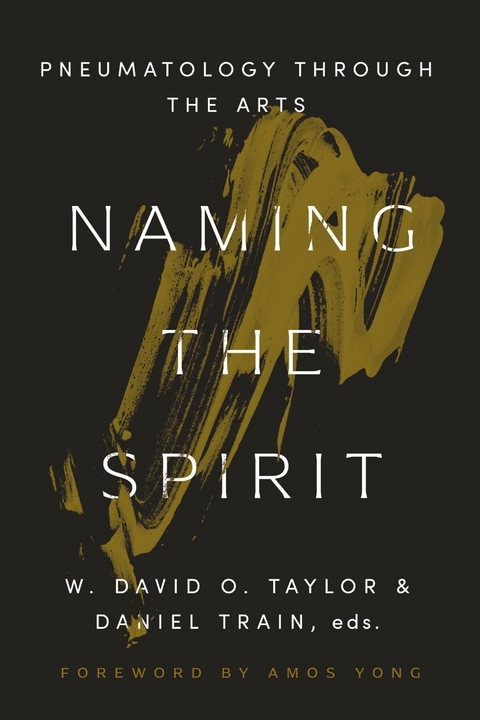
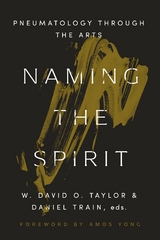
Naming the Spirit (eBook)
248 Seiten
IVP Academic (Verlag)
978-1-5140-1349-6 (ISBN)
Daniel Train (PhD, Baylor University) is assistant teaching professor of the practice of theology and the arts at Duke Divinity School, where he serves as the associate director of Duke Initiatives in Theology and the Arts (DITA). He is the coeditor of The Art of New Creation and The Saint John's Bible and Its Tradition: Illuminating Beauty in the Twenty-First Century. W. David O. Taylor (ThD, Duke University) is associate professor of theology and culture at Fuller Theological Seminary and the author of several books, including Prayers for the Pilgrimage, A Body of Praise, and Glimpses of the New Creation. In addition to a range of popular essays, he has published articles in the Calvin Theological Journal, Christian Scholar's Review, Worship, Theology Today, and Image Journal, among others. An Anglican priest, he has lectured widely on the arts, from Thailand to South Africa. In 2016 he produced a short film on the Psalms with Bono and Eugene Peterson.
Daniel Train (PhD, Baylor University) is assistant teaching professor of the practice of theology and the arts at Duke Divinity School, where he serves as the associate director of Duke Initiatives in Theology and the Arts (DITA). He is the coeditor of The Art of New Creation and The Saint John's Bible and Its Tradition: Illuminating Beauty in the Twenty-First Century. W. David O. Taylor (ThD, Duke University) is associate professor of theology and culture at Fuller Theological Seminary and the author of several books, including Prayers for the Pilgrimage, A Body of Praise, and Glimpses of the New Creation. In addition to a range of popular essays, he has published articles in the Calvin Theological Journal, Christian Scholar's Review, Worship, Theology Today, and Image Journal, among others. An Anglican priest, he has lectured widely on the arts, from Thailand to South Africa. In 2016 he produced a short film on the Psalms with Bono and Eugene Peterson.
Foreword
Amos Yong
AS A THEOLOGIAN WHO HAS SPENT much of his vocational life attempting to trace the impossible—as Jesus himself said, “The wind blows wherever it pleases. You hear its sound, but you cannot tell where it comes from or where it is going” (Jn 3:8)—I felt empowered in this impossibility through my reading of these essays collected in the pages to come. In particular, our colleagues in the following contributions invite us to notice and then appreciate the beauty of the divine wind and breath in and through the mundane experiences of life, particularly as mediated through the arts. Let me see if I can capture some of what was stirred in me through a few brief re-readings of three familiar biblical passages.
The first comes from the opening scene of Scripture, where we are told, “In the beginning when God created the heavens and the earth, the earth was a formless void and darkness covered the face of the deep, while a wind from God swept over the face of the waters” (Gen 1:1-2 NRSVA). While a number of aspects of the Genesis narrative appear and are engaged with by some of the chapters to come (especially the one by McNutt and Vander Lugt), I was inspired by the cumulative witness to observe the beautiful workings of the divine breath in what we have usually otherwise taken for granted. Hence, this initial primeval narrative implicates the sweeping of the rûaḥ ʾĕlōhîm across the primordial waters, but most of us forget about this manifestation in the unfolding creational saga.
However, aren’t we now invited to imagine the fluttering wind not only carrying forth the initial divine command, “Let there be light” (Gen 1:3), but also catalyzing the flickering and fluctuating of electromagnetic radiations of waves and frequencies that began illuminating the world? It is not only possible but even probable that the sweeping divine wind churns into sustained atmospheric storms of the sort that “separate[s] the waters from the waters” (Gen 1:6 NRSVUE) so that the waters above us gather—the sky!—even as the waters below also gather, thereby making a place for land (Gen 1:7-9). Isn’t it? From there, does the divine wind’s unpredictable blowing somehow vitalize the waters and the land in ways that prompt the emergence of self-organizing and self-metabolizing processes—single cells initially and other more complex forms of life in (agonizingly slow) tow—almost like how the Genesis narrator describes it? Doesn’t this follow the divine invitational granting of permission (rather than commanding): “The earth brought forth vegetation: plants yielding seed of every kind and trees of every kind bearing fruit with the seed in it” (Gen 1:12 NRSVUE)?
Biotic life here anticipates animal life, then, which involves not only further aquatic and terrestrial responses to divine summons but also an active divine involvement:
“Let the waters bring forth swarms of living creatures, and let birds fly above the earth across the dome of the sky.” So God created the great sea monsters and every living creature that moves, of every kind, with which the waters swarm and every winged bird of every kind. And God saw that it was good. . . . “Let the earth bring forth living creatures of every kind: cattle and creeping things and wild animals of the earth of every kind.” And it was so. God made the wild animals of the earth of every kind and the cattle of every kind and everything that creeps upon the ground of every kind” (Gen 1:20-21, 24-25 NRSVUE, italics added)
The latter more active divine role anticipated, it seems clear, the animation of earthly bodies with the divine breath of life (see Gen 2:7). In other words, what might elsewhere be described as mere evolutionary, geological, biological, and zoological processes come into aesthetic focus, through the traces of the witness of this volume (better seen in hindsight) of the divine wind.
The second comes from a passage core to the Pentecostal church and spirituality that nurtured me in faith and that has been the focus of much of my own efforts in theological interpretation of Scripture over decades: the Pentecost narrative in Acts 2. Although beautifully elaborated in Anderson’s chapter in what he calls the “spatialities of the Spirit,” what he says there alongside a number of other considerations of Pentecost more specifically, but also of the Spirit more broadly in the rest of the book, inspire me to look again at the beauty of the Spirit precisely in the disjointed humdrum of human life. On the one hand, the beautiful Spirit’s manifestation is precisely in the orchestration of the many languages of the human family; indeed, derived “from every nation under heaven” (Acts 2:5). We may not usually name the multiplicity of languages in aesthetic terms, but there is a resounding pleasantness to the richness of human language echoing in a multicultural community, even across the public square of any of our global metropolises then and now.
On the other hand, the aesthetic hermeneutic deployed for this project invites us to consider the Spirit’s beautifying effects in what we might not usually so name: the din and raucousness of non-orderly human multilinguality. In this case, Luke’s narration of the event, for example, “All were amazed and perplexed, saying to one another, ‘What does this mean?’” (Acts 2:12 NRSVUE), is indicative not just of marvelousness and wonderment at what was being voiced but also confusion, doubt, and dissonance, the latter of which persisted also cognitively. This led to the question of significance. Herein is perhaps what scholars of religion have called the mysterium tremendum et fascinens, encounters of the divine that prompt both astonishment and awe-fulness (even terror). With eyes to see, ears to hear, and perceptual sensibilities attuned, then, the divine beauty emerges for and to us kinesthetically from out of the mundane cacophony of the marketplace, indeed, wherever crowds may gather (Acts 2:6), as Luke says.
Having begun with Genesis 1 and now come through the Pentecost event (so very quickly I admit on both counts), one might guess I would then go also to the final portrait, and yes, for this, I am heeding the beckoning to our final destination by the Spirit and the bride, as John of Patmos envisioned such (Rev 22:17). Now the Christian theological tradition has generally not read the final book of the biblical canon pneumatologically, or Pentecostally, not least because the references to the Spirit are less pervasive. And yet this final unveiling of Jesus Christ not only comes also in part via the divine Spirit, in fact “from the seven spirits who are before his throne” (Rev 1:4 NRSVUE; cf. 1:10, 4:2, 17:3), to be more precise, but also is the epistolary means through which the divine Spirit addressed the seven churches in Asia. More to the point, the seven divine spirits go out from the throne of God “into all the earth” (Rev 5:6), in part to renew the ends, even the “four corners of the earth” (Rev 7:1; also Rev 20:8). From this perspective, if the creation account read in light of the pneumatic—or rûaḥ-ic, following the transliterated Hebrew term—bookend on the Scriptural front foregrounds the beautiful creation, then the eschatological new heaven and new earth with the new Jerusalem “coming down out of heaven” (Rev 21:10) read in light of the pneumatic summons on the back end similarly elucidates the gloriously reconstructed creation.
Concretely, we surely are overwhelmed by the magnitude of the city, blinded by the brilliance of the jewels adorning its foundational walls, dazzled by the pearly gates, and mesmerized by the reflective transparencies of its divinely irradiated streets. Here, if read in light of Craft and Taylor’s chapter on landscape architecture, we might see that the aesthetics of eschatological urban planning are informed by the aesthetically cultivated biosphere, with the “river of the water of life, bright as crystal, flowing from the throne of God and of the Lamb through the middle of the street of the city. On either side of the river is the tree of life with its twelve kinds of fruit, producing its fruit each month, and the leaves of the tree are for the healing of the nations” (Rev 22:2-3 NRSVUE). Might the kind of intentional cultivation of space that Craft and Taylor describe unfolding at Laity Lodge gesture toward, anticipate, or even participate in the “eschatological urban planning” we look toward? The last reference to the healing of the nations makes plain that the gorgeousness of the eschatological environment will be constituted in part also by its inhabitants—nature and culture thus blending together aesthetically—not just those from the nations or ethnic groups of the world in their distinct languages (Rev 5:9b, 7:9), but also with their cultural achievements: “the kings of the earth will bring their glory into it. . . . People will bring into it the glory and the honor of the nations” (Rev 21:24b, 26 NRSVUE). The Spirit’s invitation may be received in ways that imply only that new creational beauty derives from other triune persons and we meet the divine breath as the welcoming usher. However, Naming the Spirit: Pneumatology Through the Arts says otherwise: the many biblical texts opened up through aesthetic lenses help us to imagine the ongoing work of the divine breath as designed to beautify our worlds...
| Erscheint lt. Verlag | 2.9.2025 |
|---|---|
| Verlagsort | Lisle |
| Sprache | englisch |
| Themenwelt | Religion / Theologie ► Christentum ► Kirchengeschichte |
| Schlagworte | Architecture • Artist • Biblical • charismatic • Christ • Christian • Contemporary • creating • Culture • Design • Doctrine • Draw • drawing • Expression • Faith • Film • God • Holy • Jesus • Landscape • Making • media • music • painting • pentecostal • PERFORM • Poetry • Theater • Theology • Visual • Work |
| ISBN-10 | 1-5140-1349-5 / 1514013495 |
| ISBN-13 | 978-1-5140-1349-6 / 9781514013496 |
| Informationen gemäß Produktsicherheitsverordnung (GPSR) | |
| Haben Sie eine Frage zum Produkt? |
 EPUB (Wasserzeichen)
DRM: Digitales Wasserzeichen
Dieses eBook enthält ein digitales Wasserzeichen und ist damit für Sie personalisiert. Bei einer missbräuchlichen Weitergabe des eBooks an Dritte ist eine Rückverfolgung an die Quelle möglich.
Dateiformat: EPUB (Electronic Publication)
EPUB ist ein offener Standard für eBooks und eignet sich besonders zur Darstellung von Belletristik und Sachbüchern. Der Fließtext wird dynamisch an die Display- und Schriftgröße angepasst. Auch für mobile Lesegeräte ist EPUB daher gut geeignet.
Systemvoraussetzungen:
PC/Mac: Mit einem PC oder Mac können Sie dieses eBook lesen. Sie benötigen dafür die kostenlose Software Adobe Digital Editions.
eReader: Dieses eBook kann mit (fast) allen eBook-Readern gelesen werden. Mit dem amazon-Kindle ist es aber nicht kompatibel.
Smartphone/Tablet: Egal ob Apple oder Android, dieses eBook können Sie lesen. Sie benötigen dafür eine kostenlose App.
Geräteliste und zusätzliche Hinweise
Buying eBooks from abroad
For tax law reasons we can sell eBooks just within Germany and Switzerland. Regrettably we cannot fulfill eBook-orders from other countries.
aus dem Bereich