


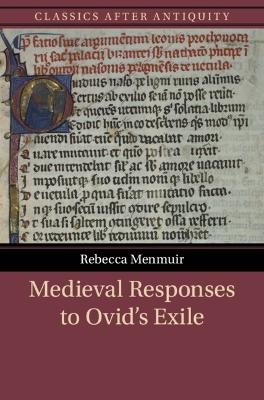
Medieval Responses to Ovid's Exile
Seiten
2025
Cambridge University Press (Verlag)
978-1-009-55392-6 (ISBN)
Cambridge University Press (Verlag)
978-1-009-55392-6 (ISBN)
Examines a variety of creative scholastic and literary responses to Ovid's exile across medieval culture, ranging across the medieval schoolroom, literary pilgrimages, fantasies of meeting or dismembering Ovid and the enduring influence of Ovid's exilic voice. Focuses especially on Geoffrey Chaucer, John Gower, John Lydgate and Christine de Pizan.
The Augustan poet Ovid exerted significant influence over the Middle Ages, and his exile captured the later medieval imagination. Medieval Responses to Ovid's Exile examines a variety of creative scholastic and literary responses to Ovid's exile across medieval culture. It ranges across the medieval schoolroom, where new forms shape Ovidian exile anew, literary pilgrimages, medieval fantasies of dismemberment and visits to Ovid's tomb. These responses capture Ovid's metamorphosis into a poet for the Christian age, while elsewhere medieval poets such as John Gower and Geoffrey Chaucer demonstrate how to inhabit an Ovidian exilic voice. Medieval audiences fundamentally understood the foundations laid by the exilic Ovid, and so from antiquity and from exile Ovid shaped his own reception. The extent, enthusiasm and engagement of medieval responses to Ovid's exile are to such a degree that they must be considered when we read Ovid's exilic works, or indeed any of his poetry.
The Augustan poet Ovid exerted significant influence over the Middle Ages, and his exile captured the later medieval imagination. Medieval Responses to Ovid's Exile examines a variety of creative scholastic and literary responses to Ovid's exile across medieval culture. It ranges across the medieval schoolroom, where new forms shape Ovidian exile anew, literary pilgrimages, medieval fantasies of dismemberment and visits to Ovid's tomb. These responses capture Ovid's metamorphosis into a poet for the Christian age, while elsewhere medieval poets such as John Gower and Geoffrey Chaucer demonstrate how to inhabit an Ovidian exilic voice. Medieval audiences fundamentally understood the foundations laid by the exilic Ovid, and so from antiquity and from exile Ovid shaped his own reception. The extent, enthusiasm and engagement of medieval responses to Ovid's exile are to such a degree that they must be considered when we read Ovid's exilic works, or indeed any of his poetry.
REBECCA MENMUIR is a Darby Fellow in English Literature at Lincoln College, Oxford, having previously held a British Academy Postdoctoral Fellowship at Queen Mary University of London. She has published widely on medieval classical reception, forgeries and the medieval schoolroom. She is also the editor of Authenticity in Medieval and Early Modern Literature (forthcoming).
Introduction; Part I. Responding to Exile: 1. Ovid's response; 2. Forming responses; 3. Resurrecting Ovid; Part II. Becoming the Exile: 4. Becoming the exile; 5. John Gower's Visio Anglie; 6. Geoffrey Chaucer's exilic voice; Epilogue: Forging exile.
| Erscheinungsdatum | 31.05.2025 |
|---|---|
| Reihe/Serie | Classics after Antiquity |
| Zusatzinfo | Worked examples or Exercises |
| Verlagsort | Cambridge |
| Sprache | englisch |
| Gewicht | 542 g |
| Themenwelt | Geschichte ► Allgemeine Geschichte ► Altertum / Antike |
| ISBN-10 | 1-009-55392-5 / 1009553925 |
| ISBN-13 | 978-1-009-55392-6 / 9781009553926 |
| Zustand | Neuware |
| Informationen gemäß Produktsicherheitsverordnung (GPSR) | |
| Haben Sie eine Frage zum Produkt? |
Mehr entdecken
aus dem Bereich



aus dem Bereich
ohne den ganzen langweiligen Kram
Buch | Hardcover (2025)
C.H.Beck (Verlag)
CHF 36,40
von den Anfängen bis zum Untergang
Buch | Hardcover (2025)
Alfred Kröner Verlag
CHF 48,95
eine Globalgeschichte der Antike
Buch | Hardcover (2025)
Klett-Cotta (Verlag)
CHF 53,20


