


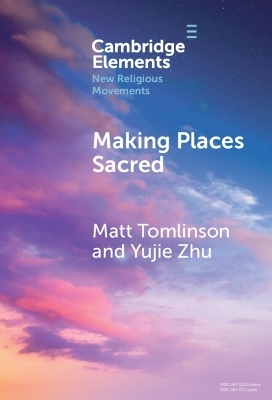
Making Places Sacred
New Articulations of Place and Power
Seiten
2025
Cambridge University Press (Verlag)
978-1-009-61632-4 (ISBN)
Cambridge University Press (Verlag)
978-1-009-61632-4 (ISBN)
This Element highlights how sacred space is newly made, often associated with blood, death, and geographic anomalies, yet no single feature determines sacred associations. It also examines the multidimensional and multisensory dimensions of sacred space, which can be made almost anywhere, including online, but can also be unmade.
Although claims to sacredness are often linked to the power of a distant past, the work of making places sacred is creative, novel, renewable, and reversible. This Element highlights how sacred space is newly made. It is often associated with blood, death, and geographic anomalies, yet no single feature determines sacred associations. People make space sacred by connecting with 'extrahuman' figures – the ancestors, spirits, and gods that people attempt to interact with in every society. These connections can be concentrated in people's bodies, yet bodies are particularly vulnerable to loss. The Element also examines the multidimensional and multisensory dimensions of sacred space, which can be made almost anywhere, including online, but can also be unmade. Unmaking sacred space can entail new sacralization. New and minority religions in particular provide excellent sites for studying sacredness as a value, raising the reliably productive question: sacred for whom?
Although claims to sacredness are often linked to the power of a distant past, the work of making places sacred is creative, novel, renewable, and reversible. This Element highlights how sacred space is newly made. It is often associated with blood, death, and geographic anomalies, yet no single feature determines sacred associations. People make space sacred by connecting with 'extrahuman' figures – the ancestors, spirits, and gods that people attempt to interact with in every society. These connections can be concentrated in people's bodies, yet bodies are particularly vulnerable to loss. The Element also examines the multidimensional and multisensory dimensions of sacred space, which can be made almost anywhere, including online, but can also be unmade. Unmaking sacred space can entail new sacralization. New and minority religions in particular provide excellent sites for studying sacredness as a value, raising the reliably productive question: sacred for whom?
Introduction; 1. Sacred for whom?; 2. Blood and death make places sacred; 3. Natural features and the sacred; 4. Performing the sacred; 5. The body – the most vulnerable sacred site; 6. Sacred space is multidimensional; 7. Sacred space is multisensory; 8. Sacred space can be unmade; 9. Sacred space reaffirms the human; Conclusion; References.
| Erscheinungsdatum | 10.04.2025 |
|---|---|
| Reihe/Serie | Elements in New Religious Movements |
| Zusatzinfo | Worked examples or Exercises |
| Verlagsort | Cambridge |
| Sprache | englisch |
| Maße | 152 x 229 mm |
| Gewicht | 227 g |
| Themenwelt | Geschichte ► Teilgebiete der Geschichte ► Religionsgeschichte |
| ISBN-10 | 1-009-61632-3 / 1009616323 |
| ISBN-13 | 978-1-009-61632-4 / 9781009616324 |
| Zustand | Neuware |
| Informationen gemäß Produktsicherheitsverordnung (GPSR) | |
| Haben Sie eine Frage zum Produkt? |
Mehr entdecken
aus dem Bereich


aus dem Bereich
von der Antike bis zur Gegenwart
Buch | Softcover (2025)
C.H.Beck (Verlag)
CHF 16,80


