


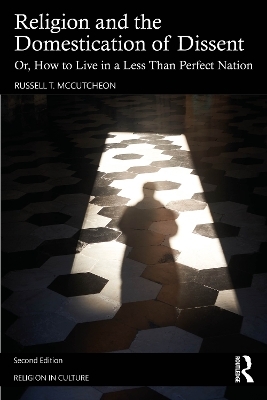
Religion and the Domestication of Dissent
Or, How to Live in a Less Than Perfect Nation
Seiten
2025
|
2nd edition
Routledge (Verlag)
978-1-032-89826-1 (ISBN)
Routledge (Verlag)
978-1-032-89826-1 (ISBN)
The cutting-edge new edition of Religion and the Domestication of Dissent examines how the classifications we use to name and negotiate our social worlds - notably 'religion' - are implicitly political, and is therefore not a descriptive but, rather, a socially formative category that accomplishes work in liberal democracies.
In its first edition, Religion and the Domestication of Dissent focused on the representations of Islam that circulated in the wake of the 9/11 attacks—representations that scholars, pundits, and politicians alike used either to essentialize and demonize it or, instead, to isolate specific aspects as apolitical and thus tolerable faith. This little book’s larger thesis therefore argued for how the classifications that we routinely use to identify and thereby negotiate our social worlds—notably such categories as “religion” or “faith”—are explicitly political.
This new edition, which updates the first and adds a new closing chapter, continues to be relevant today—a time when assertions concerning supposedly authentic and homogenous identities (whether shared by “us” or “them”) continue to animate a variety of public debates where the stakes remain high. Thinking back on how Islam was often portrayed in scholarship and popular media in western Europe and North America offers lessons for how debates today unfold on such topics as Christian nationalism—a designation now prominent among pundits intent on identifying the proper and improper ways in which religion intersects with modern political life. But it is this very distinction (between religion and politics) that ought to be attracting our attention, if we are interested not in which way of being religious is right or reasonable but, instead, in determining why some social groups are known as religious in the first place. Seeing the latter question as linked to studying how socially formative categories function in liberal democracies, Religion and the Domestication of Dissent offers an anthropology of the present, when the longstanding mechanisms of liberal governance seem to be under threat.
In its first edition, Religion and the Domestication of Dissent focused on the representations of Islam that circulated in the wake of the 9/11 attacks—representations that scholars, pundits, and politicians alike used either to essentialize and demonize it or, instead, to isolate specific aspects as apolitical and thus tolerable faith. This little book’s larger thesis therefore argued for how the classifications that we routinely use to identify and thereby negotiate our social worlds—notably such categories as “religion” or “faith”—are explicitly political.
This new edition, which updates the first and adds a new closing chapter, continues to be relevant today—a time when assertions concerning supposedly authentic and homogenous identities (whether shared by “us” or “them”) continue to animate a variety of public debates where the stakes remain high. Thinking back on how Islam was often portrayed in scholarship and popular media in western Europe and North America offers lessons for how debates today unfold on such topics as Christian nationalism—a designation now prominent among pundits intent on identifying the proper and improper ways in which religion intersects with modern political life. But it is this very distinction (between religion and politics) that ought to be attracting our attention, if we are interested not in which way of being religious is right or reasonable but, instead, in determining why some social groups are known as religious in the first place. Seeing the latter question as linked to studying how socially formative categories function in liberal democracies, Religion and the Domestication of Dissent offers an anthropology of the present, when the longstanding mechanisms of liberal governance seem to be under threat.
Russell T. McCutcheon is University Research Professor and, for 18 years, was the Chair of the Department of Religious Studies at the University of Alabama, USA. His publications include a variety of works on the history of the field, the everyday effects of the category “religion,” along with a number of practical resources for scholars, teachers, and students.
Introduction 1. “Religion” and the Lust for Dogmatic Rule 2. Swapping Spit Around the Campfire 3. The Tricks and Treats of Classification 4. A Little More Authentic than was Really Necessary 5. Another Reason Why Societies Need Dissent 6. That Versatile Little Problem-Solver 7. Having Your Cake and Eating It Too
| Erscheinungsdatum | 21.05.2025 |
|---|---|
| Reihe/Serie | Religion in Culture |
| Verlagsort | London |
| Sprache | englisch |
| Maße | 156 x 234 mm |
| Gewicht | 420 g |
| Themenwelt | Geisteswissenschaften ► Religion / Theologie |
| ISBN-10 | 1-032-89826-7 / 1032898267 |
| ISBN-13 | 978-1-032-89826-1 / 9781032898261 |
| Zustand | Neuware |
| Informationen gemäß Produktsicherheitsverordnung (GPSR) | |
| Haben Sie eine Frage zum Produkt? |
Mehr entdecken
aus dem Bereich


aus dem Bereich
Antisemitismus in der Bibel
Buch | Hardcover (2025)
Verlag Herder
CHF 29,90


