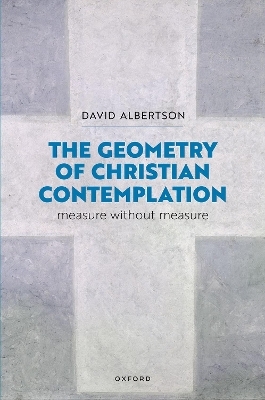
The Geometry of Christian Contemplation
Oxford University Press (Verlag)
978-0-19-894697-7 (ISBN)
The ancient Greek philosopher Plotinus had taught contemplatives to close their eyes and withdraw into the soul. Most Christians followed his directions, but others dissented. In three critical episodes, an alternative model of Christian contemplation began to emerge: from Dionysius the Areopagite, to the Byzantine monks John of Damascus and Theodore the Studite, to eccentric humanists in medieval Paris. Together these episodes add up to a very different theological aesthetics, one that can enliven the modern study of mysticism and correct some of its imbalances. For in the centuries before the scientific revolution and the secularization of nature, Christians still saw God in the exterior world, not only the interior soul. God was not an ineffable and formless Absolute, immeasurable as the soul, but an infinite Measure who leaves behind geometrical traces in the figures of the world. The God who became a human body in the Incarnation not only entered time and matter, but also spatial extension, and with it the conditions of measure: points, lines, curves, shapes, planes, dimensions, and magnitudes.
Today the wisdom of this counter-tradition can strengthen the study of mysticism, not only by supplementing our contemporary fascination with negative theology by redefining what it means to name God positively, but by suggesting a new connection between Christian mysticism and the hyper-measured, hyper-technologized world that surrounds us.
David Albertson is Associate Professor of Religion at the University of Southern California in Los Angeles, where he studies medieval Christianity and philosophy of religion and serves as Executive Director of the Nova Forum for Catholic Thought. He is the author of Cusanus Today: Thinking with Nicholas of Cusa Between Philosophy and Theology (CUA, 2024), Mathematical Theologies: Nicholas of Cusa and the Legacy of Thierry of Chartres (Oxford, 2014), and Without Nature? A New Condition for Theology (Fordham, 2009). His research is supported by the National Endowment for the Humanities and the Alexander von Humboldt Foundation.
Introduction
Part I. An Archaeology of the Formless
Chapter 1: The Silence of the World
Chapter 2: Guarding the One
Chapter 3: The Aneidetic Condition
Part II. A Genealogy of Form
Chapter 4: The Limits of Negation
Chapter 5: The Extension of Desire
Chapter 6: Kenosis into Magnitude
Chapter 7: The Icon as Figure
Chapter 8: Trinity and Form
Chapter 9: The Figure as Icon
Epilogue
| Erscheinungsdatum | 07.06.2025 |
|---|---|
| Verlagsort | Oxford |
| Sprache | englisch |
| Maße | 165 x 240 mm |
| Gewicht | 635 g |
| Themenwelt | Geisteswissenschaften ► Philosophie ► Philosophie des Mittelalters |
| Religion / Theologie ► Christentum ► Kirchengeschichte | |
| ISBN-10 | 0-19-894697-X / 019894697X |
| ISBN-13 | 978-0-19-894697-7 / 9780198946977 |
| Zustand | Neuware |
| Informationen gemäß Produktsicherheitsverordnung (GPSR) | |
| Haben Sie eine Frage zum Produkt? |
aus dem Bereich