


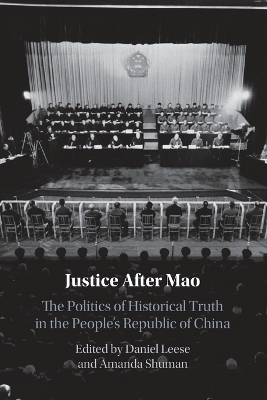
Justice After Mao
Cambridge University Press (Verlag)
978-1-009-26130-2 (ISBN)
How can a dictatorship cope with the legacy of injustices and atrocities committed in its own name? This was one of the pressing questions the Chinese Communist Party leadership faced after the death of Mao Zedong in September 1976 and the end of the Cultural Revolution. This collection presents ground-breaking, original research to address the question of historical justice in the Party's attempt to survive politically despite rampant factionalism and widespread political persecution. The volume traces complex questions of property restitution, fostering reconciliation within local communities, and establishing new standards of truth. Contributions also investigate how various actors remember the period in the present. The post-Mao period provides a lens through which to view strategies of coping with a violent past under state socialism, highlighting how selectively applied approaches now associated with the concept of transitional justice may even serve to strengthen rather than subvert authoritarian rule.
Daniel Leese is Professor of Chinese History and Politics at the University of Freiburg. Amanda Shuman is a lecturer and researcher at the University of Freiburg.
Introduction Daniel Leese and Amanda Shuman; Part I. Property: 1. Between revolution and law: Merchant families' struggles for property rights and justice under Mao and Deng, 1949–1984 Zhaojin Zeng; 2. What right to property when rebellion is justified? Revolution and restitution in Shanghai Puck Engman; 3. The pursuit of transitional justice from below: A case study from Shanghai Qin Shao; Part II. The Mechanics of Rehabilitation: 4. Dealing with victims of the Cultural Revolution: The case of the Guangxi killings, 1983–1987 Guoqing Song; 5. Villagers, cadres, and the politics of rehabilitation in post-Mao China, 1979–1982 Long Yang; Part III. The Politics of Truth: 6. Local reassessment versus central prestige: Tao Zhu, land reform, and the Pine Hill incident Mark Czeller; 7. New verdicts on the printed page: Expurgating the ,Gang of Four, in the publishing industry, 1976–1978 Matthew Wills; Part IV. Memory: 8. Narratives and voices of Cultural Revolution ,perpetrators, Man Zhang; 9. Coping with a traumatic past: Wang Bing's documentaries He Fengming and Dead Souls Flora Lichaa; 10. From individual guilt to public remorse: The ,Confessions, (Chanhuilu) column in the journal Yanhuang Chunqiu Sebastian Veg; Afterword: The Chinese Communist Party's politics of historical justice in perspective Daniel Leese.
| Erscheinungsdatum | 01.05.2025 |
|---|---|
| Zusatzinfo | Worked examples or Exercises |
| Verlagsort | Cambridge |
| Sprache | englisch |
| Themenwelt | Geisteswissenschaften ► Geschichte ► Regional- / Ländergeschichte |
| ISBN-10 | 1-009-26130-4 / 1009261304 |
| ISBN-13 | 978-1-009-26130-2 / 9781009261302 |
| Zustand | Neuware |
| Informationen gemäß Produktsicherheitsverordnung (GPSR) | |
| Haben Sie eine Frage zum Produkt? |
aus dem Bereich


