


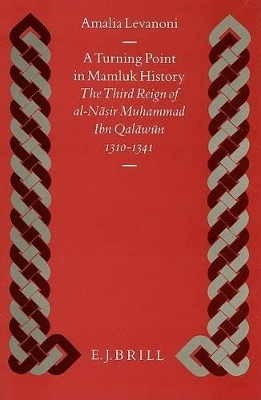
A Turning Point in Mamluk History
The Third Reign of al-Nāsir Muḥammad Ibn Qalāwūn (1310-1341)
Seiten
1995
Brill (Verlag)
978-90-04-10182-1 (ISBN)
Brill (Verlag)
978-90-04-10182-1 (ISBN)
Based on a fresh look at the contemporary Mamluk sources, this study challenges the conventional periodization of Mamluk history by dating the onset of the decline of the Mamluk state to the third reign of al-Nāsir Muḥammad. It furthermore reveals the Mamluk system as dynamic in nature, susceptible to change throughout its history.
A Turning Point in Mamluk History deals with the process of decline of the Mamluk state (1250-1517). Its main thesis is that the origins of this process are to be found in the third reign of al-Nāsir Muḥammad Ibn Qalāwūn, more specifically in the changes he effected in the Mamluk system.
The Mamluk army was the first to be confronted with these changes, whose impact on the social and political life of the Mamluk elite was already felt during al-Nāsir's own lifetime. The author follows their course of development to the end of autonomous Mamluk rule and reveals the transformation they wrought in the Mamluk code of values and political concepts.
A final chapter deals with the overall economic decline of the Mamluk state and establishes the link of its various causes—demographic decline, monetary crises, the collapse of agriculture and industry—with Mamluk government misrule. Here it is al-Nāsir's expenditure policy and its repercussions on the economy which reveal his reign as a point of no return.
A Turning Point in Mamluk History deals with the process of decline of the Mamluk state (1250-1517). Its main thesis is that the origins of this process are to be found in the third reign of al-Nāsir Muḥammad Ibn Qalāwūn, more specifically in the changes he effected in the Mamluk system.
The Mamluk army was the first to be confronted with these changes, whose impact on the social and political life of the Mamluk elite was already felt during al-Nāsir's own lifetime. The author follows their course of development to the end of autonomous Mamluk rule and reveals the transformation they wrought in the Mamluk code of values and political concepts.
A final chapter deals with the overall economic decline of the Mamluk state and establishes the link of its various causes—demographic decline, monetary crises, the collapse of agriculture and industry—with Mamluk government misrule. Here it is al-Nāsir's expenditure policy and its repercussions on the economy which reveal his reign as a point of no return.
Amalia Levanoni, Ph.D. (1990) in Islamic History, The Hebrew University of Jerusalem, teaches Medieval Islamic History at the Department of Middle Eastern History, University of Haifa. Her publications deal extensively with Mamluk history, which is her special field of interest.
| Erscheint lt. Verlag | 1.3.1995 |
|---|---|
| Reihe/Serie | Islamic History and Civilization ; 10 |
| Verlagsort | Leiden |
| Sprache | englisch |
| Maße | 155 x 235 mm |
| Gewicht | 586 g |
| Einbandart | Leinen |
| Themenwelt | Geschichte ► Allgemeine Geschichte ► Mittelalter |
| Geisteswissenschaften ► Geschichte ► Regional- / Ländergeschichte | |
| Sozialwissenschaften ► Politik / Verwaltung ► Politische Theorie | |
| Sozialwissenschaften ► Soziologie ► Spezielle Soziologien | |
| ISBN-10 | 90-04-10182-9 / 9004101829 |
| ISBN-13 | 978-90-04-10182-1 / 9789004101821 |
| Zustand | Neuware |
| Informationen gemäß Produktsicherheitsverordnung (GPSR) | |
| Haben Sie eine Frage zum Produkt? |
Mehr entdecken
aus dem Bereich


aus dem Bereich
Geschichte einer Augsburger Familie (1367-1650)
Buch | Softcover (2024)
Kohlhammer (Verlag)
CHF 47,60


