


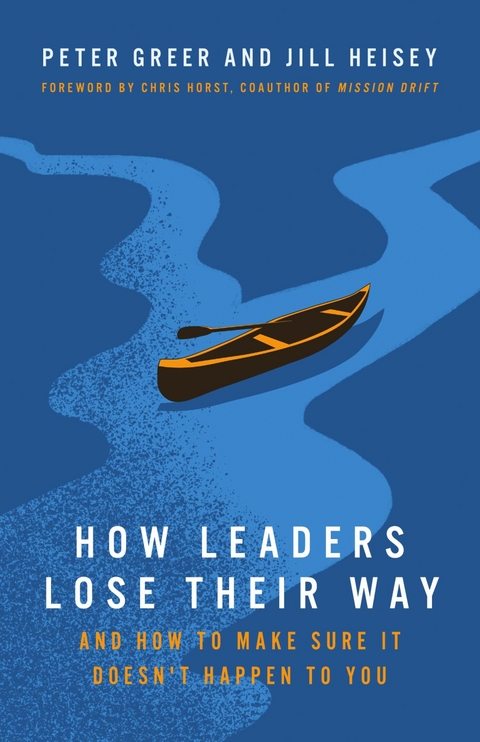
How Leaders Lose Their Way (eBook)
Peter Greer is president and CEO of HOPE International, a global nonprofit working to alleviate physical and spiritual poverty in 29 countries around the world. Peter's favorite part of his role is spending time with the remarkable entrepreneurs HOPE serves. A graduate of Harvard's Kennedy School, Peter has co-authored over 15 books, including Lead with Prayer, Mission Drift, Rooting for Rivals, and How Leaders Lose Their Way. While his sports loyalties remain in New England, he lives with his wife, Laurel, and their four children in Lancaster, PA.
Stay True to Your Mission for the Long HaulHow Leaders Lose Their Way is a powerful and reflective exploration of the pitfalls that can send leaders off course drawing lessons from the life of King Solomon and the timeless wisdom of Ecclesiastes. This book serves as a cautionary tale, equipping leaders to recognize personal and spiritual drift while providing actionable steps to maintain their mission-focused leadership. Authors Peter Greer and Jill Heisey masterfully blend Scripture with modern-day insights and practical case studies, making this book a compelling guide for pastors, ministry leaders, and organizational leaders aiming to avoid distractions, pressures, and temptations that pull them off course. This book will help you:- Admit vulnerability: Every leader is susceptible to losing their way. The first step in avoiding personal drift is recognizing that it could happen to you. - Stay disciplined: Staying on mission requires daily discipline, a reoriented understanding of success, and a balance of priorities to reach the finish line faithfully. - Build a support network: Create accountability by building a community of trusted mentors and peers. - Remain faithful: Regular reflection and confession can help you remain on the path of long-term faithfulness. How Leaders Lose Their Way positions King Solomon as both a biblical hero and an antihero. By examining Solomon's wisdom and his ultimate failure to live that wisdom out, readers gain deep insights into avoiding similar pitfalls. Each chapter includes actionable reflection tools and modern case studies designed to equip leaders with practical strategies for staying "e;mission true."e;This book is essential for Christian leaders who are ready to pause, reflect, and realign with their spiritual and organizational missions. Pursue a life of integrity, inspire the next generation, and build a legacy rooted in faithfulness. Stay on the path of mission-true leadership with How Leaders Lose Their Way.
Jill Heisey is a writer who is passionate about helping leaders and nonprofits share their stories. She has collaborated on the books Lead with Prayer, Rooting for Rivals, and The Gift of Disillusionment; written the children's book Keza Paints a Bright Future; and authored articles featured on Christianity Today's Better Samaritan blog. Jill graduated from Messiah University with degrees in politics and Spanish and resides outside Washington, DC, with her husband, Bryan, and their two daughters. Peter Greer is president and CEO of HOPE International, a global Christ-centered organization working to alleviate physical and spiritual poverty in more than twenty countries around the world. Peter's favorite part of his role is spending time with the remarkable entrepreneurs HOPE serves. A graduate of Harvard's Kennedy School, Peter has coauthored more than fifteen books, including Lead with Prayer, Mission Drift, and Rooting for Rivals. He lives with his wife, Laurel, and their four children in Lancaster, Pennsylvania.
1
The Danger of Drift
Let your eyes look straight ahead; fix your gaze directly
before you. Give careful thought to the paths for your
feet and be steadfast in all your ways. Do not turn to
the right or the left; keep your foot from evil.
It’s been two decades since I heard my grandfather’s wooden casket clunk against earthen walls, but I vividly remember the details of cemetery staff lowering his body into the ground. The graveside service had ended, and our family overstayed, not yet ready to say goodbye to this precious man whose prayers and life consistently pointed us upward. My gaze lingered on a waiting backhoe that hovered nearby.
The workers assigned the grim task of burying my grandfather didn’t know that he was the keeper of a thousand family memories. They’d never witnessed his delight in tossing his grandchildren into the air just to see them laugh, listened in on the ping-pong lessons he imparted, or glimpsed the sparkle in his eyes when he told a story. They couldn’t have known the countless ways he had cared for his wife since the day they said “I do,” or how this regal woman had collapsed in grief at the hospital saying “Don’t you leave me, Jerold” as his soul left his body.
I knew all of that, and in the days following my grandfather’s death, I learned still more. My grandfather spent his life shepherding a small Philadelphia congregation, impacting others’ lives with little fanfare and great faithfulness. At his memorial service, those who came to remember him described how he prayed with conviction, played with joy, loved without judgment, and truly cared for people. In summary, his life was one marked by loving God and loving neighbor. He lived on mission and finished well. I have no doubt that he heard the words, “Well done, good and faithful servant” (Matthew 25:23).
Though I’d gained professional clarity on HOPE’s mission some years earlier, my grandfather’s funeral offered personal clarity. It forced me to follow the rather morbid recommendation of the sixth-century abbot Saint Benedict: “Day by day remind yourself that you are going to die.”1 My grandfather’s life and death offered an invitation to pause and consider where my priorities and daily decisions might be leading.
While ministry was thriving, I was traveling too much and I was willing to do more. Growth and advancing HOPE’s mission had become so important to me that I was regularly giving God and my family my leftovers. Time in prayer and study of Scripture was marginalized and—in practice, if not in lip service—less vital than all the “important work” I had to do. Evenings at home were sacrificed for nights on the road, sharing how parents in faraway places were able to invest in their children as they accessed financial services and experienced the hope of the gospel.
From the outside, perhaps I seemed to be thriving too. Nothing was obviously amiss or blatantly wrong, but in moments of honest reflection, I could recognize that small compromises had subtly recalibrated my course. My relatively minor scheduling decisions were, in the aggregate, taking a toll on my soul. I was working hard but losing my way, pursuing organizational growth strategies without similar intentionality around what mattered still more. Compounded by time, the gap between my current trajectory and a faithful finish was growing and would continue to grow. I was living the very definition of drift, and without conscious course correction, I was not going to finish well.
Diagram shows a boat with two possible destinations: the intended destination, which is straight ahead, and the actual destination, which, through the visual of a downward bending line, indicates that the boat will finish far below the surface of the water. Small dots depicting minor but poor decisions along the way are marked on the line that dips further and further underwater as each poor decision is made.
ADRIFT
Leaders seem to routinely get caught in currents that pull them away from missional alignment. Whether it’s happened to us, someone we know and love, or someone we’ve admired from a distance, we’ve all seen a leader drastically, dramatically lose their way as though caught in a rip tide.
We see Christian leaders with decades of service and thriving ministries lose their reputation and others’ respect through a series of poor decisions. We read of business leaders who achieve the highest levels of prosperity but are caught in financial scandals and forced out in humiliation. We hear beautiful sermons about grace and love from the lips of those we later learn treated staff members abusively. We see pastors who dutifully shepherd their congregation while neglecting their own soul.
But we never think it will happen to us.
We don’t stop to consider how we might be similarly at risk, as we play in currents without realizing their strength. Blissfully unaware, we wade into dangerous waters. Even when we spot drift in others, we still splash in the waves. Too seldom do we pay attention to the warning signs.
We live surrounded by currents that carry us to places we never intended to go, and currents have the same function as rip tides. They’re less dramatic. They feel gentler and more innocuous, but they still carry us off course. Small acts of faithfulness or compromise determine our destination, and drift is all the more dangerous because it is subtle.
Although the twenty-four-hour news cycle may have heightened our awareness of prominent leaders’ integrity failures and poor finishes, personal drift is neither new nor rare. People have sought to justify compromise since Adam and Eve found a way to rationalize that first bite (Genesis 3). A consistent theme of personal mission drift courses through Scripture, with faithful leadership as the exception rather than the norm. When leadership scholar J. Robert Clinton studied biblical leaders, he found that only 30 percent “finished well,” which he defined as “walking with God in a vibrant personal relationship, developing the potential God has given to its appropriate capacity, and leaving behind an ultimate contribution that is both pleasing to God and established by Him.”2
When Clinton applied the same criteria to more than twelve hundred historical and contemporary leaders, he reached the disturbing conclusion that “evidence from today indicates that this ratio is probably generous. Probably less than one in three are finishing well today.”3 Through conversations with friends who have vulnerably recounted their own stories of drift, I’ve come to believe that Clinton’s assessment remains shockingly accurate. Drift is the default.
Feeling the pull in my own life, I wanted to understand what causes leaders to drift. Why those who start well don’t always finish well. How rational people make irrational choices and even seemingly noble pursuits can lead us off course. Perhaps still more important, I wanted to understand what might keep us from drifting. Is there something fundamentally different about the one in three who finishes well?
When Jill and I thought of avoiding drift, we first thought of a boat dropping anchor. But the more we learned, the more we recognized the inadequacy of that illustration. At best, anchors keep us where we are. Anchors are not dynamic. To finish well, we’ll need oars, not anchors.
ROWING ON MISSION
For a few years I lived near the Charles River in Cambridge, Massachusetts. As often as time allowed, I’d bike along the river so I could catch a glimpse of crew teams practicing. I’ve always been awed by the illusion of boats gliding atop the water as rowers plunge their oars beneath the surface in perfect synchronicity.
I’ve always wanted to try the sport, and on a recent summer day, Jill and I had the opportunity. Along with some HOPE colleagues, we donned matching crew T-shirts and looked the part when we arrived in Princeton, New Jersey, to spend a day on the water. First, we learned the basic mechanics on indoor rowing machines. It seemed easy enough. Yet within an instant of getting on the water, our unfounded confidence collided with our very unstable reality.
It seemed any shift in body weight threatened to capsize the boat. The shell swayed precariously. Despite our instructors’ uncommon patience and thorough explanations, our oars splashed and occasionally collided as we aimlessly meandered around the lake. Several hours into our lesson, at our peak performance, our boat lurched back and forth like a one-year-old learning to walk. We laughed a lot, overstretched our muscles, and developed a new appreciation for the skill rowing requires. Never again will we associate the word effortless with rowing!
Observing experienced rowers from a distance is deceptive. There is nothing easy about keeping the boat headed toward the finish line. Most of the time our little crew team was so consumed with the mechanics of rowing that we forgot to even consider where we were headed!
This experience became an object lesson in how complex and challenging an endeavor it is to stay on mission with far more...
| Erscheint lt. Verlag | 16.9.2025 |
|---|---|
| Vorwort | Chris Horst |
| Verlagsort | Lisle |
| Sprache | englisch |
| Themenwelt | Religion / Theologie ► Christentum ► Moraltheologie / Sozialethik |
| Schlagworte | 40/40 vision • Belief • Biblical • Career • Christian • christlike • Consequences • Crisis • Drift • ecclesiastes • Faith • godly • growth • Health • Identity • Leadership • Lost • Mission • Off Course • Passion • Personal • platform • Power • Professional • Purpose • scandal • Scripture • Solomon |
| ISBN-10 | 1-5140-1355-X / 151401355X |
| ISBN-13 | 978-1-5140-1355-7 / 9781514013557 |
| Informationen gemäß Produktsicherheitsverordnung (GPSR) | |
| Haben Sie eine Frage zum Produkt? |
 EPUB (Wasserzeichen)
DRM: Digitales Wasserzeichen
Dieses eBook enthält ein digitales Wasserzeichen und ist damit für Sie personalisiert. Bei einer missbräuchlichen Weitergabe des eBooks an Dritte ist eine Rückverfolgung an die Quelle möglich.
Dateiformat: EPUB (Electronic Publication)
EPUB ist ein offener Standard für eBooks und eignet sich besonders zur Darstellung von Belletristik und Sachbüchern. Der Fließtext wird dynamisch an die Display- und Schriftgröße angepasst. Auch für mobile Lesegeräte ist EPUB daher gut geeignet.
Systemvoraussetzungen:
PC/Mac: Mit einem PC oder Mac können Sie dieses eBook lesen. Sie benötigen dafür die kostenlose Software Adobe Digital Editions.
eReader: Dieses eBook kann mit (fast) allen eBook-Readern gelesen werden. Mit dem amazon-Kindle ist es aber nicht kompatibel.
Smartphone/Tablet: Egal ob Apple oder Android, dieses eBook können Sie lesen. Sie benötigen dafür eine kostenlose App.
Geräteliste und zusätzliche Hinweise
Buying eBooks from abroad
For tax law reasons we can sell eBooks just within Germany and Switzerland. Regrettably we cannot fulfill eBook-orders from other countries.
aus dem Bereich


