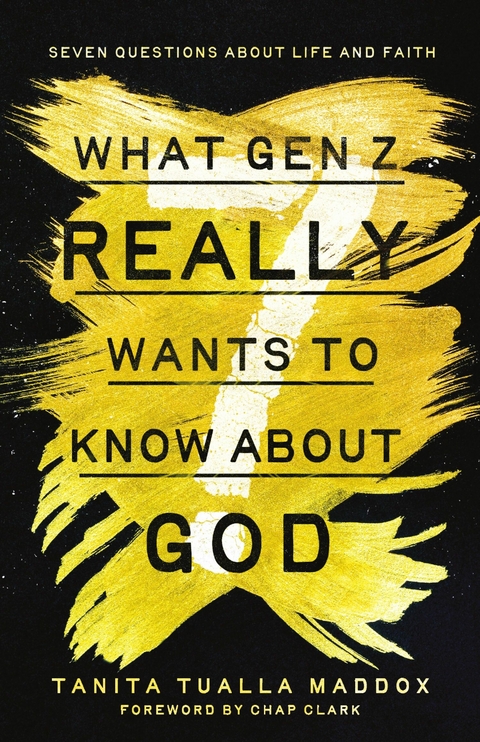
What Gen Z Really Wants to Know About God (eBook)
Tanita Tualla Maddox (DMin, Phoenix Seminary) is the national director for generational impact for Young Life and serves as an associate regional director in the Mountain West Young Life region. With an expertise in contextualizing the gospel for Gen Z, Tanita has been featured on The Holy Post podcast and has been published in The Great Commission Research Journal, the Journal of Youth and Theology, and more. She has served as Young Life leader with adolescents for over twenty-six years and serves as a volunteer Young Life leader in her local community. She lives in Spokane, Washington, with her husband and two children.
What is Good News to Gen Z?Gen Z, born into a complex and rapidly changing world, carries unique questions about life and God. Church methodologies that worked for previous generations often miss their mark with this one. Understanding Gen Z's real questions about faith opens the door to meaningful conversations and deeper connections. In What Gen Z Really Wants to Know About God, veteran youth worker and Gen Z expert Tanita Tualla Maddox presents a thoughtful and powerful guide for ministry practitioners striving to connect with this generation. Based on years of research and practical experience, Maddox's book provides insights into the seven key questions Gen Z is asking about life and faith, offering actionable advice tailored to their values and worldview. This book goes beyond just answering questions it explores how to translate the unchanging truths of the gospel into Gen Z's cultural context. Through reflective wisdom and practical tools, Maddox equips ministry leaders to meet Gen Z where they are and disciple them toward a vibrant, sustainable faith. This book is designed not only to answer questions but also to equip ministry leaders to apply its insights across various ministry settings, making it an essential resource for youth pastors, campus ministry leaders, seminary students, and even parents. What Gen Z Really Wants to Know About God bridges the gap between generations, empowering leaders to engage with the next generation of believers in impactful and lasting ways. Buy your copy today and get the tools you need to disciple Gen Z toward lasting faith.
Tanita Tualla Maddox (DMin, Phoenix Seminary) is the national director for generational impact for Young Life and serves as an associate regional director in the Mountain West Young Life region. With an expertise in contextualizing the gospel for Gen Z, Tanita has been featured on The Holy Post podcast and has been published in The Great Commission Research Journal, the Journal of Youth and Theology, and more. She has served as Young Life leader with adolescents for over twenty-six years and serves as a volunteer Young Life leader in her local community. She lives in Spokane, Washington, with her husband and two children.
INTRODUCTION
What’s Going On with
Gen Z and the Church?
Have I become irrelevant?
There has probably been a moment in the last few years when we looked at the ministry we were doing and asked: Am I effective anymore? For me, that moment arrived when Generation Z (Gen Z) entered the doors of the building. There was a shift I couldn’t put my finger on, but I knew something had changed. I saw panic attacks at events, students with too much anxiety to go to school, girls who would only meet with me one-on-one and not in groups, open hostility to faith unlike what I had seen before, and more. I hadn’t changed what I was doing, but I was experiencing a very different outcome. I had been leading youth ministry for twenty years, but was suddenly feeling lost, like I had no idea what I was doing. Why is what has worked for so long no longer working? My first inclination was to think there was something wrong with me; I was the problem. I had gotten too old for this, and I wasn’t effective in ministry anymore. Have I become irrelevant?
After a little digging, I realized there had been a generational shift, and Gen Z had arrived so quickly, we didn’t realize they were here until the oldest members of the generation were graduating from high school. Gen Z wasn’t the problem though. The problem was a disconnect between me, the way I had always done things, and this new generation. I did not know or understand Gen Z.
I realized I was out of touch, and I had better figure out who they are, what they are looking for, and what they are asking, in order to better share the gospel with them and help them grow in their faith, or risk becoming increasingly ineffective and irrelevant.1 So I began to listen, study, and read. I spent days, weeks, months, and now years seeking to understand the next generation. This book is an extension of my doctoral thesis.2 I became committed to knowing Gen Z, both in study and relationship, so I could better share the gospel and disciple this generation.
GEN Z FLIGHT
There has been a lot of buzz around younger generations leaving the church, and a lot of speculation about why. Gen Z is more likely than previous generations to be raised by parents who have no religious affiliation (those who would check the box atheist, agnostic, or none).3 Even those Gen Zers who were practicing Christians when they were younger are leaving churches. As Gen Z ages into their twenties, a significant portion turn away from Christianity or Christian communities like churches.4 A 2023 survey by Springtide Research Center found four-in-ten Gen Zers (aged 13–25) never attend religious services.5 The Survey Center on American Life also found Gen Z is leaving their faith at younger ages than previous generations, with 48 percent of those leaving doing so between ages 13 and 17, and 26 percent of those leaving doing so between ages 18 and 29.6
Looking at surveys regarding Gen Z and the Christian faith, it’s hard to decipher what version of Christian faith they are leaving. According to the Jesus Survey, most Gen Z Christians agree Jesus, Mohammed, Buddha, and other belief systems or religions all have equal value and standing when it comes to the afterlife.7 This survey was conducted in 2012, just as Gen Z were becoming teenagers, and exhibits the influences on Gen Z as they grew up. These are Christians—those who have professed faith in Jesus Christ—who also believe all roads lead to heaven. This does not translate into religious practice for Gen Z, such as attending church services or reading the Bible. As of 2023, 68 percent of Gen Z agree there are many religions they agree with.8
According to sources such as the American Bible Society and others, Gen Z is also not familiar with the Bible or the stories of the Bible, or how to read or understand the Bible.9 I recently sat with a college student who was brought up in a Christian family, was active in her faith, and had attended church her whole life. I was referring to the stories of Joseph and Moses as she was wrestling with having a multiethnic background, and thus shared a multicultural experience with these Old Testament heroes. She was unfamiliar with these stories, and I had to do an overview summary to get her caught up. The felt-board Bible stories from my childhood Sunday school classes were unfamiliar to my Gen Z friend. I’ve also sat with a recent high school graduate who in the midst of our conversation said, “But Jesus sinned too, right?” These are not outlier kinds of conversations. They are the conversations with a generation, even the Christians in that generation, who do not know what is in the Bible. With the absence of knowledge, Gen Z is making guesses, and it ripples out into not knowing what to believe about the Bible.
There are concerns and questions around Gen Z and the future of Christianity. What if Gen Z isn’t just leaving, but they weren’t here to begin with? In 2023, 31 percent of Gen Zers said they had never participated in a religious or spiritual community.10 Many such as Pew Research note it’s not just Gen Z’s interest or belief in Christianity that has decreased, but belief in all religions.11 Overall, Gen Z is not engaging with faith. As Gen Z is moving from middle schools and high schools to college campuses and careers, the impact on churches and ministries is more widely felt. Seeing the decline of engagement by the next generation, many churches and ministries are looking for answers to questions like:
-
Why is Gen Z leaving the Christian faith?
-
How do we reach Gen Z with the gospel?
-
What does discipling Gen Z look like?
-
What is going on with Gen Z and the church?
These are good and important questions to ask. A positive dynamic that has come with the arrival of Gen Z is that churches and ministries have done some self-examination to figure out where the disconnect is.
A Barna Group study highlighted one such disconnect between Gen Z and older Christian adults: the faith and gospel prioritized by churches are not the same faith and gospel prioritized by Gen Z.12 This isn’t to say that there is more than one faith and one gospel, but in the full breadth and depth of the Christian faith and gospel, both parties are focused on different aspects. According to Church Doesn’t End with Z, Gen Z does not see a connection between the gospel they are hearing at church and their everyday lives; the gospel seems irrelevant.13 Churches are not addressing the questions around faith and meaning that matter to the next generation.14 What is being communicated to Gen Z is “that God is not concerned about the world they inhabit—and presumably that God is not concerned about them.”15
GENERATIONAL DISCONNECT
About twelve years ago, I took a course with David Livermore, author of Cultural Intelligence, and an example he used stuck with me. He asked the class this question: “Why did the prodigal son go hungry?” (see Luke 15:11-20). I was quick to answer, “Because he squandered all of his money.” But the story points to three big reasons why the prodigal son was hungry: (1) there was a famine, (2) no one would give him anything to eat, and (3) he spent all his money. Livermore pointed out that depending on our cultural context, we all may answer that question differently.
For the sake of this example, let’s say older Christian adults cite the reason for the prodigal son’s situation is (3) he spent all his money, but Gen Zers agree that (2) no one would give him anything to eat. Gen Z is focused on community and charity, while older Christians are focused on personal stewardship and responsibility. They are looking at the same passage, but not having the same conversation. They are prioritizing and focusing on different things, both valuable parts of the passage. This is what is meant by Gen Z and the older generations of Christians (who are leading our churches and ministries) not prioritizing the same faith or same gospel. As a result, the church and Gen Z aren’t having the same conversation and are missing each other. No one is at any fault, but we need to learn how to get back into the same conversation.
Gen Z has the perception that the church is not open to, or is even hostile to, doubts and skepticism. The evangelism and discipleship that many of us practice do not fully address Gen Z’s life experiences, and many Gen Zers feel they cannot talk about it. For Gen Z, this translates to a lack of belonging in the Christian faith. They think, If you want to belong, accept everything that is taught and don’t ask questions or have doubts. By asking our Gen Zers a question that opens the door to their questions, we can demonstrate that there is room for them and all of their questions, doubts, and skepticism in conversation with Jesus.
Studies from both...
| Erscheint lt. Verlag | 16.9.2025 |
|---|---|
| Vorwort | Chap Clark |
| Verlagsort | Lisle |
| Sprache | englisch |
| Themenwelt | Religion / Theologie ► Christentum ► Kirchengeschichte |
| Schlagworte | acceptance • Belief • Bible • Christ • Christian • Church • Community • Cultural • Discipleship • Doubt • Evangelism • Generation • Good • Gospel • Jesus • learn • Millennial • ministry • New • NeXT • REACH • relevant • Rising • Safety • Student • Trust • Truth • Twenties • Understand • younger • Youth |
| ISBN-10 | 1-5140-1217-0 / 1514012170 |
| ISBN-13 | 978-1-5140-1217-8 / 9781514012178 |
| Informationen gemäß Produktsicherheitsverordnung (GPSR) | |
| Haben Sie eine Frage zum Produkt? |
 EPUB (Wasserzeichen)
DRM: Digitales Wasserzeichen
Dieses eBook enthält ein digitales Wasserzeichen und ist damit für Sie personalisiert. Bei einer missbräuchlichen Weitergabe des eBooks an Dritte ist eine Rückverfolgung an die Quelle möglich.
Dateiformat: EPUB (Electronic Publication)
EPUB ist ein offener Standard für eBooks und eignet sich besonders zur Darstellung von Belletristik und Sachbüchern. Der Fließtext wird dynamisch an die Display- und Schriftgröße angepasst. Auch für mobile Lesegeräte ist EPUB daher gut geeignet.
Systemvoraussetzungen:
PC/Mac: Mit einem PC oder Mac können Sie dieses eBook lesen. Sie benötigen dafür die kostenlose Software Adobe Digital Editions.
eReader: Dieses eBook kann mit (fast) allen eBook-Readern gelesen werden. Mit dem amazon-Kindle ist es aber nicht kompatibel.
Smartphone/Tablet: Egal ob Apple oder Android, dieses eBook können Sie lesen. Sie benötigen dafür eine kostenlose App.
Geräteliste und zusätzliche Hinweise
Buying eBooks from abroad
For tax law reasons we can sell eBooks just within Germany and Switzerland. Regrettably we cannot fulfill eBook-orders from other countries.
aus dem Bereich