


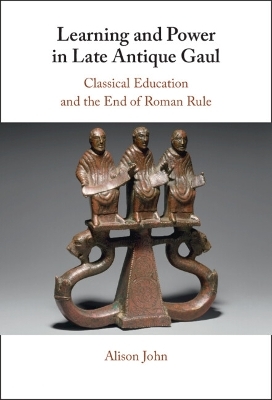
Learning and Power in Late Antique Gaul
Classical Education and the End of Roman Rule
Seiten
2026
Cambridge University Press (Verlag)
978-1-009-54342-2 (ISBN)
Cambridge University Press (Verlag)
978-1-009-54342-2 (ISBN)
- Noch nicht erschienen (ca. Januar 2026)
- Versandkostenfrei
- Auch auf Rechnung
- Artikel merken
This book explores the relationships between cultural practices and political structures in late antique Gaul. It investigates what uses and values education has in a society – how is education valued by communities, governments and by individuals, and how does this change in response to political, religious, and cultural upheavals?
This book traces the changing political and social roles of classical education in late antique Gaul. It argues that the collapse of Roman political power in Gaul changed the way education was practiced and perceived by Gallo-Romans. Neither the barbarian kingdoms nor the Church directly caused the decline of classical schools, but these new structures of power did not encourage or support a cultural and political climate in which classical education mattered; while Latin remained the language of the Church, and literacy and knowledge of law were valued by barbarian courts, training in classical grammar and rhetoric was no longer seen as a prerequisite for political power and cultural prestige. This study demonstrates that these fundamental shifts in what education meant to individuals and power brokers resulted in the eventual end of the classical schools of grammar and rhetoric that had once defined Roman aristocratic public and private life.
This book traces the changing political and social roles of classical education in late antique Gaul. It argues that the collapse of Roman political power in Gaul changed the way education was practiced and perceived by Gallo-Romans. Neither the barbarian kingdoms nor the Church directly caused the decline of classical schools, but these new structures of power did not encourage or support a cultural and political climate in which classical education mattered; while Latin remained the language of the Church, and literacy and knowledge of law were valued by barbarian courts, training in classical grammar and rhetoric was no longer seen as a prerequisite for political power and cultural prestige. This study demonstrates that these fundamental shifts in what education meant to individuals and power brokers resulted in the eventual end of the classical schools of grammar and rhetoric that had once defined Roman aristocratic public and private life.
ALISON JOHN is a Postdoctoral Research Fellow at All Souls College, Oxford. Her research focuses on the history and literature of Late Antiquity, and she has published on Greek education in Gaul, bilingual epigraphy, and the prosopography of teachers.
Acknowledgements; Abbreviations; Introduction; 1. Classical education in the late roman world; 2. The cultural ecosystem of late antique gaul; 3. The relationship between education and power; 4. Education in society and culture; 5. Classical education and church schools; Conclusion; Appendix. 1 Prosopography of Teachers and Students in Late Antique Gaul; Appendix. 2 CTh 13.3.11 – Gratian's 'School Edict'; Bibliography; Index Locorum; General Index.
| Erscheint lt. Verlag | 22.1.2026 |
|---|---|
| Zusatzinfo | Worked examples or Exercises |
| Verlagsort | Cambridge |
| Sprache | englisch |
| Themenwelt | Geschichte ► Allgemeine Geschichte ► Vor- und Frühgeschichte |
| Geschichte ► Allgemeine Geschichte ► Altertum / Antike | |
| Geschichte ► Allgemeine Geschichte ► Mittelalter | |
| Geisteswissenschaften ► Geschichte ► Regional- / Ländergeschichte | |
| ISBN-10 | 1-009-54342-3 / 1009543423 |
| ISBN-13 | 978-1-009-54342-2 / 9781009543422 |
| Zustand | Neuware |
| Informationen gemäß Produktsicherheitsverordnung (GPSR) | |
| Haben Sie eine Frage zum Produkt? |
Mehr entdecken
aus dem Bereich


aus dem Bereich
Konzepte – Methoden – Theorien
Buch | Softcover (2024)
UTB (Verlag)
CHF 55,85
auf den Spuren der frühen Zivilisationen
Buch | Hardcover (2023)
C.H.Beck (Verlag)
CHF 27,95


