


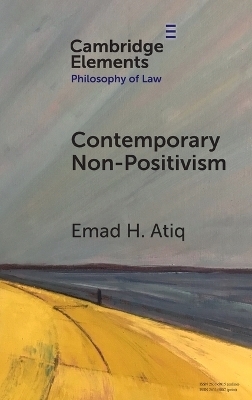
Contemporary Non-Positivism
Seiten
2025
Cambridge University Press (Verlag)
978-1-009-53912-8 (ISBN)
Cambridge University Press (Verlag)
978-1-009-53912-8 (ISBN)
This Element defends and clarifies the thesis that the legality of a system of rules depends on its moral features. Law is an artifact whose existence depends on adequately performing an essentially normative function. Its justification lies in its explanatory power which proves vital for understanding legal language, reasoning, and practice.
This Element defends and clarifies the thesis that the legality of a system of rules depends on its moral features. Positivists who deny this dependence struggle to explain: (1) the traditional classification of moral norms as a form of a priori law; (2) judicial reliance on moral norms in legal discovery; (3) persistent theoretical disagreement about intra-systemic, law-determining facts; (4) why radically arbitrary or immoral schemes of social organization represent borderline cases of law; and (5) why law, like other artifacts, can be evaluated in a kind-relative sense (“as law”). Meanwhile, traditional versions of non-positivism overstate the dependence going further than the desiderata warrant. A moderate theory is formulated: law is an artifact whose existence depends on adequately performing an essentially normative function. The theory's justification lies in its explanatory power: a comparison with other “value-driven” artifacts, such as artworks, proves vital for understanding legal language, reasoning, and practice.
This Element defends and clarifies the thesis that the legality of a system of rules depends on its moral features. Positivists who deny this dependence struggle to explain: (1) the traditional classification of moral norms as a form of a priori law; (2) judicial reliance on moral norms in legal discovery; (3) persistent theoretical disagreement about intra-systemic, law-determining facts; (4) why radically arbitrary or immoral schemes of social organization represent borderline cases of law; and (5) why law, like other artifacts, can be evaluated in a kind-relative sense (“as law”). Meanwhile, traditional versions of non-positivism overstate the dependence going further than the desiderata warrant. A moderate theory is formulated: law is an artifact whose existence depends on adequately performing an essentially normative function. The theory's justification lies in its explanatory power: a comparison with other “value-driven” artifacts, such as artworks, proves vital for understanding legal language, reasoning, and practice.
1. Introduction: subject matter and methodology; 2. The argument against positivism; 3. How to be a legal non-positivist; 4. Outstanding questions; References.
| Erscheinungsdatum | 11.02.2025 |
|---|---|
| Reihe/Serie | Elements in Philosophy of Law |
| Zusatzinfo | Worked examples or Exercises |
| Verlagsort | Cambridge |
| Sprache | englisch |
| Maße | 152 x 229 mm |
| Gewicht | 271 g |
| Themenwelt | Geisteswissenschaften ► Philosophie ► Ethik |
| Geisteswissenschaften ► Philosophie ► Metaphysik / Ontologie | |
| Recht / Steuern ► Allgemeines / Lexika | |
| Recht / Steuern ► EU / Internationales Recht | |
| ISBN-10 | 1-009-53912-4 / 1009539124 |
| ISBN-13 | 978-1-009-53912-8 / 9781009539128 |
| Zustand | Neuware |
| Informationen gemäß Produktsicherheitsverordnung (GPSR) | |
| Haben Sie eine Frage zum Produkt? |
Mehr entdecken
aus dem Bereich

aus dem Bereich
Buch | Hardcover (2025)
Suhrkamp (Verlag)
CHF 32,15


