


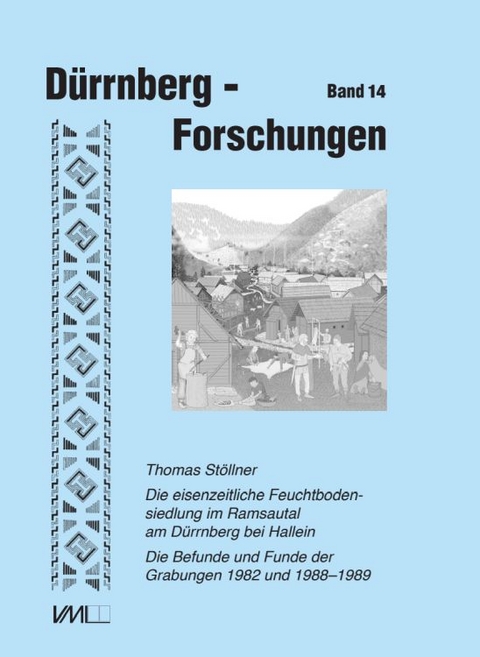
Die eisenzeitliche Feuchtbodensiedlung im Ramsautal am Dürrnberg bei Hallein
Die Befunde und Funde der Grabungen 1982 und 1988-1989
Seiten
2024
VML Vlg Marie Leidorf (Verlag)
978-3-89646-898-7 (ISBN)
VML Vlg Marie Leidorf (Verlag)
978-3-89646-898-7 (ISBN)
In der ebenen Niedermoorfläche bestand auf etwa 150 x 450 m von 480/460 bis um 250 v. Chr. eine mehrphasige Siedlung mit Holzerhaltung, von der die Bauhölzer bereits publiziert wurden [DF 4] und zu der ein weiterer Band mit sonstigen Hölzern und Holzgefäßen folgen wird. Das Areal gehört - im Gegensatz zu Resten bei Ramsaukopf, Putzenfeld, Hinterramsau, Hochbichl und Simonbauernfeld - zu den am besten erforschten eisenzeitlichen Siedlungszonen des Dürrnbergs. Insbesondere die 1988-89 nach Standards südwestdeutscher Feuchtbodenarchäologie untersuchten 220 m² erlauben die Differenzierung von 8 Siedlungshorizonten [1a-4b], der abschließenden Kulturschicht 4/1 sowie 6 Schwemmhorizonten. Dabei wurden 26.500 Funde geborgen, darunter Keramik, Kleinfunde, Hölzer, Tierknochen, Säuglingsskelette, botanische Makroreste und dendrochronologische Proben. Sie erlauben eine Auswertung zur chronologischen und stratigraphischen Entwicklung, zu Taphonomie, Fundverteilung, Aktivitätszonen mit - auch professionellem - Handwerk sowie Siedlungspraxis, etwa der häufige Umbau von Häusern. Seit dem späten 4. Jh. sind Anwohner mit Bergbaubezug deutlicher greifbar.
In the flat low moorland area, a multi-phase waterlogged settlement existed in an area of some 150 by 450 m from 480/460 to around 250 B.C. Its building timbers have already been published [DF 4] and another volume with other wooden artefacts and vessels will follow. In contrast to the remains at Ramsaukopf, Putzenfeld, Hinterramsau, Hochbichl and Simonbauernfeld, the area is one of the best-researched Iron Age settlement zones on the Dürrnberg. In particular, the 220 m² investigated in 1988-9 according to the standards of South-West German wetland archaeology allow the differentiation of 8 settlement horizons [1a-4b], the final cultural layer 4/1 and 6 alluvial horizons. In the process, 26,500 finds were recovered, including pottery, small finds, wood, animal bones, infant skeletons, botanical macro-remains and dendrochronological samples. They allow for an evaluation of the chronological and stratigraphic development, taphonomy, find distribution, activity zones with - also professional - crafts and settlement practices, such as the frequent remodelling of houses. From the late 4th century B.C. onwards, residents with a mining background became more clearly recognisable. In the flat low moorland area, a multi-phase waterlogged settlement existed in an area of some 150 by 450 m from 480/460 to around 250 B.C. Its building timbers have already been published [DF 4] and another volume with other wooden artefacts and vessels will follow. In contrast to the remains at Ramsaukopf, Putzenfeld, Hinterramsau, Hochbichl and Simonbauernfeld, the area is one of the best-researched Iron Age settlement zones on the Dürrnberg. In particular, the 220 m² investigated in 1988-9 according to the standards of South-West German wetland archaeology allow the differentiation of 8 settlement horizons [1a-4b], the final cultural layer 4/1 and 6 alluvial horizons. In the process, 26,500 finds were recovered, including pottery, small finds, wood, animal bones, infant skeletons, botanical macro-remains and dendrochronological samples. They allow for an evaluation of the chronological and stratigraphic development, taphonomy, find distribution, activity zones with - also professional - crafts and settlement practices, such as the frequent remodelling of houses. From the late 4th century B.C. onwards, residents with a mining background became more clearly recognisable.
In the flat low moorland area, a multi-phase waterlogged settlement existed in an area of some 150 by 450 m from 480/460 to around 250 B.C. Its building timbers have already been published [DF 4] and another volume with other wooden artefacts and vessels will follow. In contrast to the remains at Ramsaukopf, Putzenfeld, Hinterramsau, Hochbichl and Simonbauernfeld, the area is one of the best-researched Iron Age settlement zones on the Dürrnberg. In particular, the 220 m² investigated in 1988-9 according to the standards of South-West German wetland archaeology allow the differentiation of 8 settlement horizons [1a-4b], the final cultural layer 4/1 and 6 alluvial horizons. In the process, 26,500 finds were recovered, including pottery, small finds, wood, animal bones, infant skeletons, botanical macro-remains and dendrochronological samples. They allow for an evaluation of the chronological and stratigraphic development, taphonomy, find distribution, activity zones with - also professional - crafts and settlement practices, such as the frequent remodelling of houses. From the late 4th century B.C. onwards, residents with a mining background became more clearly recognisable. In the flat low moorland area, a multi-phase waterlogged settlement existed in an area of some 150 by 450 m from 480/460 to around 250 B.C. Its building timbers have already been published [DF 4] and another volume with other wooden artefacts and vessels will follow. In contrast to the remains at Ramsaukopf, Putzenfeld, Hinterramsau, Hochbichl and Simonbauernfeld, the area is one of the best-researched Iron Age settlement zones on the Dürrnberg. In particular, the 220 m² investigated in 1988-9 according to the standards of South-West German wetland archaeology allow the differentiation of 8 settlement horizons [1a-4b], the final cultural layer 4/1 and 6 alluvial horizons. In the process, 26,500 finds were recovered, including pottery, small finds, wood, animal bones, infant skeletons, botanical macro-remains and dendrochronological samples. They allow for an evaluation of the chronological and stratigraphic development, taphonomy, find distribution, activity zones with - also professional - crafts and settlement practices, such as the frequent remodelling of houses. From the late 4th century B.C. onwards, residents with a mining background became more clearly recognisable.
| Erscheinungsdatum | 16.01.2025 |
|---|---|
| Reihe/Serie | Dürrnberg-Forschungen. III. Abt. Siedlung ; 14 |
| Verlagsort | Rahden/Westf. |
| Sprache | deutsch |
| Maße | 210 x 297 mm |
| Gewicht | 2440 g |
| Einbandart | gebunden |
| Themenwelt | Geschichte ► Allgemeine Geschichte ► Vor- und Frühgeschichte |
| Schlagworte | Ernährung • Hausbau • Holzerhaltung • Salz • Siedlungsarchäologie • Tierknochen |
| ISBN-10 | 3-89646-898-7 / 3896468987 |
| ISBN-13 | 978-3-89646-898-7 / 9783896468987 |
| Zustand | Neuware |
| Informationen gemäß Produktsicherheitsverordnung (GPSR) | |
| Haben Sie eine Frage zum Produkt? |
Mehr entdecken
aus dem Bereich
aus dem Bereich
auf den Spuren der frühen Zivilisationen
Buch | Hardcover (2023)
C.H.Beck (Verlag)
CHF 27,95
Konzepte – Methoden – Theorien
Buch | Softcover (2024)
UTB (Verlag)
CHF 55,85
die archäologische Wahrheit über die Bibel
Buch | Softcover (2023)
C.H.Beck (Verlag)
CHF 25,20


