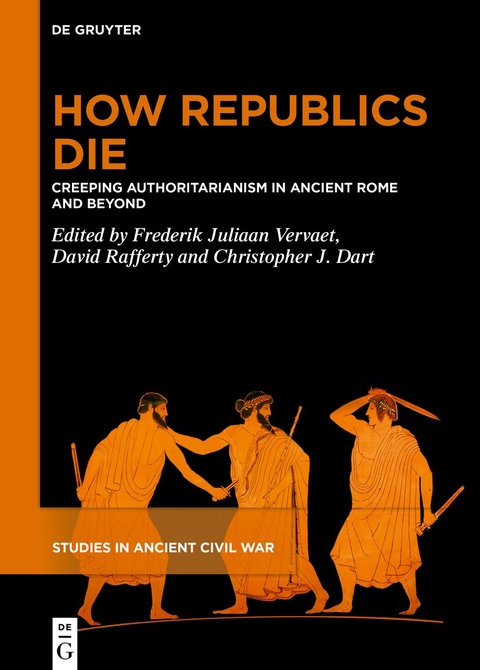
How Republics Die
Studies in Ancient Civil War provides a unique and timely academic forum for exploring civil war in antiquity, from internal strife to reintegration. Combining historical, philological, and archaeological views, the series examines any given aspect of ancient civil war and its lasting reverberations throughout time, spanning the Mediterranean and Near East from the second millennium BCE to the first millennium CE.
Authoritarianism is everywhere on the advance; democracies seem fragile and threatened. We console ourselves that where rule by the people has long established itself, it has never collapsed from internal causes. Except it did, once: in Rome.
This book gathers together Roman historians with political scientists and scholars of other periods of authoritarian takeover to explore how open and democratic political systems have historically fallen prey to autocrats. The Late Roman Republic is the main focus, with a mix of large-scale thematic and analytical chapters paired with more detailed case studies, from some of the leading scholars in the field. Other chapters widen the scope, analysing comparable cases from ancient Athens to Napoleon to Hitler's Germany and Franco's Spain.
The book as a whole draws on contemporary political science scholarship on democratic decay and competitive authoritarianism. It shows that these concepts are not only applicable to modern states, but that we can properly use them to study past democratic collapses as well. This provides the tools for a more historically-informed understanding of how republics die, as part of a renewed conversation between historians and political scientists.
Frederik Juliaan Vervaet, University of Melbourne, Melbourne, Australia; David Rafferty, University of Adelaide, Adelaide, Australia; Christopher J. Dart, University of Melbourne, Melbourne, Australia.
"The collected essays demonstrate how much historians of the ancient world can gain from political science and comparative history. [...] It is fantastic that this book is freely available online: it represents an important retort to some modern public figures who use a distorted or excessively eulogistic narrative of the ancient (usually Roman) world to justify their actions."
Timothy Smith, in: The Classical Review (2025), published online: 1-3 (https://doi.org/10.1017/S0009840X25101984)
| Erscheinungsdatum | 18.04.2025 |
|---|---|
| Reihe/Serie | Studies in Ancient Civil War ; 4 |
| Zusatzinfo | 0 b/w and 1 col. ill., 2 b/w tbl. |
| Verlagsort | Berlin/Boston |
| Sprache | englisch |
| Maße | 170 x 240 mm |
| Gewicht | 1039 g |
| Themenwelt | Geschichte ► Allgemeine Geschichte ► Altertum / Antike |
| Geisteswissenschaften ► Geschichte ► Regional- / Ländergeschichte | |
| Geschichte ► Teilgebiete der Geschichte ► Militärgeschichte | |
| Schlagworte | Antike • authoritarianism • Autoritarismus • Bürgerkrieg • Civil War • Classical Antiquity • Roman Empire • Römisches Reich |
| ISBN-10 | 3-11-165027-8 / 3111650278 |
| ISBN-13 | 978-3-11-165027-2 / 9783111650272 |
| Zustand | Neuware |
| Informationen gemäß Produktsicherheitsverordnung (GPSR) | |
| Haben Sie eine Frage zum Produkt? |
aus dem Bereich