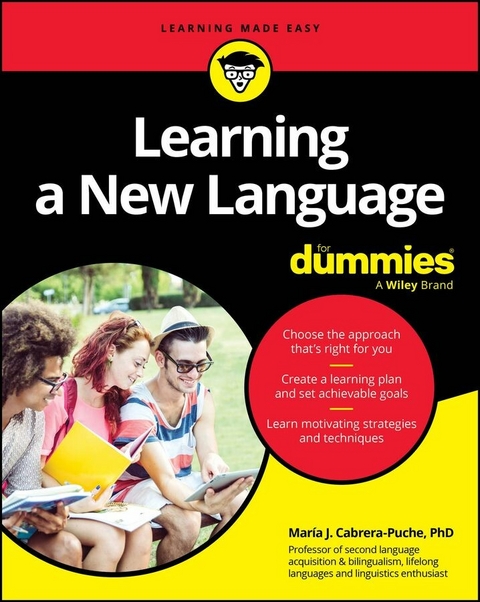
Learning A New Language For Dummies (eBook)
377 Seiten
For Dummies (Verlag)
978-1-394-24992-3 (ISBN)

Strategies, tools, and motivation for learning a new language
Learning A New Language For Dummies explains how you can create a personal plan to achieve your language learning goals. Get research-based suggestions for speeding up your language acquisition and learn about the benefits of leveling up your linguistic ability. Even if you've never studied a language before, this easy-to-understand guide will prepare you to pick the learning methods that will work best for you. You#ll also get an intro to the basics of how humans learn languages, so you can stay motivated, set realistic goals, and achieve success. No matter what language you want to learn, this Dummies guide will help you start off on the right foot.
- Choose a language learning approach that fits you and your lifestyle
- Get step-by-step guidance for making a plan and setting achievable goals
- Learn techniques and strategies for learning quicker and retaining more
- Improve your odds of success with a foundation of knowledge about the learning process
Anyone considering learning a new language or refreshing their knowledge of a language-and language teachers, too-will love Learning a New Language For Dummies.
Dr. María J. Cabrera-Puche is a Professor of Languages and Cultures at West Chester University of PA, where she teaches Spanish (all proficiency levels), linguistics, bilingualism, and language teaching methods. Her areas of focus include second language acquisition, bilingualism, and assessment. Among other publications, María is co-author of the Spanish textbook Tu mundo: español sin fronteras, and co-editor of Romance Linguistics 2006. María is a certified ACTFL ILR OPI tester.
Strategies, tools, and motivation for learning a new language Learning A New Language For Dummies explains how you can create a personal plan to achieve your language learning goals. Get research-based suggestions for speeding up your language acquisition and learn about the benefits of leveling up your linguistic ability. Even if you've never studied a language before, this easy-to-understand guide will prepare you to pick the learning methods that will work best for you. You#ll also get an intro to the basics of how humans learn languages, so you can stay motivated, set realistic goals, and achieve success. No matter what language you want to learn, this Dummies guide will help you start off on the right foot. Choose a language learning approach that fits you and your lifestyle Get step-by-step guidance for making a plan and setting achievable goals Learn techniques and strategies for learning quicker and retaining more Improve your odds of success with a foundation of knowledge about the learning process Anyone considering learning a new language or refreshing their knowledge of a language and language teachers, too will love Learning a New Language For Dummies.
Chapter 1
Craving a New Language
IN THIS CHAPTER
Looking at the definition of language
Highlighting what you need to learn a new language
Understanding the components of communication
Considering the functions of language
Outlining the branches of linguistics
Thinking of learning a new language? Wonderful! You’re in the right place. Since you’re reading this book, I’m guessing that you’re pretty enthusiastic about learning a new language. If so, you already have a key ingredient for such a journey: your motivation!
In this chapter, you get an overview of the process of learning a new language. I start by defining what language is. It seems like a simple term, but linguists (people who study language) have pondered over how to define language for years. I also explain the importance of knowing more than one language in today’s world and becoming part of the bilingual (or multilingual) team; then I dive into what communication is and discuss its components, as well as its features and functions. Finally, I briefly mention some of the disciplines that study language.
If you want to learn a language you can use with many speakers, here’s a fun fact: The most spoken languages around the globe (as a native speaker and as a second language) are English, Mandarin Chinese, Hindi, Spanish, French, and Modern Standard Arabic. You can find out more about choosing a language to learn in Chapter 11.
Defining What “Language” Means
Language is a natural human ability that we acquire effortlessly by merely being exposed to it and using it to communicate with other members of our language community. Language is essential in our lives to maintain social interactions because it helps us express thoughts, ideas, desires, emotions, and culture.
Language also is a form of self-identity. Yes, that’s right! The way you speak and the language you use reveal a lot about your identity and your culture. Think about it: When you hear someone talking, can you guess if they’re from your area or not? Can you guess their age or gender? What about their socioeconomic status? Can you guess if they’re native speakers of the language or language learners? It’s not uncommon to answer yes to all or most of these questions. That’s what I mean when I say that language is a form of self-identity.
Technically speaking, languages are formed by arbitrary signs (words) that are governed by certain rules (grammar). (You can read more about the arbitrariness of words in the later section “Recognizing special design features.”) Despite their complexity, languages are systematic and rule-governed, so linguists are able to study them in a scientific way. Thanks to the rules that govern languages, members of a speech community produce and understand an infinite number of sentences.
Most researchers agree that humans are born already programmed to learn languages, and some structures in our brains are specialized for language processing. So, some of the work is already done for you, without any visible effort!
A FEW FUN FACTS ABOUT LANGUAGES
If you haven’t decided which language you want to learn yet, you have many to choose from! According to Ethnologue (www.ethnologue.com/), which is one of the most important online sources of information about languages, there are more than 7,000 languages in the world! Here’s some interesting data about these languages:
- About 90 percent of the world population speaks 700 of these languages.
- More than 50 percent of the population speaks 23 of these languages.
- Eighty-five percent of the people in the world use either Asian or European languages.
- Forty percent of these languages (more than 3,000 languages) are endangered languages (they have fewer than 1,000 users).
Gaining a Superpower by Learning a New Language
Learning new languages is an exciting and rewarding task! Bilinguals can communicate with more people than monolinguals do, and languages give you the opportunity to discover different cultures and provide broader perspectives of the world and humanity. Talk about a superpower!
And learning languages isn’t as difficult as some people may think; note that you’ve already acquired at least one language — the one you’re using now to read this book. You may only need some guidance on how to achieve your goal to learn a new one. Furthermore, you may have heard that the more languages you learn, the easier it becomes to learn a new one. So, go for it! The following sections explain what you need to learn a new language and give an overview of the benefits of language learning.
Knowing what you need up front
You need a few ingredients for a successful experience when learning a new language so that you can join the bilingual (or multilingual) superpower team sooner rather than later. (I explain all of them in detail throughout this book.) To learn a language, you need the following:
-
Strong motivation: Learning a language should feel like a joyful act. You should feel the excitement within you, like the butterflies you feel when you see someone you’re dating. You shouldn’t feel pushed/obliged to learn it; you should have an intense desire to do so.
To help you find your motivation, try writing down at least five reasons why you want to learn a particular language. For example, suppose you want to learn French so you can travel around France more easily, speak with friends and family members who live there, read French literature in its original form, watch French movies without subtitles, and enjoy French restaurants even more by reading the menus in French.
-
Time and consistency: I suggest spending at least 15 minutes on your new language every day. It’s better to dedicate some time to it on a daily basis than to spend many hours working on it only once a week.
Try to connect learning a language with your daily life. For example, while your coffee is brewing, use those spare minutes to read in your new language, listen to music in the language, review flashcards, and so on. You can also change your email/phone settings to your new language, try watching TV and movies in your new language, or write your to-do list in your new language. These repetitive actions will be a huge help in your learning progress!
-
Resources: You need to find compelling books, dictionaries, audiovisual material, and similar resources in your target language. Being repeatedly exposed to diverse material that uses your new language will help you retain that language.
If possible, find native or proficient speakers of the language to practice with. This is a really valuable resource! You can reach out to local universities or be on the lookout for local language clubs that meet periodically; pay attention to the bulletin boards in coffee shops, libraries, and universities. You can also use online apps to find conversation partners. I share some online apps and sites you can use in Chapter 14.
- A feeling of relaxation: You shouldn’t feel stressed out when learning or practicing the language. You need to feel comfortable and accept the idea that making mistakes is part of the deal. In the language-learning field, we refer to that as having a low affective filter. You can read more about the importance of the affective filter in Chapter 7.
- A plan: Consider your motivation and goals, and outline the steps you will follow to reach that goal. The clearer your plan is, the easier it will be to implement it. See Chapter 12 for details.
-
A handle on basic vocabulary: Building your vocabulary is especially important in the beginning of the learning process; learning words is even more important than mastering the language structure (grammar). You can start by learning everyday vocabulary, and words that are linked to your interests and hobbies. See Chapter 13 for details.
Note that you can communicate with others using just individual words. Grammatical accuracy comes with time, and it shouldn’t be the focus for novice learners. Traditional classroom teaching can help a lot when it’s time to polish your grammar.
Seeing the benefits of being bilingual (or multilingual) in the world
Defining bilingualism or multilingualism isn’t an easy task, and consequently, measuring the number of bilinguals in the world is equally difficult. Actually, no official data about bilingualism exists. However, some researchers, such as François Grosjean, say that half or slightly more than half of the world’s population is bilingual, and others, such as Colin Baker, state that the number is between 50 percent and 70 percent.
Normally the census of a country doesn’t ask whether members of its population are bilingual, but the census may ask about the languages they know, which is used to calculate the number of bilingual speakers. However, we still have the difficulty of deciding what being bilingual means or what knowing a language entails. Some countries, such as Switzerland, have a more restrictive view of the definition of bilingualism than others, such as the United States. So, as you can see, obtaining reliable data about the number of bilinguals in the world...
| Erscheint lt. Verlag | 10.1.2025 |
|---|---|
| Sprache | englisch |
| Themenwelt | Schulbuch / Wörterbuch ► Wörterbuch / Fremdsprachen |
| Geisteswissenschaften ► Sprach- / Literaturwissenschaft ► Sprachwissenschaft | |
| Technik | |
| Schlagworte | become fluent • esl teacher • esl teacher book • how learn a language • L2 • language apps • Language Learning • language learning apps • language learning book • learn french • learn german • learning a language • learn spanish • speak a new language |
| ISBN-10 | 1-394-24992-6 / 1394249926 |
| ISBN-13 | 978-1-394-24992-3 / 9781394249923 |
| Informationen gemäß Produktsicherheitsverordnung (GPSR) | |
| Haben Sie eine Frage zum Produkt? |
 EPUB (Adobe DRM)
Kopierschutz: Adobe-DRM
Adobe-DRM ist ein Kopierschutz, der das eBook vor Mißbrauch schützen soll. Dabei wird das eBook bereits beim Download auf Ihre persönliche Adobe-ID autorisiert. Lesen können Sie das eBook dann nur auf den Geräten, welche ebenfalls auf Ihre Adobe-ID registriert sind.
Details zum Adobe-DRM
Dateiformat: EPUB (Electronic Publication)
EPUB ist ein offener Standard für eBooks und eignet sich besonders zur Darstellung von Belletristik und Sachbüchern. Der Fließtext wird dynamisch an die Display- und Schriftgröße angepasst. Auch für mobile Lesegeräte ist EPUB daher gut geeignet.
Systemvoraussetzungen:
PC/Mac: Mit einem PC oder Mac können Sie dieses eBook lesen. Sie benötigen eine
eReader: Dieses eBook kann mit (fast) allen eBook-Readern gelesen werden. Mit dem amazon-Kindle ist es aber nicht kompatibel.
Smartphone/Tablet: Egal ob Apple oder Android, dieses eBook können Sie lesen. Sie benötigen eine
Geräteliste und zusätzliche Hinweise
Buying eBooks from abroad
For tax law reasons we can sell eBooks just within Germany and Switzerland. Regrettably we cannot fulfill eBook-orders from other countries.
aus dem Bereich