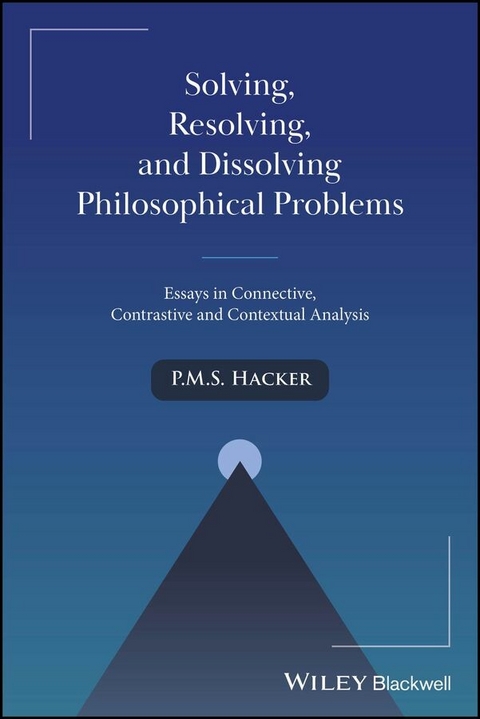
Solving, Resolving, and Dissolving Philosophical Problems (eBook)
253 Seiten
Wiley-Blackwell (Verlag)
978-1-394-27883-1 (ISBN)

Equips readers with the intellectual tools required to tackle perennial philosophical problems
Solving, Resolving, and Dissolving Philosophical Problems is addressed to all who are interested in philosophical questions. It presupposes little philosophical knowledge, only curiosity and an open mind. It demands a willingness to learn not doctrine but method, and the courage to suspend judgement and to challenge received ideas.
Advocating the method of the 3 C-s: Connective, Contrastive, and Contextual Analysis, the book demonstrates the method by putting it to work - examining fifteen salient philosophical questions that concern all thinking people. It is organized thematically into four parts. Part I introduces questions in philosophy of psychology (the nature of the mind; the mind/body problem; the nature of consciousness and its demystification; knowledge of other minds). Part II deals with epistemological questions (knowledge, belief; memory; imagination, thinking; dreaming). Part III deals with value (the roots of morality; the nature of good and evil; the need for a secular conception of the soul; happiness). The application of the method in the essays produces striking, original and unanticipated results that will give readers pause. The final part of the book articulates in detail the methodology of the 3 C-s exemplified by the fifteen essays and defends it against objections.
Solving, Resolving, and Dissolving Philosophical Problems: On the Methodology of Connective, Contrastive, and Contextual Analysis is an excellent textbook for undergraduate students in introductory philosophy courses alongside more advanced scholars, as well as an invaluable resource for educated general readers with an interest in philosophical methodology.
P.M.S. HACKER is an Emeritus Fellow at St John's College, Oxford. He is a leading authority on the philosophy of Wittgenstein. He has also written extensively on philosophy of mind, philosophy and neuroscience, and philosophy of language. He is author of 25 books and 175 papers. His most recent works are the 2nd edition of Philosophical Foundations of Neuroscience (co-authored with the great neuroscientist M. R. Bennett), his human nature tetralogy: Human Nature: the Categorial Framework; The Intellectual Powers; The Passions; The Moral Powers; and A Beginner's Guide to the Later Philosophy of Wittgenstein.
Equips readers with the intellectual tools required to tackle perennial philosophical problems Solving, Resolving, and Dissolving Philosophical Problems is addressed to all who are interested in philosophical questions. It presupposes little philosophical knowledge, only curiosity and an open mind. It demands a willingness to learn not doctrine but method, and the courage to suspend judgement and to challenge received ideas. Advocating the method of the 3 C-s: Connective, Contrastive, and Contextual Analysis, the book demonstrates the method by putting it to work examining fifteen salient philosophical questions that concern all thinking people. It is organized thematically into four parts. Part I introduces questions in philosophy of psychology (the nature of the mind; the mind/body problem; the nature of consciousness and its demystification; knowledge of other minds). Part II deals with epistemological questions (knowledge, belief; memory; imagination, thinking; dreaming). Part III deals with value (the roots of morality; the nature of good and evil; the need for a secular conception of the soul; happiness). The application of the method in the essays produces striking, original and unanticipated results that will give readers pause. The final part of the book articulates in detail the methodology of the 3 C-s exemplified by the fifteen essays and defends it against objections. Solving, Resolving, and Dissolving Philosophical Problems: On the Methodology of Connective, Contrastive, and Contextual Analysis is an excellent textbook for undergraduate students in introductory philosophy courses alongside more advanced scholars, as well as an invaluable resource for educated general readers with an interest in philosophical methodology.
| Erscheint lt. Verlag | 6.1.2025 |
|---|---|
| Sprache | englisch |
| Themenwelt | Geisteswissenschaften ► Philosophie ► Allgemeines / Lexika |
| Schlagworte | axiology intro • epistemology intro • philosophical logico-linguistic analysis • philosophical problems analysis • philosophical psychology intro • philosophy connective analysis • philosophy contextual analysis • philosophy contrastive analysis |
| ISBN-10 | 1-394-27883-7 / 1394278837 |
| ISBN-13 | 978-1-394-27883-1 / 9781394278831 |
| Informationen gemäß Produktsicherheitsverordnung (GPSR) | |
| Haben Sie eine Frage zum Produkt? |
 PDF (Adobe DRM)
Kopierschutz: Adobe-DRM
Adobe-DRM ist ein Kopierschutz, der das eBook vor Mißbrauch schützen soll. Dabei wird das eBook bereits beim Download auf Ihre persönliche Adobe-ID autorisiert. Lesen können Sie das eBook dann nur auf den Geräten, welche ebenfalls auf Ihre Adobe-ID registriert sind.
Details zum Adobe-DRM
Dateiformat: PDF (Portable Document Format)
Mit einem festen Seitenlayout eignet sich die PDF besonders für Fachbücher mit Spalten, Tabellen und Abbildungen. Eine PDF kann auf fast allen Geräten angezeigt werden, ist aber für kleine Displays (Smartphone, eReader) nur eingeschränkt geeignet.
Systemvoraussetzungen:
PC/Mac: Mit einem PC oder Mac können Sie dieses eBook lesen. Sie benötigen eine
eReader: Dieses eBook kann mit (fast) allen eBook-Readern gelesen werden. Mit dem amazon-Kindle ist es aber nicht kompatibel.
Smartphone/Tablet: Egal ob Apple oder Android, dieses eBook können Sie lesen. Sie benötigen eine
Geräteliste und zusätzliche Hinweise
Buying eBooks from abroad
For tax law reasons we can sell eBooks just within Germany and Switzerland. Regrettably we cannot fulfill eBook-orders from other countries.
aus dem Bereich